Why Builders Should Care and What They Need to Know When Choosing AI-Enabled Software
By Erik Cofield

As the home building industry continues to evolve, so do the tools that power it. Many custom and production builders, remodelers, manufacturers, communities and dealers are now adopting Enterprise Resource Planning software that includes artificial intelligence capabilities. But when diving into the AI features of modern ERP platforms, you’ll often hear two terms tossed around:
AI Bots and AI Agents
While they may sound similar, they serve very different purposes — and knowing the difference can help you choose the right ERP system for your business, although really, ideally, anyone in residential construction should look for an ERP system that has both.
Let’s walk through the core differences between AI bots and AI agents, how each functions, and how home builders of any type or size can leverage them to streamline operations, reduce overhead, and drive growth. The first time someone sees what AI agents can do, they are usually both a little scared and a little amazed.
What Are AI Bots?
AI bots are essentially rule-driven automation tools that respond to specific prompts or commands. You’ve likely interacted with them already — think of customer service chatbots or virtual assistants that schedule meetings, or a web form that answers some questions, but can’t really hold much of a conversation.
In ERP systems for residential construction, a few of the many uses for AI bots are to…
- Answer basic queries (“What’s the budget status of Project A?”)
- Generate reports (like monthly labor costs or inventory summaries)
- Automate repetitive tasks (such as sending payment reminders, processing invoices, or updating schedules and notifying trades contractors or consumers)
How AI Bots Work
AI bots operate using predefined logic, often enhanced by natural language processing, or NLP. They’re reactive — they wait for a user command and then execute a task based on programmed rules or AI-enhanced understanding. They are considered “dumb” compared to AI agents, which are considered “smart” because an AI agent, once set up and trained, can take autonomous actions.
For example, in an ERP system, you might type:
“Show me all projects that are over budget this month.”
The AI bot recognizes the intent, pulls relevant data from your financial module, and returns a list almost instantly.
Key Characteristics of AI Bots: AI bots are…
- Task-oriented and reactive
- Fast with low-complexity execution
- Ideal for structured data tasks
- Limited in autonomy — they don’t make decisions without instruction
What Are AI Agents?
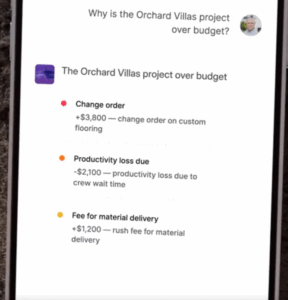
AI agents take things a step further. These are autonomous or semi-autonomous systems that actively monitor, learn from, and interact with your ERP environment to make decisions or recommendations.
Instead of waiting for your command, AI agents might notice that your drywall inventory is running low on a fast-moving project and proactively initiate a purchase order — or alert your procurement team.
In an ERP for residential construction, use cases include AI agents helping with:
- Labor forecasting
- Vendor performance analysis
Predictive maintenance on equipment (factories/workstations) - Supply chain risk management
- Inventory management
- Creating purchase orders
- Creating an estimate (from, say, a pdf)
How AI Agents Work
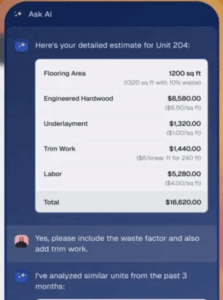
AI agents use a combination of machine learning, business rules, and real-time data to assess situations and make context-aware decisions. They may also collaborate with other systems (or agents) to complete more complex workflows. In the future, the situation will be: “My AI agent will interact with your AI agent.”
Unlike bots, agents don’t need constant direction — they continuously monitor your ERP environment, identify issues or inefficiencies, and take action, or escalate issues, based on what they learn.
Key Characteristics of AI Agents: AI Agents are…
- Proactive and decision-capable
- Context-aware and learning-enabled
- Ideal for complex, dynamic environments
- Able to collaborate with humans and other AI agents
How AI Bots Help Drive Efficiency
Here’s where AI bots shine in an organization’s ERP:
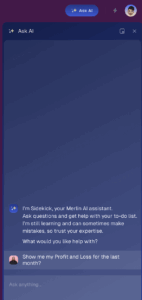
- Real-Time Access to Key Metrics: Instead of digging through menus, just ask, “What’s the ETA on framing materials for Lot 12?”
- Task Automation: Have a bot handle repetitive updates, such as progress reports or permit application status changes.
- Simplified Training: New team members can ask bots for help or data without needing to master the full ERP system right away. These make implementation and onboarding both much easier on the user, and much more quickly for the company.
For instance, if a site manager types “Update Project Greenhill’s status to ‘Electrical Started,’” the bot immediately logs the update, notifies relevant parties, and triggers the scheduling of the next phase.
How AI Agents Transform Home Builder Operations
- Predict Delays Before They Happen: By analyzing weather, labor availability, and supplier delivery timelines, agents can warn you days in advance that a project might miss its completion target.
- Optimize Material Orders: Agents can analyze usage trends, lead times, and current inventory to auto-generate purchase orders, preventing costly delays due to material shortages.
- Prevent Cost Overruns: Agents can flag budget creep in real-time by correlating field reports, change orders, and supplier billing.
For example, an AI agent notices a pattern of delays every time HVAC installs are scheduled on multi-story builds. It alerts your operations manager and recommends a shift in the workflow to avoid stacking subcontractors inefficiently.
What Should Companies Look for in ERP AI Capabilities
When shopping for an ERP system, consider asking the following:
Does the system offer both AI bots and agents?
You want short-term efficiency (bots) and long-term intelligence (agents).
Can bots be customized for your workflows?
For example, if you often ask for subcontractor performance metrics, your bot should learn to retrieve those instantly.
Are agents configurable to your business rules?
AI agents should reflect your company’s way of building — not just a generic model.
Is there transparency in decision-making?
Builders need to trust the system — look for ERPs where agents explain why they made a recommendation.
What’s the roadmap?
Ensure the vendor is investing in future AI development so your ERP evolves with your business.
AI in an ERP isn’t just a buzzword anymore — it’s a strategic advantage for builders ready to scale smarter and work more efficiently. AI bots can help a team move faster, while AI agents help the team to build better by offering insights, automation, and predictive intelligence.
Final Thoughts on AI Bots and Agents
It is very important to note that while some systems have most of these elements, no system has all of them wrapped up together. Builders may still need to add specific tools to whatever system they are using. Think of AI bots as a digital intern — and AI agents as a future project manager. The right ERP system should empower both.
As builders evaluate ERP platforms, it’s best to look beyond checkboxes and dig into how the system helps you build. Whether a custom builder or a regional production builder, a modular factory, a manufactured home builder, a community, or a dealer, all of these companies can benefit from an ERP system, even if they won’t use the whole system, or won’t all use it the same way.
But embracing the right kind of AI can be the blueprint for growth.
Erik Cofield is the vice president of strategy for MerlinAI. He has 30 years of experience helping companies in residential construction. A member of NAHB, Cofield specializes in AI, sales and marketing strategy, business management, and leveraging technology in the sales process. He has provided consulting services to builders, developers, remodelers, and construction companies of all sizes and types. He is the author of books available through Amazon and can be reached at erik@merlinai.co.
MHInsider is the leader in manufactured housing news and is a product of MHVillage, the top marketplace for manufactured homes.