Health Care, Transportation Lead Hiring — Home Sales Flat Year-Over-Year
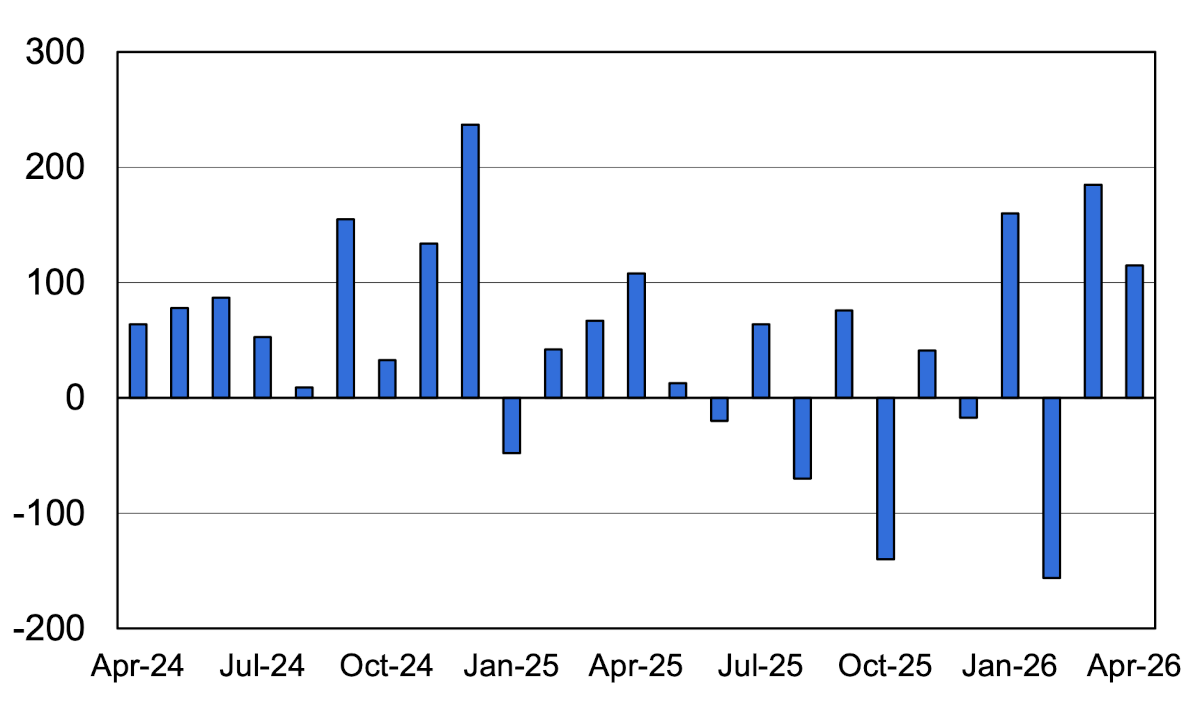
The U.S. economy added 115,000 jobs in April and the unemployment rate held steady at 4.3 percent, the Bureau of Labor Statistics reported — a result that blew past Wall Street expectations amid an uncertain economic backdrop.
Analysts anticipated a gain of 65,000 jobs, making April’s number notable. The report follows a revised March gain of 185,000, which was the strongest month in job gains since December 2024.
“I’m looking through the report trying to find problems, and it’s fairly bulletproof this month,” Allianz North American Senior Economist Dan North said. “The numbers overall aren’t impressive — they’re still pointing toward a softening job market, but certainly not a collapse.”
Areas of the Economy Producing Jobs
- Health care led all sectors for the month, adding 37,000 jobs, roughly in line with its 12-month average of 32,000 per month. Most of those gains came from nursing and residential care facilities and home health care services.
- Transportation and warehousing was the second-biggest contributor, adding 30,300 jobs. Couriers and messengers drove that gain, adding 37,900 positions — though the sector overall remains about 105,000 below its February 2025 peak.
- Retail trade added 21,800 jobs, aided by warehouse clubs, supercenters, and other general merchandise retailers, along with building material and garden supply dealers.
- Construction added 9,000 jobs in April, with nonresidential specialty trade contractors gaining 12,600 positions, partially offset by a decline in residential specialty trade contractors. Construction has shown little net change over the past year.
Unemployment Picture
The 4.3 percent jobless rate has remained above 4 percent since June 2024. The number of people working part-time for economic reasons — those who would prefer full-time work — jumped by 445,000 to 4.9 million in April, a figure that weighed on the broader “real” unemployment measure.
Long-term unemployment — those jobless 27 weeks or more — was essentially unchanged at 1.8 million, accounting for 25.3 percent of all unemployed people. The labor force participation rate edged down to 61.8 percent, and the employment-population ratio fell to 59.1 percent.
Wages Increase Slightly
Average hourly earnings for private-sector workers rose 6 cents, or 0.2 percent, to $37.41 in April. During the past 12 months, wages are up 3.6 percent — a smaller gain than the 3.8 percent annual pace economists had expected, and a sign that wage pressures may be easing.
Prior Month Revisions
The BLS revised February’s already-weak reading down by 23,000, bringing the total job loss for that month to 156,000 — far steeper than the initial reported decline of 92,000. March was revised up by 7,000 to 185,000. Combined, the two-month revision left employment 16,000 lower than previously reported.
Fed Implications
The April report lands at a complicated moment for the Federal Reserve, which has kept its benchmark interest rate on hold as policymakers weigh a labor market that is slowing but not collapsing against inflation that remains elevated. In March, consumer prices rose at an annual rate of 3.3 percent, driven largely by higher gasoline costs tied to conflict in the Middle East.
With the jobs market holding steady, the Fed is broadly expected to stay on the sidelines. The next employment report, covering May, is scheduled for release on June 5, 2026.
Recent Housing Statistics
New single-family home sales increased 7.4 percent in March to a 682,000 annual rate, beating the expected 652,000. Sales are up more than 3 percent from a year ago.
Sales in March rose in the Northeast and South but fell in the Midwest and West. Existing home sales increased 0.2 percent in April to a 4.02 million annual rate, lagging the consensus expected 4.05 million. Sales are flat year over year.
MHInsider is the leader in manufactured housing news and is a product of MHVillage, the top marketplace for manufactured homes.