A rural patch of land in Sheboygan County, Wisconsin, is being transformed into what local organizers hope will be the nation’s first dementia village — a residential neighborhood designed so people living with dementia can “live as usual” while receiving on-site support.
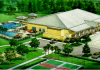
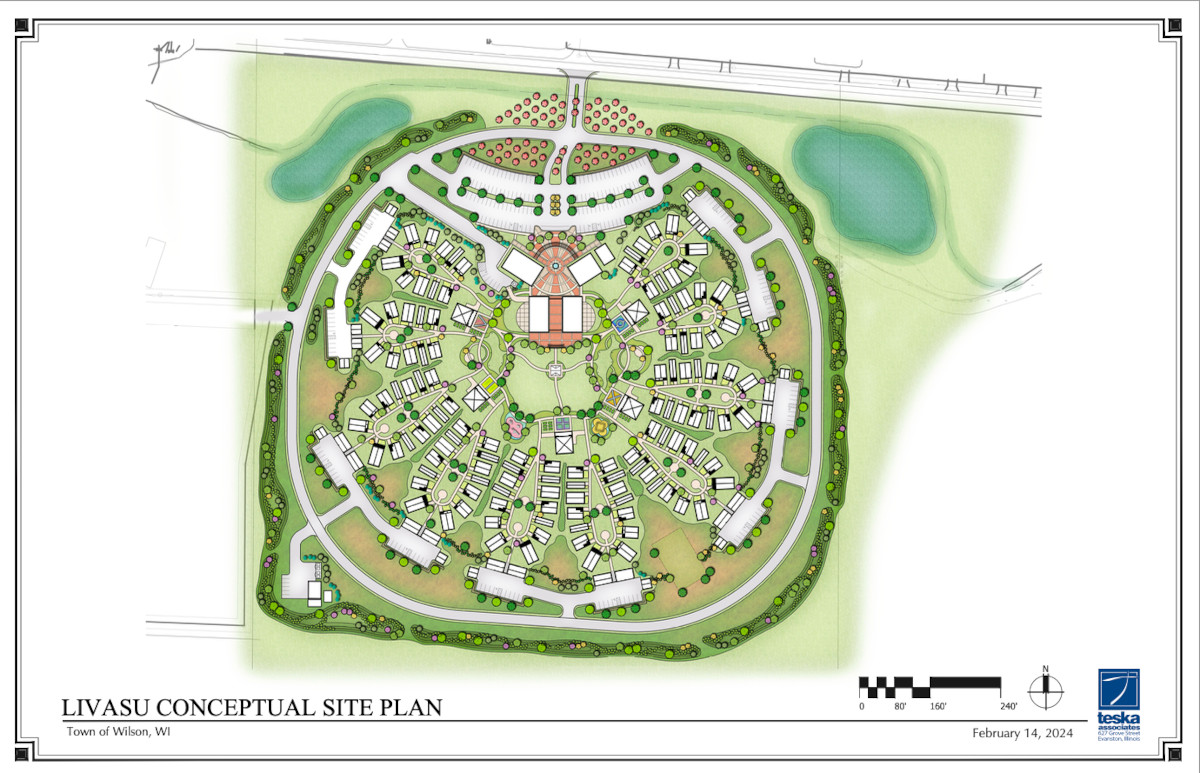
Livasu, pronounced “Li-VAY-Su”, will be built on nearly 80 acres with a plan for 124 individually owned, adaptable homes arranged around a village center with amenities intended to serve homeowners and welcome the wider public. Amenities are to include a restaurant, grocery store, theater, gym, spa, hobby spaces, and walking paths.
The community will have round-the-clock care available, including on-site support staff. Livasu will not look to replace or add health care services, but will be intentional about giving the residents privacy, independence, and family life while providing caregiving services.
‘Living As Usual’
Mary Pitsch, co-founder of Dementia Innovations, said after years of working with county residents — helping to improve public understanding and helping to improve the lives of families impacted by dementia — that she felt there was a lot more to be done. She initiated a public-private partnership focused on dementia crisis situations that then led to the idea for Livasu, a derivation of the phrase “Living as usual.” There were many county residents looking for help with continuing to manage their current lives in unison with managing the cognitive changes. Too many people were left to manage on their own because they weren’t ready for a residential care facility, she said.
“We just weren’t doing a great job as a county responding to the needs of a segment of our population,” Pitsch said. “We changed how we look at those crisis responses. We did a lot of training and changed our emergency protocols. But we knew more could be done. How do we change these situations from even happening?”
The answer was by looking at the environment in which the person with dementia was living.
Organizers say the Sheboygan County village shares concepts of care with a successful dementia-friendly community in Europe — the Hogeweyk village in the Netherlands — and is intended as an alternative to traditional institutional settings.
Pitsch said the focus is to foster a resident’s abilities rather than disabilities.
“We started putting ideas together. We knew what we wanted. We wanted something that feels like a regular neighborhood, but one for people with dementia,” she said. “It gives them an environment that allows the person with dementia to take some risk.”
Backers say the village model allows people with cognitive impairment to keep routines, relationships, and dignity while reducing the need for restrictive interventions. Integrating public amenities and encouraging interaction with the broader community will normalize the lives of those living with dementia and offer family members new choices for long-term living arrangements, including allowing couples to remain together, a frequent challenge in conventional memory-care settings.
The Livasu plan grew out of local collaboration that began with a 2018 Dementia Crisis Task Force in Sheboygan County. That grassroots partnerships included law enforcement, emergency medical services, social workers, hospital personnel, and the county 911 emergency call center.
This partnership evolved into a non-profit model, Dementia Innovations, where the mission is education, community collaboration, and supporting a “dignity of risk” lifestyle for people living with dementia.
The Wisconsin Housing Alliance is one of the partners in the project.
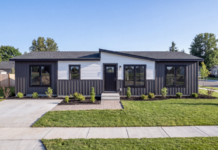
“Our logo and tag line says ‘The Voice of Factory-Built Housing.’ With groups like Dementia Innovations utilizing manufactured housing in their projects, we don’t need to speak as loudly,” Wisconsin Housing Alliance Executive Director Amy Bliss said. “I am so proud of Mary and her team of people dedicated to solving a community need. In addition, I am proud of Cavco-Dorchester and North Country Homes for taking on a project that required a good deal of energy, thoughtfulness, and hard work to make these homes tailored to meet the needs of those with dementia.”
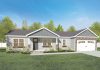
Todd Metz from Cavco, said The Ivy is set to serve as the community’s model home and as an office. Site preparation, including extensive construction, has been underway since the fall of 2025, he said.
The goal is to have 20 homes ready for the spring/summer of 2026. In all, the community will have more than 120 homes with a combination of single-section and multi-section homes.
“Many entities would have walked away because it was something new and different,” Bliss said. “In this case, the industry stepped up and found a way to support this cause. I wish all industry members started with a yes when presented with unique projects such as this.”
“It was all about how we could get the most benefit,” Pitsch said. “We wanted to create good walking paths, but in a tighter area. It is winter here much of the year, so longer walks aren’t great and we wanted be realistic about how much of the property would need to be maintained through seasonal weather.”
Why A Village?
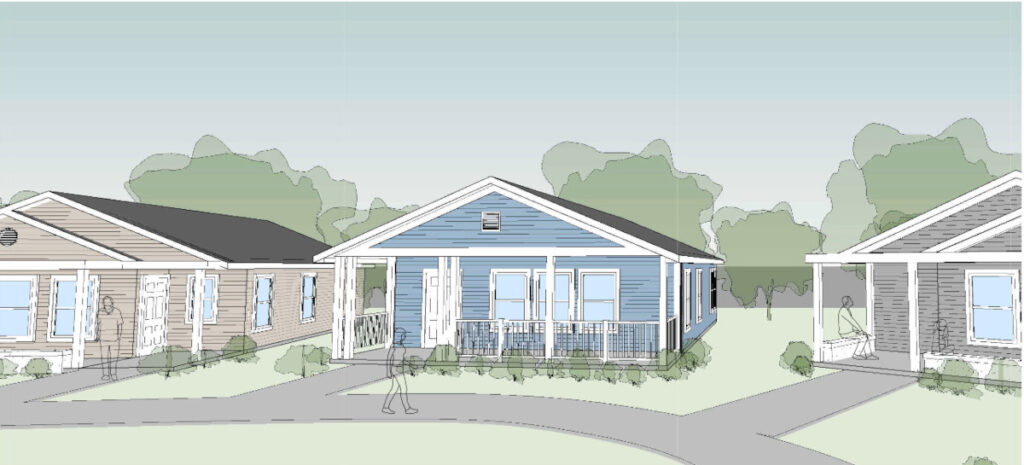
A conceptual site plan circulated by the group shows concentric neighborhoods, a centralized village hub, and barrier-free grounds designed for small, familiar routes, and community interaction. The homes — all manufactured homes — are owned by the resident and made adaptable to changing needs.
The $13 million development is being funded through a capital campaign, lining up partners that include regional banks, foundations, architects, and builders.
The village concept has personal roots for many involved. Organizers and early supporters frequently cite family caregiving experiences as motivation. Jim Holmes, whose wife Patti died after a long struggle with dementia, told reporters that the idea of letting people remain “free to do whatever they want” helped inspire the project. Local news coverage has highlighted multiple
families and volunteers who say they want better alternatives for their loved ones than the options they have encountered.
Community buildings, infrastructure, a model home, and new resident homes all began coming into Livasu at the end of 2025 and will continue through the year.
“We are building a part of a larger community the same way people build libraries and other community spaces,” Pitsch said. “We are really trying to change the culture for how we care for people with dementia. We’re trying to be as flexible as we can be for the homeowners.”
MHInsider is the leader in manufactured housing news and is a product of MHVillage, the top marketplace for manufactured homes.