The U.S. Department of Housing and Urban Development’s Office of Housing has created a new Office of Manufactured Housing Programs as an independent office that reports to Assistant Secretary for Housing and Federal Housing Commissioner Julia Gordon.
The office previously was under the Office of Housing’s Office of Risk Management and Regulatory Affairs. The new status acknowledges the importance of manufactured housing in meeting the nation’s housing needs.
“This organizational change represents a recognition of the critically important role that manufactured housing plays in our country’s housing market,” Gordon said. “Thanks to the work executed by our Office of Manufactured Housing Programs over the last two years, we have made significant progress to support the availability of modern and affordable manufactured homes.”
Manufactured housing has figured prominently in the Biden-Harris Administration’s efforts to increase the supply of affordable housing, and has proved to be a well-developed, helpful avenue to a high-value homeownership experience, especially for buyers in the low- to mid-level portions of the housing market where so few quality homes are available.
During the last two years, HUD’s Office of Manufactured Housing Programs has worked to facilitate widespread changes that support long-term growth in the availability and acceptance of manufactured homes, including:
Supporting the continued production of manufactured homes despite COVID-19 supply chain challenges: The office supported the ongoing production and availability of manufactured homes by issuing the first-ever industry-wide Alternative Construction Letters to alleviate COVID-19 supply chain challenges.
Implementing the first major changes in almost a decade to the Manufactured Home Construction and Safety Standards, commonly referred to as the HUD Code: HUD’s final rule for the manufactured housing third set of standards became effective in July 2021 and added provisions to the HUD Code such as attached garages and carports; zero-lot-line townhome-style housing; and requirements for carbon monoxide alarms.
Initiating the largest set of proposed changes to the HUD Code in over two decades: Through its combined fourth and fifth set of standards proposed rule published in July 2022, HUD is proposing to bring the HUD Code in line with more recent manufactured housing industry standards, including allowing materials that facilitate modern design approaches and improve quality; allowing certain ridge roof designs; adding provisions for multifamily manufactured homes of up to three units; updating requirements for open floor plans, truss designs, and specifications for attics; and accessibility improvements; and others.
More About the Office of Manufactured Hosing Programs
The Office of Manufactured Housing Programs is part of HUD’s Office of Housing and administers the Manufactured Home Construction and Safety Standards, commonly referred to as the HUD Code. The HUD Code establishes federal standards for the design and construction of manufactured homes to assure quality, durability, safety, and affordability. The office enforces standards directly or through state agencies that have partnered with HUD, inspects factories and retailer lots, regulates installation standards for homes, and administers a dispute resolution program for defects. The Office also oversees a Manufactured Housing Consensus Committee, a federal advisory committee composed of 21 producers, users, and general interest and public officials to advise HUD.
Dennis Hill, who spent 55 years organizing some of the largest and most successful events in manufactured housing, passed away on July 2.
He was 80.
Mr. Hill was the talent behind Show Ways Unlimited, based in Roswell, Ga., and the hundreds of manufactured housing industry trade shows he and his team put on. Prior to the start of his 55 years in manufactured housing, he went to graduate school at the University of Georgia.
In 1966 he was swept up in the U.S.’s call for 50,000 troops to Vietnam. He trained and prepared but never was shipped out.
Instead, he was sent to Fort Rucker in Alabama where he organized musical acts to entertain the troops, 4,000 to 5,000 at a time. In civilian life, he found that same thrill in organizing trade shows and industry events, starting with shows in Atlanta and Nashville and more recently organizing the annual show in Louisville and the former Tunica Show, now held in Biloxi.
Working five decades ago at the Southeastern Manufactured Housing Institute, Hill said that the trade show business literally just popped up.
“The regional group was there for 10 years, and my original role was member services and the service and supplier division,” Hill said. “Maybe it was a catch-all for anything and everything.
“My boss walked in and said ‘You’re going to do a trade show’ and I said ‘What is a trade show?’ I guess I figured it out.”
Mr. Hill had many people around him, including a 22-member board, to help organize a trade show from earliest planning, through working with partners and vendors, to securing space and getting show homes organized and speakers assembled.
He said it was an experience that got his blood flowing. Doing shows was something akin to running a political campaign with all the months of planning that must coalesce into action.
Mr. Hill was good at motivating people and took great joy in seeing a show come together.
Tim DeWitt, the former director of the Michigan association, collaborated for nearly 40 years with Hill.
“He found a niche and honed in on it. I think what’s made him as successful as he has been… when you’re in a state association it’s very helpful to be able to work with a private promoter who has more room to move and can make decisions to get something implemented a lot faster than you’d be able to working in public sphere,” DeWitt said. “He was always a calming influence, and that’s important. He supported us in good times and bad, and we could rally around that.”
Mr. Hill retired in 2021 but remained in contact with many industry colleagues. He is survived by his wife of 58 years Nancy, their daughter Alison, two grandchildren, Bri and Max, and a great-grandson, Everest Sebastian.
A Celebration of Life will be held on July 9, 2023, at 3:30 p.m., at Alpharetta Presbyterian Church, 180 Academy St, Alpharetta, Ga. In lieu of flowers, donations may be made to The Tunnel 2 Towers Foundation, Furkids Animal Rescue in Alpharetta, or the APC Pastors Emergency Fund.
Datacomp published July 2023 JLT Market Reports, mobile home comps for manufactured home communities in Colorado, Delaware, New Jersey, and Wyoming, which include occupancy, home details, pricing specifics, and other vital data.
JLT Market Reports provide detailed research and information on manufactured home communities in 187 U.S. housing markets. Reports include the latest trends and statistics, marketing programs, and a variety of other useful management insights.
Datacomp’s JLT Market Reports are the nation’s #1 provider of market data for the manufactured housing industry. JLT Market Reports are recognized as the industry standard for manufactured home community market analysis.
July 2023 manufactured housing market data published in JLT Market Reports for Colorado, Delaware, New Jersey, and Wyoming include information on 241 “All ages” and “55+” manufactured home communities.
Altogether, the reports from the four states’ manufactured home communities include data representations for 63,392 homesites.
What’s in JLT Market Reports?
Each JLT manufactured home community rent and occupancy report from Datacomp has detailed information about investment-grade communities in the major markets. The detailed information includes:
Number of homesites
Occupancy rates
Average community rents, and increases
Community amenities
Vacant lots
Repossessed and inventory homes, and much more
JLT Market Reports also include management insights that rank communities by the number of homesites, occupancy rates, community type, and housing mix. Established reports show trends in each market with a comparison of July 2023 data to July 2022 and a historical recap from 1996 to present in most markets.
The July 2023 JLT Market Reports for manufactured home communities in Colorado, Delaware, New Jersey, and Wyoming are available for purchase and immediate download online at the Datacomp JLT Market Report website, or they may be ordered by phone in electronic or printed editions at (800) 588-5426.
Each fully updated report for mobile home communities is a comprehensive look at investment-grade properties within a market, enabling owners and managers, lenders, appraisers, brokers, and other organizations to effectively benchmark those communities and make informed business decisions.
Jay Crotty, the co-founder of SkyView Advisors, believes that the commercial real estate industry is at a crucial point in its history. Crotty started his career at the traditional brokerage model in 2001. After several years of success in the multifamily sector, he stepped away in 2008 to buy and sell an electronic component and aerospace hardware company. However, his passion remained in commercial real estate. He came back into the industry several years later to form SkyView Advisors with Ryan Clark, an attorney and his lifelong best friend. They set out on a mission to revolutionize the way commercial real estate is bought and sold.
With ample experience and a significant footprint in the industry, Crotty and his colleagues have a track record, but they have also worked hard to bring in experts from outside the traditional model.
The founders view their firm as a technology company and talent development business that happens to sell real estate, one of the largest markets in the world. It has invested in Salesforce, Microsoft, and custom AI solutions to make a more efficient business model.
Multi-Industry Tech Offerings
SkyView Advisors specializes in three asset classes: self-storage, manufactured housing, and healthcare real estate. It has created an offer portal that allows clients to submit their best and final offer through the website. According to Crotty, restrictions during the Covid pandemic were a great accelerator for this kind of use and interaction, particularly among the 55-year-old demographic.
“We’re thinking about this for other industries, and how we can lead in this way,” Crotty said. “Every member of our team thinks about it and talks about it all the time.”
There is plenty of room to grow in manufactured housing, as well as in other industries and markets. The historical demand for resilient asset classes such as manufactured housing, healthcare real estate, and self-storage is fueled by long-term owners who are ready to sell. Crotty said he and his team have been studying manufactured housing for a long time, and there are other asset classes they continue to investigate.
“From the very start of the company, we knew we were going to go into multiple asset classes,” Crotty said.
Inspired for Change
Innovation being one of its core values, SkyView Advisors takes it upon itself to lead the trend.
“A great model for us is Rocket Mortgage, if you think of what that marketplace was… highly fragmented, there are still people sitting in wood-paneled offices. But it’s become more about a ‘mortgage in a box.’ You can pull up the phone app and get a mortgage.”
SkyView Advisors has handled more business than any other brokerage for self-storage to this point in 2023 and had $1 billion in transaction volume last year.
Crotty and Clark have built a system that delivers exceptional value in self-storage, creating millions of dollars in additional revenue for owners over the past decade. This system is designed to ensure the same quality of service across other asset classes, including manufactured housing.
“We’re business people first, entrepreneurs,” Crotty said. “There’s not been a ton of innovation, and why would you when it’s been such a great business, a great builder of wealth? But it will change, it has to change.”
Annual home prices fell in April for the first time since 2012, according to the S&P CoreLogic Case-Shiller U.S. National Home Price NSA Index. It showed a 0.2 percent year-over-year decrease.
Data from the latest national index was reported on June 27.
The 10-City Composite showed a decrease of 1.2 percent, down from the 0.7 percent decrease in March. The 20-City Composite posted a 1.7 percent year-over-year loss, down from -1.1 percent in March.
Indices Up Month over Month
After seasonal adjustments, the U.S. National Index posted a month-over-month increase of 0.5 percent. The 10-City Composite gained 1 percent and the 20-City Composite posted an increase of 0.9 percent.
“The U.S. housing market continued to strengthen in April 2023,” S&P DJI Managing Director Craig J. Lazzara said. “Home prices peaked in June 2022, declined until January 2023, and then began to recover.”
Home Starts on the Rise
May housing numbers released jointly by the U.S. Census Bureau and the Department of Housing and Urban Development showed positive growth in housing starts and completions, largely driven by multi-family starts.
May housing starts came in at a seasonally adjusted annual rate of 1.631 million, up 21.7 percent, beating the market estimate of 1.34 million.
Housing starts are up 5.7 percent year-over-year, driven by gains in the Midwest, South, and West.
The jump in May represented the largest single-month gain in home starts since January of 1990.
“Looking at the details, gains were broad-based with three of four major regions and both single-family and multi-unit starts contributing,” Brian Wesbury, chief economist at First Trust Advisors, noted in a recent letter to subscribers. “While one month doesn’t make a trend, housing starts are now at the highest level since the previous peak in April of 2022, before mortgage rates began to surge. This signals that the developers may have finally found their footing in what has been a challenging environment for sales.”
Building permits and housing completions are up annually by 5.2 and 5 percent, respectively.
Solomon Greene, principal deputy assistant secretary for policy development and research.
In mid-June, the U.S. Department of Housing and Urban Development released a notice of funding opportunity, also known as a NOFO, to build the evidence base to accelerate the adoption of innovative and effective practices and policies that will increase the production and supply of quality affordable housing.
The NOFO provides up to $4 million to…
assess the potential for off-site construction methods to increase housing supply, lower the cost of construction and/or reduce housing expenses for low- and moderate-income owners and renters,
and to study how reforms to local zoning and other land-use regulations can increase the supply of quality, affordable housing and expand housing choices and opportunities for low- and moderate-income households.
Proposals Due Aug. 1
Solomon Greene is the principal deputy assistant secretary for policy development and research at HUD.
“In recent decades, housing supply simply has not kept up with demand, which has driven up housing costs and limited affordable housing options for low- and moderate-income families. However, the housing supply shortage has also inspired pro-housing policy reforms at the state and local levels and new attention to alternative construction methods,” Solomon said. “The goal of this research is to better understand which of these reforms and innovations are most effective at producing new affordable housing and what are the conditions for success.”
This notice is the latest in HUD’s effort to support researchers, community residents, practitioners, and policymakers to work together to increase the housing supply.
In June, HUD organized the Innovative Housing Showcase on the National Mall. This event showcased new building technologies and housing solutions, with a particular focus on off-site construction, including manufactured housing. The goal was to explore ways to make housing more innovative, resilient, and affordable for American families. In April, HUD published a Policy & Practice brief that summarized the impacts of restrictive land-use policies on housing supply, location, and affordability. The brief also highlighted reforms that state and local governments can adopt to increase the availability of housing. Also in April, HUD announced a research grant awarded to Cornell University. The grant supports a study on the effects of zoning in the largest cities across the U.S.
Datacomp, the publisher of JLT Market Reports and the nation’s #1 provider of market data for the manufactured housing industry, has published the June 2023 mobile home park comps with occupancy, home details, pricing specifics, and other vital data on manufactured home communities markets in Iowa, Nebraska South Carolina, and Virginia.
JLT Market Reports provide detailed research and information on communities in 187 major housing markets throughout the United States. These include the latest trends and statistics, marketing programs, and a variety of other useful management insights.
Datacomp publishes the JLT Market Reports and is the nation’s #1 provider of market data for the manufactured housing industry. JLT Market Reports are recognized as the industry standard for manufactured home community market analysis.
June 2023 manufactured housing market data published in JLT Market Reports for Iowa, Nebraska, South Carolina, and Virginia include information on 172 “All ages” and “55+” manufactured home communities.
Altogether, the reports from Iowa, Nebraska, South Carolina, and Virginia manufactured home communities include data representations for 28,919 homesites.
More About JLT Market Reports
Each JLT manufactured home community rent and occupancy report from Datacomp has detailed information about investment-grade communities in the major markets. The detailed information includes:
Number of homesites
Occupancy rates
Pricing
Community amenities
Vacant lots
Repossessed homes and inventory homes
JLT Market Reports also include management insights that rank communities by the number of homesites, occupancy rates, community type, and housing mix. Established reports show trends in each market with a comparison of June 2023 statistics to June 2022 and a historical recap in most markets from 1996 to the present date.
The June 2023 JLT Market Reports for manufactured home communities in Iowa, Nebraska, South Carolina, and Virginia are available for purchase and immediate download online at the Datacomp JLT Market Report website, or they may be ordered by phone in electronic or printed editions at (800) 588-5426.
Each fully updated report for mobile home communities is a comprehensive look at investment-grade properties within a market, enabling owners and managers, lenders, appraisers, brokers, and other organizations to effectively benchmark those communities and make informed business decisions.
After working together for years in finance with an industry giant and getting their feet wet turning around a manufactured home community they acquired together, Ben Halliday and Jordan Bucy decided to blend their banking and real estate experience to start Zippy, a new community-focused chattel lender.
It took some time to find the right entry point. Initially, the two looked at a lot of deals they found interesting, but often didn’t pencil. Eventually the pair landed on a value-add community in Lubbock, Texas, though not without some hesitation.
Turns out the hesitation, at this point long passed, was somewhat founded.
“The community we bought was pretty run down, 20 years of deferred maintenance. The sewer and water were bad, half the sites had no water and a dozen of the homes of the 91 sites were actually viable homes,” Zippy CEO Ben Halliday said. “We spent our nights and weekends there for three years. We focused on property management during the week and then on the weekend we’d go on-site and get to work on redevelopment.”
“We’d stay at the community on the weekends, sleeping in one of the available houses for sale at the time, digging sewer lines and rehabbing homes. It was hard work, but it was even more rewarding,” Zippy COO and President Jordan Bucy said.
The pair eventually replaced the old infrastructure, landscaped and installed new amenities including a playground, dog park, and party pavilion. During this time, Halliday and Bucy brought in and sold new homes to fill up the original development. Beyond the joy in seeing new homeowners relish in their upgraded community, one of the proudest moments was when the City of Lubbock visited during a rezoning initiative to add 32 lots on adjacent land.
“Several council members and planning officials visited our community to inspect the progress, as part of their diligence,” Halliday said. “We were so proud to host them and thankful we ultimately got approval to add to our growing community. The mayor gave us a nod and thanked us ‘for bringing affordable housing to Lubbock’. That was immensely appreciated.”
Reflection on a Problem and Developing a Tech-Driven Solution
As Halliday and Bucy worked in the community, they developed a passion for manufactured housing. They were proud of the neighborhood that formed over the years, and proud of the homes so many families called home. But one big challenge kept nagging them.
“Since we were five hours away during the work week, we took advantage of modern property management tools and took our homeowners online for payments and maintenance requests, and it was well-received — no more paper checks!” Bucy said. “That’s when we knew our industry was ready for digital.”
They built a digital sales process using available technology selling a handful of homes a month, mainly as a result of social ads and the community’s website.
“It worked great, but it all broke down during financing,” Halliday said. “We wanted a process that was more modern, friendly and fast for us and the homebuyer. But it was 2017, and there were few options for community operators to offer customers a digital home buying experience.”
The Next Journey
It took a few years of trial and error, but Bucy and Halliday finished their project at The Lone Star community and began to contemplate what was next for them.
“Maybe our background as bankers led us here, or our continued obsession with the homebuying experience — probably both — but we couldn’t get over the finance experience and the lack of tools and technology available,” Halliday said.
Faced with a decision between a planned new development, or a completely new venture in MH lending, the two landed on Zippy. Halliday admits the pair was more excited about developing a community from the ground up, but the Zippy co-founders kept discussing how they would hit their infill goals and deliver home ownership “the way it should be”and the financing experience always dominated the conversation.
Yet unnamed, the Zippy of their dreams would be a snappy, modern lending platform for today’s consumer, a web-based experience that is seamless and nearly immediate, backed by a team of industry veterans and experienced technologists.
“Let’s go fix this problem,” Halliday recalls saying to his now co-founder Bucy.
Bucy cemented the decision with what would be Zippy’s mantra, “Let’s do this.”
Great Tech + Amazing People = Happy Homeowners
So much of the industry was still paper-based at that time, and there was plenty of room for growth. When the pandemic hit, the housing sector went on a rocket ride and the fuel it needed was efficient finance technology.
“We wanted to create a digital front door for the homeownership journey for manufactured housing,” Bucy said. “This allows us to accept and work applications from anywhere in the world, 24-7. And that really opens things up.”
A top priority early on was the philosophy of partnering with a homebuyer in a way that delivers all the benefits of modern technology, paired with a dedicated home buying guide.
“We have a single person who works with the homebuyer all the way through the journey. We spent a lot of time envisioning and building a virtual close, where today our bilingual closers walk a buyer through their loan documents in a virtual closing room, ensuring they’re set up for success, from start to finish,” Bucy continued. “Of course, a hugely important stakeholder in MH ownership is the retailer. This part was the easiest to build, as we’d spent years dreaming up what we wish we had while selling homes.”
Zippy’s digital borrower portal keeps sellers updated on loan progress in real time, delivering new leads, loan status updates, document requests, closing updates, and digital marketing tools.
The Zippy Application Process
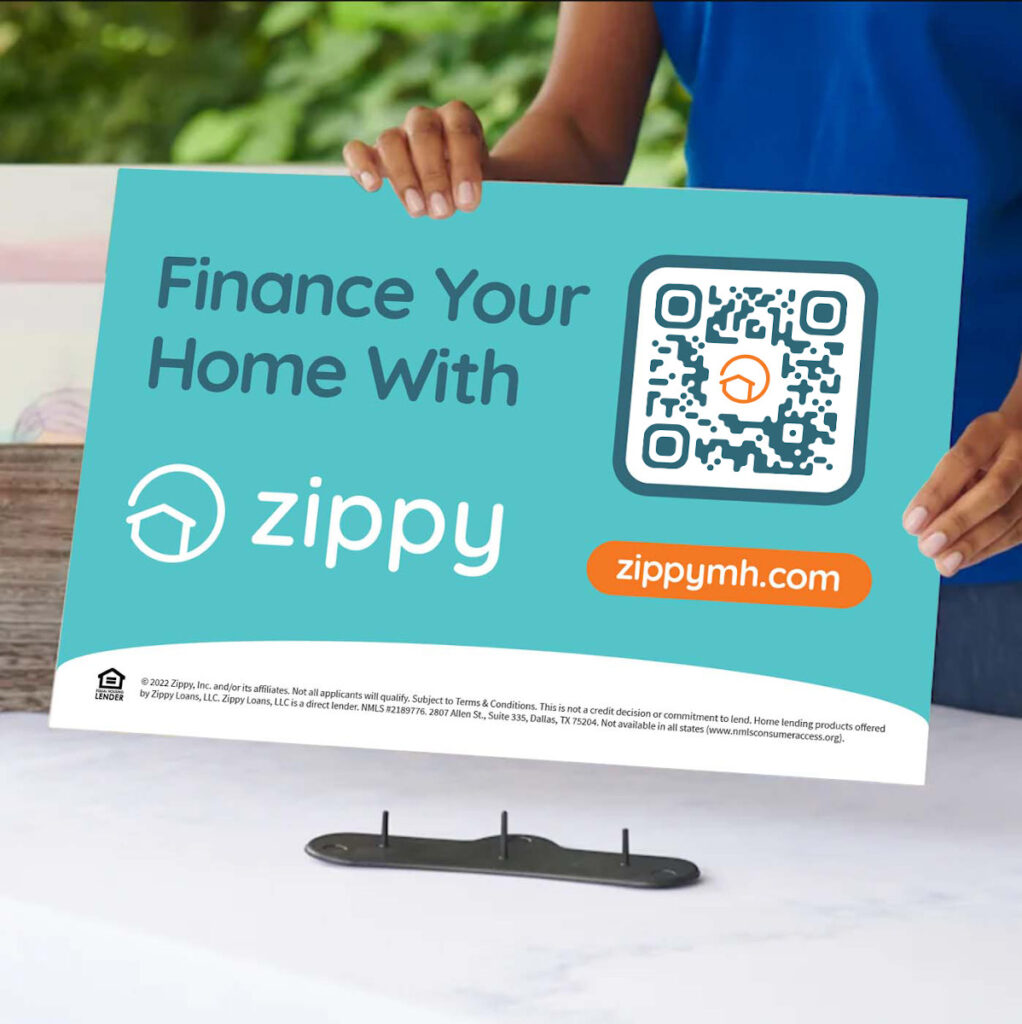
“The home buyer pulls out a smartphone and takes a photo of a QR code that pops up a form to gain residence at that specific community,” Halliday said. “It then lets us know there is someone who is interested in buying.”
The form has 10 fields. It is made to look simple from the user’s perspective, but contains a large amount of custom-built technology that runs sophisticated information about the location, community, and home, and then about the buyer.
“We can get a good offer to the buyer within seconds,” Bucy said.
The response to the original inquiry pops up in the app, and simultaneously goes to the applicant’s email. Then an individual they refer to as your designated ZippyGuide, a licensed mortgage loan originator, immediately places a call to the applicant to congratulate them on the beginning of their home buying journey, and asks them about their goals.
The customer is invited to a borrower portal, and can move forward independently uploading documents and making decisions only the consumer can make. Among other questions, it asks about the desired term for a loan, down payment amount, approximate home price, and whether the inquiry is for a single home or more than one. The closing can be done on a smartphone from any location and typically takes 15 minutes.
“The home buyer has all the information they need to make the right decision for themselves,” Bucy said. “We also recognize the challenges of the community owner and manager, so we have a custom-built portal that a community manager can load all of their info into and interact with us on the home buying journey so they know what’s happening throughout the process.”
The average residential transaction in the U.S. takes more than a month, Zippy currently averages half of that, and can close what they call “Go Go Go” loans in as little as five days, when everyone is aligned.
Fintech Draws Investor Interest
At press time, Zippy was available to customers in 12 states — Alabama, Arizona, Florida, Georgia, Indiana, Kansas, Oregon, Kentucky, Michigan, Missouri, Texas, and Virginia. The plan is to double its presence during 2023, thanks to a strategic partnership with FirstBank.
“FirstBank has extensive experience in manufactured home lending and has invested in fintech partnerships that enable us to offer innovative solutions that meet the needs of our customers,” FirstBank Chief Innovations Officer Wade Peery said. “In today’s housing market, finding new paths to affordable homeownership is critical. This partnership will make buying a home possible for many new individuals and families.
Connecting with Community Owners, Residents
Halliday credits Bucy for identifying the manufactured housing industry opportunity, and Bucy credits Halliday with the inspiration to bring new technology to the space. The pair have continued to enjoy community ownership, building a great lending platform, and coming up with new ways to provide great places to live.
“We developed this really strong passion for the industry,” Bucy said.
“You see the value of well-built, modern, good-looking homes and the communities our industry is building today are truly stunning places to live,” he said. “These days it’s more home loans than playground building, but it still feels really good.”
Halliday said he and the Zippy team have loads of pride in the industry.
“We’re making a real impact on housing affordability,” Halliday said. “It will be our life’s work to help our industry deliver great homes to great people, and we’re so proud to do it.”
The Federal Reserve in its June 14 meeting opted to halt interest rate hikes in the face of waning inflation, slowing growth, and a resilient job market.
Tighter credit conditions for households and businesses are likely to weigh on economic activity, hiring, and inflation. The extent of these effects remains uncertain. The Committee remains highly attentive to inflation risks, the Fed stated. The June pause follows 10 consecutive rate hikes beginning in March of 2022. That streak included four consecutive three-quarter point hikes during the second and third quarters of last year.
The Fed wants the market to reach maximum employment with a 2 percent inflation rate, which is half of the current rate, down from 9 percent at the peak.
“In support of these goals, the Committee decided to maintain the target range for the federal funds rate at 5 to 5-1/4 percent. Holding the target range steady at this meeting allows the Committee to assess additional information and its implications for monetary policy,” the Fed stated.
What To Know About The Federal Reserve
The Federal Reserve, commonly referred to as the Fed, plays a vital role in shaping and maintaining the stability of the United States economy. Established in 1913, the central bank is responsible for conducting monetary policy, supervising and regulating financial institutions, and promoting overall economic stability.
At the core of the Fed’s responsibilities lies its control over monetary policy. The Federal Open Market Committee, comprised of members from the Federal Reserve Board and regional Federal Reserve Bank presidents, determines the course of this policy. By adjusting interest rates and managing the supply of money and credit in the economy, the Fed aims to foster conditions that support maximum employment, stable prices, and moderate long-term interest rates.
One of the primary tools used by the Federal Reserve to influence monetary conditions is the manipulation of the federal funds rate. This interest rate, the rate at which banks lend reserve balances to each other overnight, serves as a benchmark for various lending rates throughout the economy. By raising or lowering the federal funds rate, the Fed can influence borrowing costs for businesses and consumers, thereby affecting spending and investment levels.
The Federal Reserve also acts as a supervisor and regulator of financial institutions to ensure the safety and soundness of the banking system. It conducts regular examinations of banks and implements regulations to protect consumers and maintain the stability of the financial system. The Fed’s oversight extends to a wide range of institutions, including commercial banks, savings associations, credit unions, and holding companies.
In times of financial crisis or economic turmoil, the Federal Reserve serves as a lender of last resort. During the 2008 financial crisis, for example, the central bank implemented a range of emergency measures to stabilize the banking sector and support credit markets. It provided liquidity to financial institutions, expanded its balance sheet through large-scale asset purchases (known as quantitative easing), and introduced innovative lending facilities to address the severe market dislocations.
HUD Secretary Marcia Fudge kicks of IHS23 on the National Mall in Washington, D.C. on June 9.
The U.S. Department of Housing and Urban Development invited innovative housing professionals to the National Mall June 9-11 to kick off National Homeownership Month and put on display some of the nation’s top creations that help provide increased access to high-quality affordable housing.
“HUD and its Office of Policy Development and Research have supported innovation in housing and building technologies since the beginning, and these investments have contributed to changes in building codes, improvements in industry practice, and most importantly, lower housing costs for American families,” HUD Principal Deputy Assistant Secretary for Policy Development and Research Solomon Greene said. “The Showcase continues that tradition, featuring the latest technologies and designs that can help meet the nation’s growing housing affordability and climate resilience needs.
“We are so grateful for all of those who brought their innovations to the National Mall,” he said.
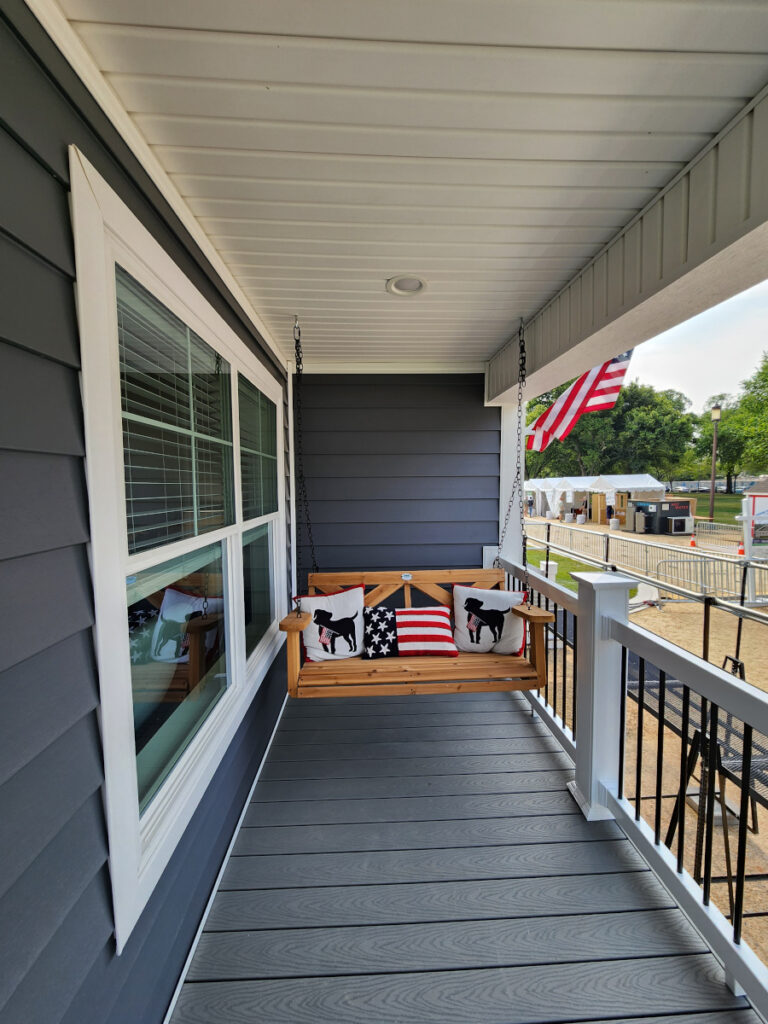
Visitors on the National Mall stream into the Sanibel, a new duplex model home from Cavco Industries. The 1,770-foot floor plan offers side-by-side 885-square-foot residences, each with a front porch, large living, dining, and kitchen space, two bedrooms, and ample storage.
Sam Landy, president of UMH Properties, said the duplex homes will go on their own 5,000-square-foot lot.
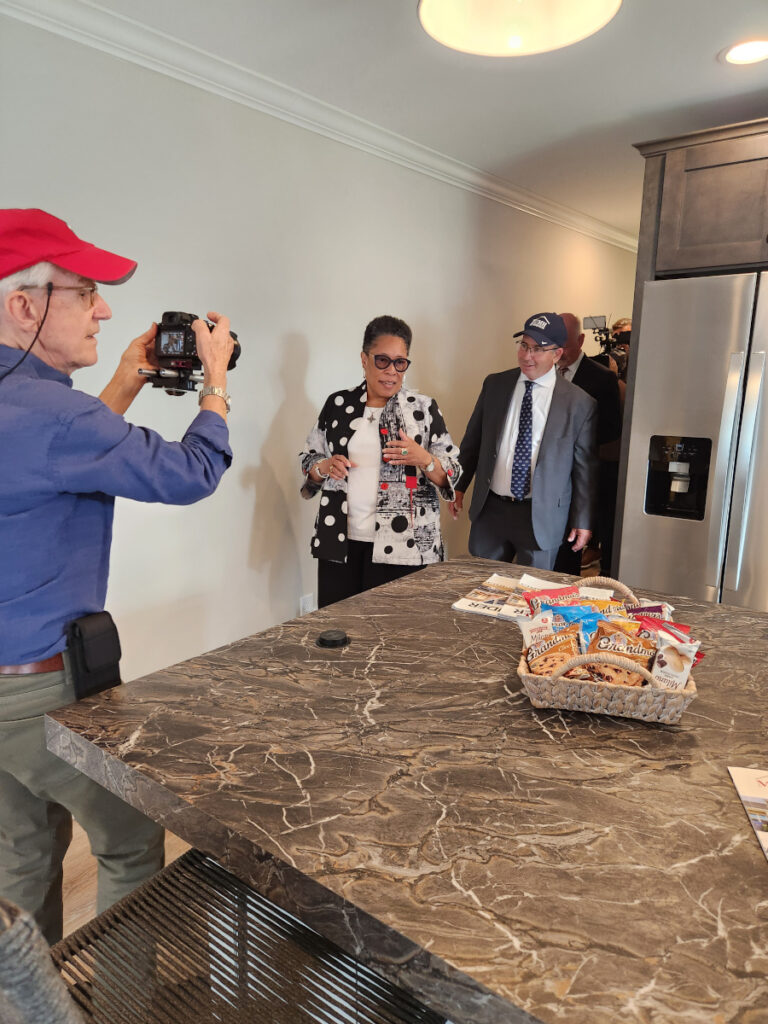
“So people can have their own garden, they can have a pet, they have a shed, there’s no common-wall neighbor above, below, beside them,” Landy told Secretary Fudge during a walk-through of the home. “They have their privacy, so it becomes a very enjoyable place to live.”
Fudge noted during the tour what a great value the new type of home could be for young people and families looking to rent. “This is something they would never expect,” she said.
“This is great,” Fudge said. “Thank you, thank you, thank you. I could stay all day but I have to go see some more houses.”
Leaders from across the country came to Washington, D.C., to represent the industry, including Cavco Industries President Bill Boor, at right. Earlier in the week, the Manufactured Housing Institute hosted its MHI on the Hill event, which involved manufactured housing professionals from all parts of the industry taking to Capitol Hill to share housing priorities with Senatorial and Congressional elected officials and staff.
The wide-open and inviting kitchen and dining space in the Sanibel offers a place to prepare a meal for the family, or host a dinner party.
The Sanibel has a pair of spacious bedroom, including this well-lit space on the back of the home. Notice, out the left window is the Washington Monument.
The home on display on the National Mall was made possible through a partnership between Cavco Industries, the Phoenix, Ariz.-based builder, and UMH Properties, the Freehold, N.J.-based community owner. The Sanibel duplex on display was built in a factory in Virginia and is destined for a community in Carlisle, Pa., to be the new home for a pair of families.
Oct. 6-8 at Avalon Hotel in Alpharetta, Ga.
Manufactured housing community owners have never had more information available to them — or more decisions to...
The Midwest Manufactured Housing Federation has announced that attendee registration is now open for the 2027 Louisville Manufactured Housing Show, returning to the Kentucky...
HUD’s Innovative Housing Showcase, MHI’s Homes on the Hill and Annual Meeting Begin Sept. 22
Two of the country’s largest builders of manufactured homes will...