Addresses Manufactured Housing Community Needs for Access Management, Security
HandyTrac Systems, a provider of biometric key control technology, is positioning its key management platform as a security tool for manufactured housing communities, where operators often oversee large properties with numerous access points and limited on-site oversight.
The Alpharetta, Georgia-based company makes electronic key cabinets designed to track and document who accesses keys to show homes, offices, maintenance facilities, common areas, and vendor entry points across a community.
“Manufactured housing communities face security challenges that differ from other property types, including sprawling geographic footprints, a mix of resident-owned, community-owned and vacant homes, and frequent vendor and contractor traffic,” HandyTrac Director of Business Development Chad Habegger said.
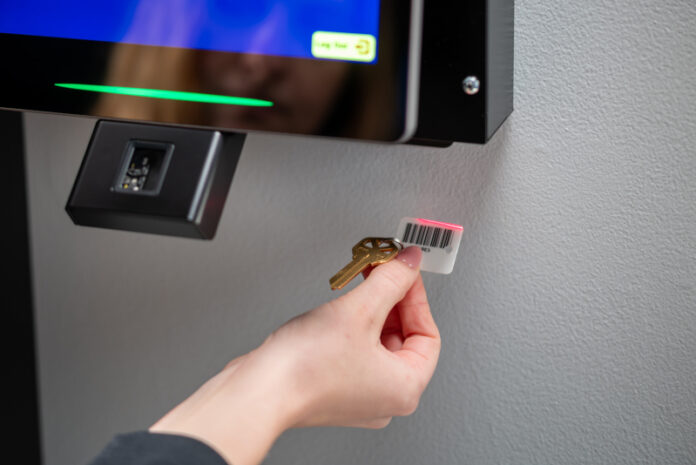
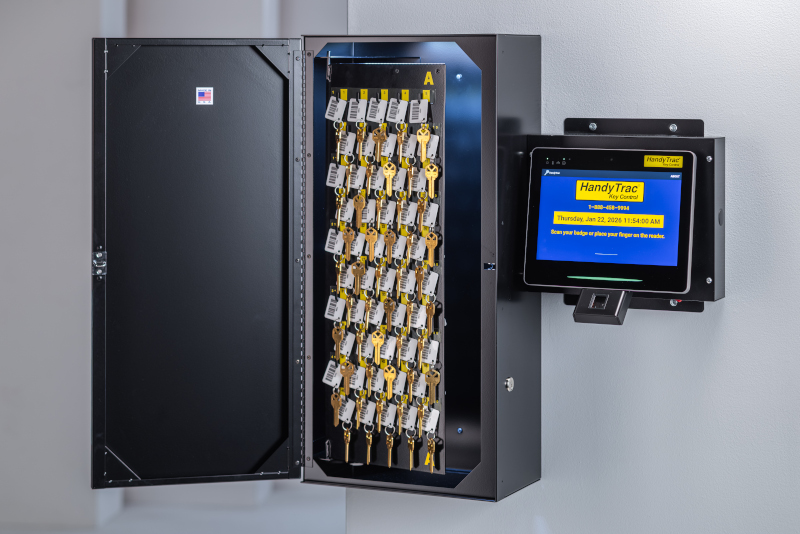
When security-related issues are handled informally through phone calls, text messages or paper notes, important details can be lost, creating risk for owners, managers and residents. HandyTrac’s system is built around an 18-gauge steel key cabinet with a built-in door alarm that triggers email notifications when the cabinet is opened outside of approved activity, giving managers visibility even when they are off site. Access to the cabinet is limited to approved users, and every interaction is logged automatically.
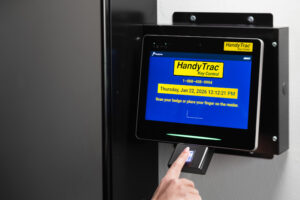
“The system also uses biometric authentication, such as fingerprint identification, to ensure only authorized individuals can retrieve keys, removing risks tied to shared codes or borrowed credentials,” Habegger said. “An automated randomized key placement feature prevents predictable storage patterns inside the cabinet, adding another layer of protection against unauthorized removal.”
Beyond access control, the company said the platform is designed to help operators track maintenance and safety issues that affect overall community security. A recent addition to the offering is alert notifications within the app. HandyTrac utilizes custom notes and activity codes that allow users to track the detail of who pulled a key and why and turns that information into detailed audit trails. Each reported issue is assigned and documented until resolved. Each home, lot, or common area also builds its own history of reported issues and completed actions, creating a comprehensive record managers can reference later.
The system also documents work assigned to vendors, contractors, and internal staff to help ensure security-related tasks are completed properly and on time.
HandyTrac markets the technology to manufactured housing owners, multi-site operators, and property managers responsible for safety and regulatory compliance. It is part of a broader lineup of HandyTrac systems marketed for use in multifamily housing, senior living communities, student housing and other property types, with the company offering multiple cabinet models to fit properties of varying size and complexity.
Product Features:
Large 10″ Touch Screen Interface Fast 8 Core ARM Cortex-X1 1.8ghz Processor Full website access directly on the display Easy Wall Mounting Wi-Fi and Ethernet Multilingual Support (English, Spanish, Tagalog) Full System Warranty US-Based Technical Support Single or Double Cabinet Biometric Fingerprint Access Enhanced Security One-Touch Building Pull Integration for Pulling Multiple Keys Audit Trail – Reports are backed up to Amazon Web Services Customizable Activity Codes Instant Reports – Keys Out, Who Has Key and Why, When Returned Built-in Door Alarm with Email Notification Unit Notes Unit Restrictions Yardi Interface
At a manufactured home community in Fostoria, Ohio, industry veteran Brandon Schilling beholds something he thinks of as “the school bus test”.
The company he leads as president and CEO, BrightStar Communities, had acquired the community in Northeast Ohio, and the group had largely completed its initial plan to revitalize the asset.
“When the kids who live in the community are getting off, we look to see how many of the kids who are staying on the bus are pointing out the window, saying ‘I want to play there!’” Schilling said.
With that endorsement from an excited child, Schilling and his team have a strong notion that they’ve landed once again on what they call “The brightSTAR Way”.
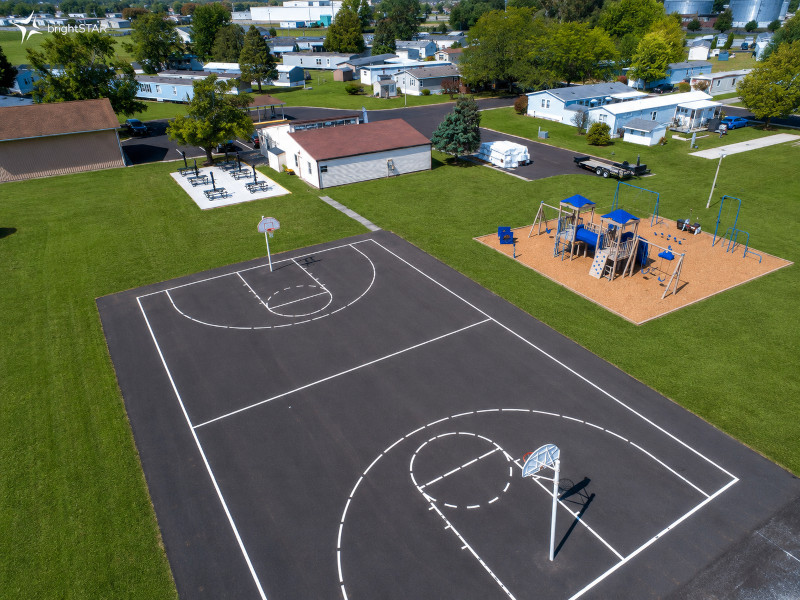
New entry signs, upgraded utilities, new playgrounds, repaved roads, new homes with high-quality skirting, and restored clubhouses are all part of the plan for every community they own or buy.
“This is a set of non-negotiables. We just won’t compromise,” Schilling said of the company standard.
In managing its properties and in the acquisition of new communities for the BrightStar portfolio, the BrightStar team holds that every resident deserves a safe and pleasing environment in which to live, where they hold a sense of pride.
BrightStar has operated for more than 50 years and owns more than 20 communities across Ohio and Indiana, and, increasingly, in the Southeast.
For much of the company’s history, its practice in the manufactured housing industry had been in third-party management. In recent years, BrightStar began acquiring communities. Foxhole Equity bought an interest in the company in 2019.
“That’s been a huge success for us going forward,” BrightStar Director of Acquisitions Carter Moses said of the strategy.
In Fostoria, the acquisition was typical of what BrightStar buys: a community that needs attention and residents who are committed to each other and the neighborhood.
“A lot of it is the curb appeal, adding where needed,” Moses said.
Schilling said the former clubhouse in Fostoria had become a maintenance building.
“We fully re-did the clubhouse,” Schilling said. “It was a value-add buy, as most of the acquisitions are. There had been no upgrades, no changes in years. There was a need for repair and new homes to replace the older ones.”
The ‘Paradigm Shift’
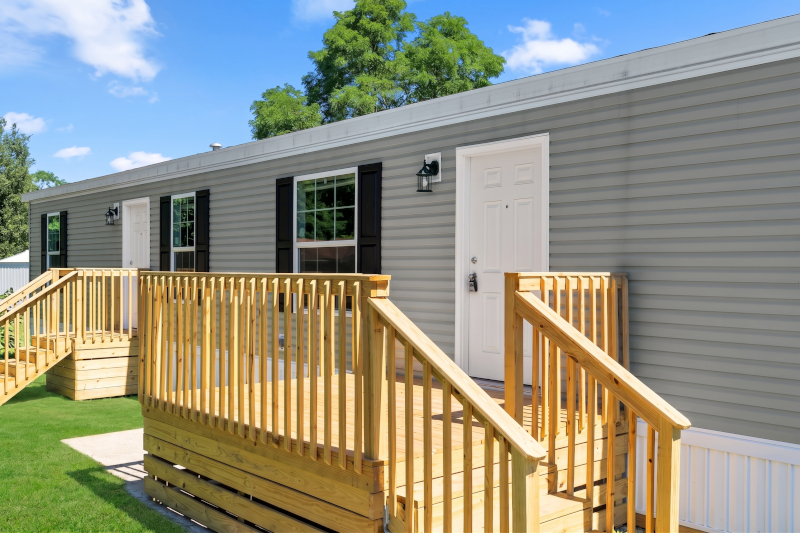
The entry of a new home in Fostoria.
Repaved roads and upgraded clubhouses increase curb appeal, but what makes a community — a neighborhood — is the people who live there and their interaction with each other.
“We know all of the residents by name, and their kids’ names, too,” Moses said. “We get out and connect with them and encourage that type of interaction.”
The community manager and staff, for instance, organized a cookies and letter-writing night during Christmas.
Schilling said when the staff wanted to show of the improvements in Fostoria, it was decided they should have an event.
“We called the mayor,” Schilling said. “We held a community event. We toured homes with the residents.
“It was a paradigm shift,” he said.
Soon, the residents took up the mantle and took to social media to show their pride in Fostoria.
“They face off against other area communities, challenging them in a way,” Moses said. “It’s a community faceoff, of sorts, in a friendly way.”
Moses said Fostoria represents one of many success stories within the BrightStar portfolio.
Currently, the group has seven more communities under contract and is keeping an eye out for further opportunities and expansion.
“This is a long-term, legacy business,” Moses said.
The question that manufactured housing community owners and operators were asking a year ago was whether AI could actually be useful in their business. That debate is over, and the questions now are more practical: Where do I start? How do I connect AI to my existing systems? And what happens to my team?
Why Communities Need A Unique Approach
Most AI tools entering property management were designed for multifamily. That is a problem for operators, because the two asset classes operate on fundamentally different logic.
In manufactured housing, a resident is often both a leaseholder and a homeowner simultaneously. Home sales processes and land-lease dynamics require different workflows than a high-rise leasing funnel. State-level regulations on lot rent increase notices, eviction notice requirements that vary by state and can void a proceeding if the wrong period or language is used.
Retrofitting a multifamily AI tool — or for that matter any tech solution — for MH tends to reveal its gaps after go-live, when broken workflows surface in real transactions. The better path is purpose-built tooling or platforms that have invested in integrations with the systems community operators already use. Depth of integration across the industry’s leading systems, like ManageAmerica, Rent Manager, and Yardi, is a signal of how seriously a vendor has committed to the vertical.
Domos is an AI platform built specifically for manufactured housing communities, with integrations across those systems and a focus on the workflows manufactured housing operators run.
What an AI ‘Ecosystem’ Actually Means
The word “ecosystem” matters here. Most operators start their AI exploration by evaluating point solutions: one tool for sales inquiries, another for maintenance triage, a third for payment reminders. Each solves a discrete problem. The challenge is that workflows do not operate discretely.
A resident’s journey from first inquiry to signed lease and to ongoing tenancy involves handoffs across multiple functions. When AI tools for each function operate in isolation, those handoffs become manual reconnection points. Data does not flow, context gets lost, and staff end up doing the integration work that the technology was supposed to eliminate.
An AI ecosystem approach connects those workflows end-to-end and ties them back to the property management system of record. AI that reads from and writes to the property management software and customer relationship management system, or CRM, goes beyond just answering questions. It takes actions, updates records, and closes loops.
One Domos customer has applied this to their home sales process. AI workers manage workflows from first inquiry through closing, without requiring a human to coordinate each stage. But the connected approach delivers something else that point solutions never could: visibility across the entire funnel.
“To me, the greatest benefit has nothing to do with time being freed up — it has everything to do with data and transparency, something this industry has always lacked. There was no true way to measure conversion data, identify breakpoints, or uncover buyer trends until AI. The speed at which we can now identify those trends and adjust means no lead is left behind,” Endeavor Communities principal partner Ryan Smith said.
What Happens to Human Teams?
When operators hear “AI workforce,” the first question is usually some version of: do my people still have jobs? The concern is reasonable and the industry has not been straightforward enough about what actually changes.
The honest answer is that a capable AI should absorb work that previously required headcount. For operators looking to scale, that is often the primary value: growing a portfolio without proportionally growing the team.
Think about what onsite staff spend their time on today: logging calls, updating resident records, entering work orders, chasing data across systems. These are not judgment calls, they are data entry tasks that happen to require a human because this is how systems were built. Today, the interaction model flips: teams stop talking to software and start talking to their workers; AI workers who handle the system interactions on their behalf, faster and more consistently than any manual process. The human’s job becomes doing what only humans can do: the in-person showing, the difficult resident conversation, the decision that requires reading a room, not updating a field in a property management software.
That shift lands best when onsite staff is brought in early. They know the workflows better than anyone, which makes them essential to a successful deployment. They are also typically the most skeptical. Operators who have done this well report the same pattern: the people who pushed back hardest tend to become the strongest internal advisers and advocates once they see what changes.
“Our goal isn’t to do away with employees, it’s to scale. We want our teams putting their energy into the human part of the job: the in-person conversations, the relationships, the work only people can do,” Rhonda Stroud, a partner and head of property management for Bedrock Communities. “AI takes the administrative weight off their plates so they can focus on the rest. There was initial skepticism, but our onsite managers and maintenance teams are now the ones telling us how much time it gives them back.”
Guardrails, Limitations, and What to Watch
The strongest case for AI adoption in the industry cannot be separated from an honest accounting of its limitations.
Compliance is the most critical area. The Fair Housing Act governs how AI can communicate with prospective residents, and HUD’s 2024 guidance made explicit that the Act applies to housing decisions regardless of whether a human or an algorithm makes them, including the screening of prospects and within all resident communications. Manufactured housing adds further complexity: lot rent increase notice requirements vary by state, with mandatory periods ranging from 30 days to three months and specific statutory language that differs by jurisdiction. Eviction notice rules for land-lease communities are similarly state-specific; the wrong notice period or missing required language can void the proceeding. An AI system that has not been configured with these constraints is a liability, not an asset.
Beyond compliance, operators should ask vendors direct questions before signing. What does the AI hand off, and to whom? How are errors caught? Can AI hallucinations be prevented? Is the system configurable, or does it operate as a black box? The goal is an AI that operators can constrain and oversee. That distinction separates tools built for manufactured housing from tools that were built for something else and pointed at it.
How to Start Implementing
Operators who feel behind on AI adoption often hesitate to move, waiting for the right moment. That hesitation has a cost that compounds quietly.
AI systems that update continuously mean operators do not carry the maintenance burden themselves. By the time an operator finishes building an in-house solution, the underlying models, connectors, and agentic behaviors that solution was built on are already materially outdated.
The implementation path is also clearer now than it was six months ago. Early adopters absorbed the learning curve, and results are no longer limited to pilot phases.
A Practical Approach to AI
Before evaluating vendors, run a two-part internal audit. First, map which workflows consume the most staff time with the least variation. Repetitive, high-volume processes are the best candidates to delegate to AI workers.
Second, look at organizational structure honestly. Centralized operations tend to extract more value from AI faster. If decision-making and workflows are fragmented across sites, that structure is worth addressing before or alongside any AI deployment.
The operators getting the most out of AI are treating it as a workforce and organizational strategy, not a software purchase. Portfolios scaling without proportional headcount growth, teams focused on work that actually requires human judgment, and staff who are more effective and more satisfied in their roles. That is the outcome worth building toward.
Yardi has been in the converging world of real estate and technology for a long time, including in the manufactured housing industry with its primary offerings and an adapted version for smaller operations, called Yardi Breeze Premier. After years of development, the company has released Yardi MH Manager, a new right-sized, manufactured-housing-focused offering that helps meet the needs of mid- to larger-sized operators.
Built for Control in a Single Platform
Yardi built and deployed MH Manager for manufactured housing community owners and operators who serve and manage residents, homesites, home inventory, and daily operations. It offers…
1. Management of homes and homesites 2. Acceptance of online payments, as well as other resident tools 3. Automated daily workflows 4. The use of built-in accounting designed for MH operations 5. A reduction in manual processes, elimination of disconnected systems
“MH Manager is an intuitive and powerful property management software that meets the needs of a property manager in this industry and eases the workflow of everyday operations,” Tanner Buuck, Yardi’s sales manager for manufactured housing, said. “By combining property management, accounting, and resident services into one platform, operators can eliminate the need for multiple systems, reduce data entry errors, and gain real-time insights into operations.”
Yardi was founded in 1984 by Anant Yardi, who created the first platform Basic Property Management, on an Apple computer for his real estate properties in Santa Barbara, Calif. In the ensuing decades, Yardi expanded with its Voyager product and strategic acquisitions, and now operates 80 countries with a workforce of more than10,000 employees.
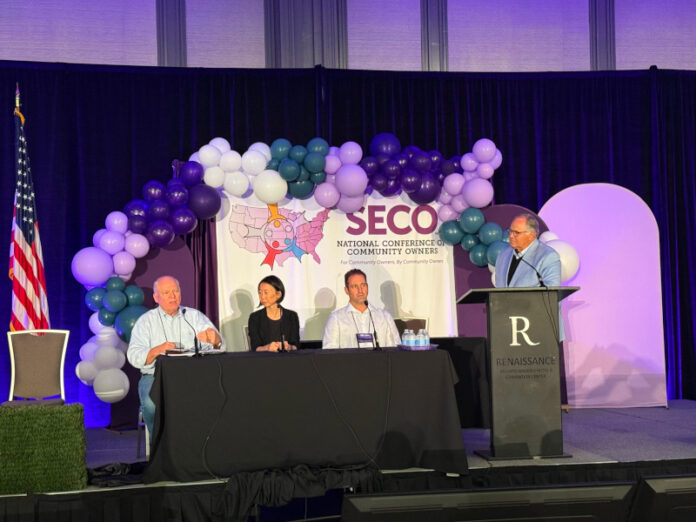
An educational panel from SECO 2025. From left, Ed Barber, Jane Yang, Bryce McMurtry, and moderator Chris Nicely. Photo courtesy of SECO.
Oct. 6-8 at Avalon Hotel in Alpharetta, Ga.
Manufactured housing community owners have never had more information available to them — or more decisions to make. From advances in artificial intelligence and technology to changing operational demands, acquisitions, risk management, and evolving resident expectations, today’s owners are constantly balancing long-term strategy with day-to-day operations. As a result, opportunities for education are valuable.
Hosted by the nonprofit Southeast Community Owners organization, SECO26 takes place Oct. 6–8, 2026, at The Hotel at Avalon in Alpharetta, Georgia. This year’s conference marks a move from its longtime home at The Waverly Hotel near The Battery in Atlanta to a new venue in the heart of Avalon, a walkable mixed-use district offering convenient access to restaurants, shops, and entertainment.
What began 15 years ago as a gathering of regional community owners has grown into a nationally recognized conference, welcoming attendees from coast to coast. Community owners from more than 35 states are regularly in attendance at SECO conferences.
With Yardi Breeze returning as the presenting sponsor, SECO26 will bring together manufactured housing community owners, operators, investors, suppliers, and other industry professionals for two and a half days of education designed specifically for the community ownership sector.
The educational program reflects many of the challenges owners navigate today. Artificial intelligence will be a major focus, with multiple sessions designed for varying levels of experience — from attendees exploring AI for the first time to those looking for practical ways to incorporate it into their businesses. Additional sessions will examine operations, acquisitions, liability reduction, technology, management strategies, asset protection, and other topics intended to provide practical, real-world takeaways.
The exhibit hall gives attendees direct access to companies providing products and services tailored to manufactured housing communities, making it easy to compare solutions, discover new technologies, and build relationships with industry vendors. Attendees will also have the opportunity to tour five model homes from leading manufactured home builders, providing a firsthand look at current home designs, features, and innovations.
As the manufactured housing industry continues to evolve, SECO26 provides an opportunity for community owners and operators to step away from their day-to-day responsibilities, explore new solutions,and return home with practical strategies for their businesses. For additional information, including the conference agenda, speakers, exhibitors, and registration details, visit SECOConference.com.
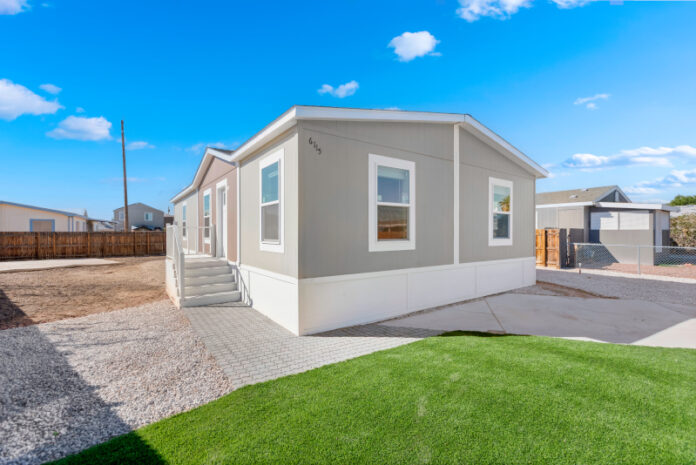
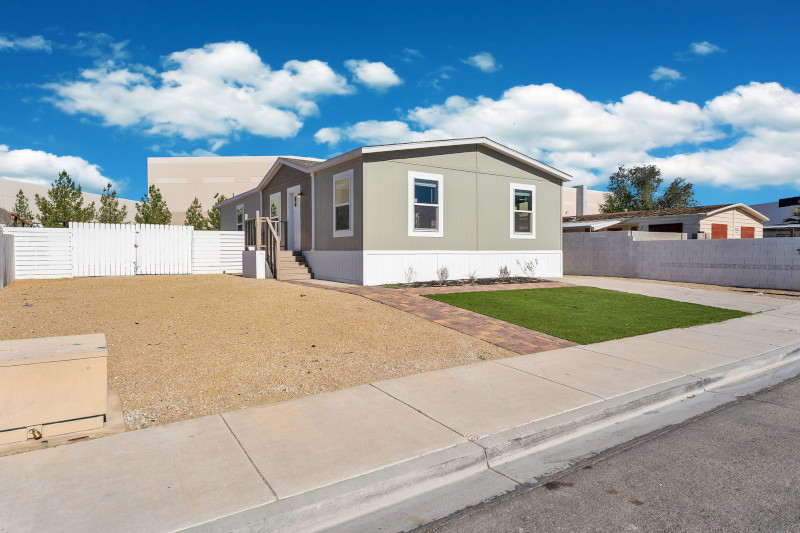
A new home on a formerly vacant lot in Las Vegas filled by Shea Factory Homes. Photos courtesy of Pat Shea
By Patrick Shea
For many Americans, homeownership feels increasingly out of reach. Rising home prices, limited housing inventory, and increasing construction costs have created significant barriers for working families.
For me, that challenge has become both a professional mission and a personal passion.
I began my career in the manufactured housing industry more than six years ago as an installer based in Illinois. In that time, I have participated in the installation of more than 500 manufactured homes across the Midwest and West.
Working directly in the field taught me everything from site preparation and transportation logistics to installation, inspections, and code compliance. More importantly, it allowed me to witness firsthand the positive impact manufactured housing can have on families seeking homeownership.
Throughout those years, I developed a reputation for delivering safe, quality, and code-compliant homes while helping families achieve one of life’s most important milestones — owning a home.
Land on a Vision
After relocating to the Las Vegas area, I quickly recognized the tremendous need for affordable housing solutions throughout Southern Nevada. Like many fast-growing markets across the country, the region continues to face increasing housing costs and a shortage of attainable homeownership opportunities.
I wanted to become part of the solution. I obtained my manufactured home dealer’s license and established Shea Factory Homes, a dealership that focuses on providing modern manufactured homes and attainable homeownership opportunities. At the same time, I continued building Shea Construction & Co., our installation and site-development company specializing in manufactured housing projects.
Together, these companies allow us to offer a streamlined approach that covers every stage of the development process — from land evaluation and planning to home placement and completion.
What makes our model unique, however, is the partnership between development, investment, execution, and speed.
A significant contributor to our success has been our work alongside valued investors, whose efforts behind the scenes have helped identify many of the redevelopment opportunities we pursue today.
While completed homes often receive attention, successful redevelopment projects begin long before construction starts. Finding viable opportunities requires extensive market research, property analysis, and relationship building. Many of the properties we target are vacant lots, abandoned parcels, or underutilized sites that others overlook. Each property must be evaluated for zoning requirements, utility access, development costs, permitting considerations, market demand, and overall feasibility.
Identifying the right property is only the first step.
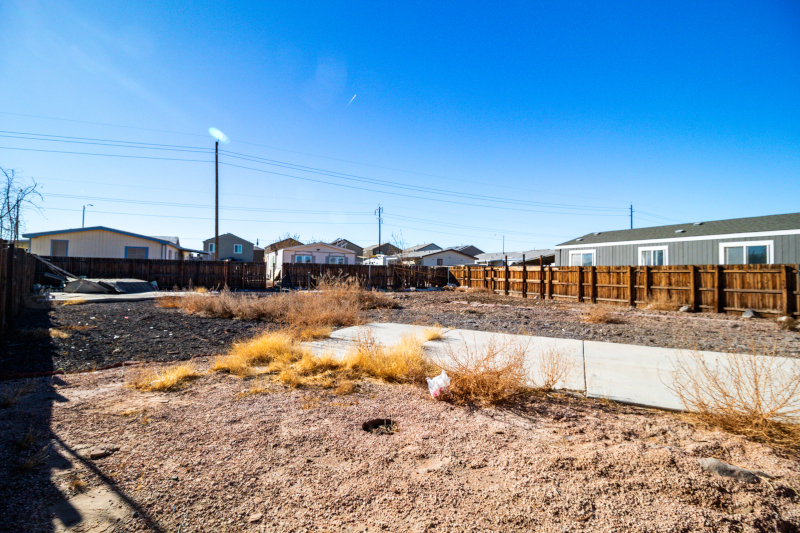
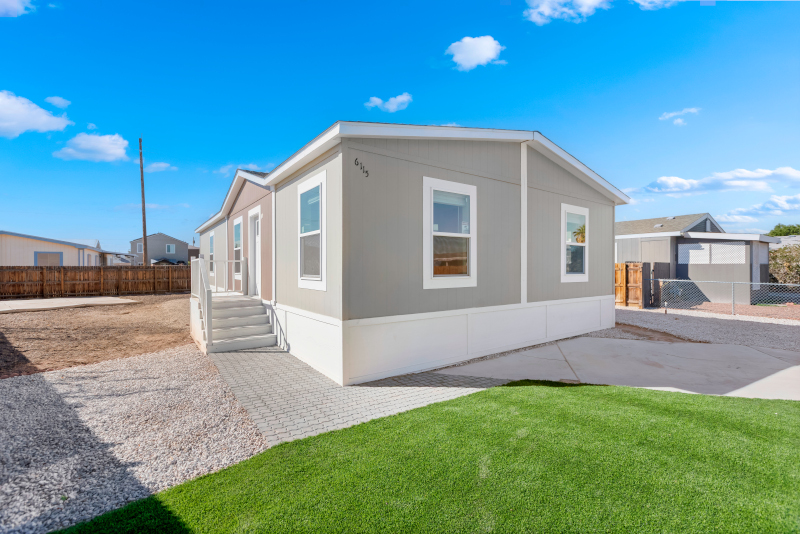
Crystal Peak before land work and infill with a new manufactured home.The new home on Crystal Peak in Vegas.Before photo of the vacant land on Berthelot in Las Vegas.A new home on a formerly vacant lot in Las Vegas filled by Shea Factory Homes. Photos courtesy of Pat Shea
‘Bridging the Gap’
Investors play a critical role in bridging the gap between opportunity and action. By sourcing deals, cultivating investment relationships, and helping secure project funding, a good investment partner makes it possible for a team, ours included, to transform vacant and neglected properties into productive residential housing.
One of the greatest advantages of our approach is speed. Once a suitable parcel has been acquired and development planning is complete, a new manufactured home can typically be ordered and delivered within approximately three to four weeks. Following arrival, site completion, installation, utility connections, inspections, and final preparations can be completed within a month, allowing the home to be ready for occupancy on a significantly shorter schedule than would be the case for many standard site-built construction projects.
In a market facing ongoing housing shortages, time matters. Every month saved in the development process represents families being housed sooner, neighborhoods being revitalized faster, and communities benefiting from additional housing inventory more quickly.
While no single solution can solve the affordability crisis, manufactured housing offers one of the most practical and scalable ways to bring quality housing to market efficiently without sacrificing safety, durability, or long-term value.
The results can be seen throughout our redevelopment projects across the Las Vegas Valley.
The accompanying before-and-after photographs illustrate how abandoned, outdated, and underutilized parcels can be transformed into attractive residential properties featuring modern manufactured homes. What were once vacant lots become opportunities for families, neighborhoods, and communities alike.
At Shea Factory Homes, our mission extends beyond simply selling homes. We take pride in helping families achieve homeownership and begin building real equity.
Every home we place represents more than a housing unit. It represents an opportunity for a family to create stability and invest in the future.
Looking ahead, we believe this redevelopment model has tremendous potential beyond Las Vegas. Communities throughout Nevada, California, Arizona, Utah, and other Western markets face many of the same affordability challenges we see in Southern Nevada.
By combining strategic investment partnerships, redevelopment expertise, and modern manufactured housing solutions, we believe meaningful progress can be made toward expanding housing supply and increasing access to homeownership throughout the region.
Patrick Shea began his journey in the manufactured home industry in the South Suburbs of Chicago. As a licensed installer, he worked with multiple communities across the Midwest, Arizona, and Nevada. After founding Shea Factory Homes and Shea Construction & Co., he shifted his focus toward developing affordable single-family manufactured homes. Now rooted in Las Vegas, he is committed to serving first-time homebuyers, hardworking blue-collar families, veterans, and individuals priced out of the traditional housing market.
The 2026 Women of Distinction met in June in Costa Mesa, California. Photo courtesy of Barry Cole.
On June 26, the third annual Cole Accolades Luncheon Honoring Women of Distinction in the manufactured housing industry was held at the private Park Club in Costa Mesa, California.
This event is sponsored solely by Barry Cole of MHIS, a California-based insurance provider for the industry. What started as a way of identifying those women who have worked hard during their careers, assisting in the successes of their companies — some now retired and others still working — has become an annual tradition.
“This yearly program was established for women, in all areas of the manufactured housing industry, who might not have had the recognition they absolutely, surely deserve,” Cole said to the attendees. “Some of you have made your own success, and some have made your bosses successful.
“Hopefully, having all MH associations and non-profits join and publicize the efforts of this event will bring awareness of great manufactured housing women achievers,” he said.
In 2026, 12 women who have given their time to help develop the successes that their companies have enjoyed were honored.
They are:
Tisha Anderson | Star Management Patty Gritton | Homes Direct Sharon Mann | Skyline Donna Meckel | Les Frame Management Lynn Plumlee | Nu Trend Homes Debbie Rebolo | HomeQuest Rebecca Rebelo | Saddleback Mobilodge Angel Rogers | Star Training and Consulting Veronica Tachias | Newport Pacific Erica Taylor | Augusta Communities Josie Wheeler | Cousin Gary Homes Robin Youngdahl | Clayton Homes
One woman among the 12 honorees, Lynn Plumlee, passed away before the event. Her mother attended the luncheon on her behalf. It was an emotional moment for everyone in attendance.
Many who have been honored in the past two events attended and supported those newly chosen honorees.
Each honoree looks forward to the beautiful event each year, and enjoys the company of so many from throughout the industry.
Maria Horton is the director of business development and a regional manager for J&H Asset Property Management, an owner of manufactured home communities and a provider of third-party and fee-based management services for communities. She lives in Garden Grove and works in Yorba Linda, but at any moment can be found anywhere in Southern California.
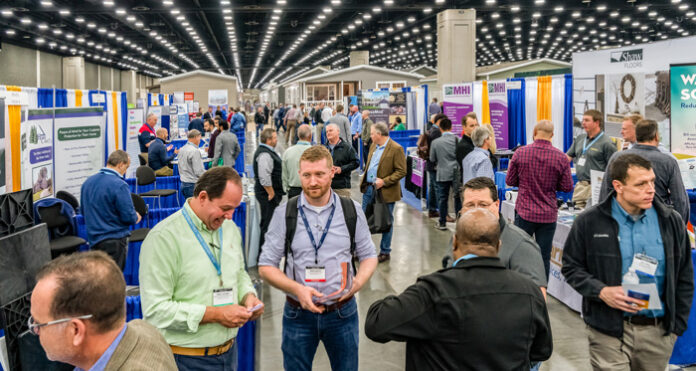
The Midwest Manufactured Housing Federation has announced that attendee registration is now open for the 2027 Louisville Manufactured Housing Show, returning to the Kentucky Exposition Center in Louisville, KY. from Jan. 20-22.
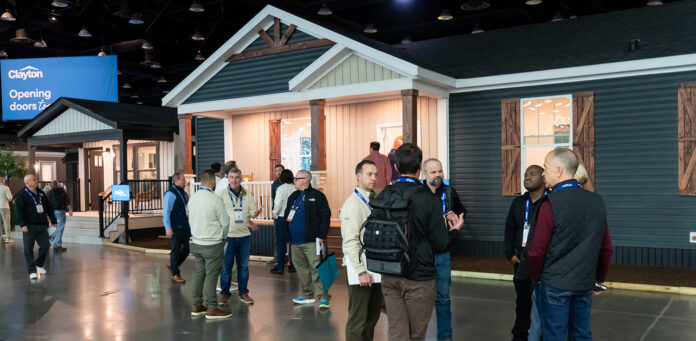
The Louisville Show draws thousands of industry professionals to tour over 40 model homes from the nation’s leading manufacturers, making it the largest indoor display of factory-built homes in the country. As the precursor to the spring and summer selling season, the Louisville Show provides manufactured housing professionals across the country the opportunities needed for a strong sales year.
“The Louisville Show has been an industry cornerstone for over 60 years and is definitely a must-attend event for any manufactured housing professional,” MMHF President Eric Oaks said. “With the latest model homes on display and hundreds of exhibitors showing off the newest innovations, this is the event for anyone looking to gain a competitive edge in the industry.”
Attendees can also learn from industry leaders as they share their insights for 2027 and beyond. Topics covered during the educational seminars at the 2026 show ranged from state of the industry, to builder/developer trends, to financing, to community management.
“Not only will this year continue the positive momentum for the Louisville Show, but we’re excited to have more than 425,000 square feet of exhibit space,” Byron Stroud, 2027 Louisville Show Chairman, said. “That means attendees will get to see even more innovations from our exhibitors, have more chances to connect with their peers, and of course see more model homes.”
For information about attendee registration, sponsorship opportunities, hotel block announcements, and other updates regarding the Louisville Show, visit TheLouisvilleShow.com.
Those interested in exhibiting or becoming a sponsor are urged to visit TheLouisvilleShow.com/exhibitors or call (616) 888-8030 today, as exhibitor booths and sponsorships are quickly selling out.
The Louisville Show is an industry trade event not open to the general public. For more information, visit TheLouisvilleShow.com.
The Grande Arbor, from Cavco Industries, is the first-of-a-kind chassis-free manufactured home, on display Sept. 22-24, 2026, on the National Mall in Washington, D.C. Photo courtesy of Cavco.
HUD’s Innovative Housing Showcase, MHI’s Homes on the Hill and Annual Meeting Begin Sept. 22
Two of the country’s largest builders of manufactured homes will be featured Sept. 22-24 on the National Mall in Washington, D.C., for the U.S. Department of Housing and Urban Development’s Innovative Housing Showcase in partnership with the Manufactured Housing Institute and its Homes on the Hill event that this year coincides with the annual member meeting.
Cavco Industries, based in Phoenix, Arizona, is partnering with UMH Properties to show the first-ever chassis-free manufactured home, a design and engineering option unleashed by the historic 21st Century ROAD to Housing bill that became law in July. UMH, based in Freehold, New Jersey, makes the showcase viable by agreeing to share cost and to purchase the homes on display for its community residents or potential buyers. Champion Homes, based in Troy, Michigan, is bringing a pair of homes, each of which also leverages the new design flexibility — a two-story manufactured home that is geared toward urban infill in tight metropolitan settings — as well as a thoughtfully designed ranch home that fits nicely in nearly any residential setting.
The annual showcase is held each year to highlight housing designs and technologies intended to increase the supply of homes and lower costs for owners and renters. The showcase draws policymakers, industry leaders, members of Congress and the public for tours of model homes, as well as educational discussion panels on housing affordability.
Cavco said the new home, Grande Arbor, and its “double grande suite floor plan” target the growing demand for multigenerational living.
“Addressing the affordable housing crisis remains a top priority for our company,” Cavco President and CEO Bill Boor said. “Innovation and advocacy for manufactured housing at the national and local level go hand in hand.
“That’s why events like the Innovative Housing Showcase are so important,” he said. “Policymakers and others can see for themselves the homes we are developing to meet buyers’ needs while keeping prices affordable. The Grande Arbor does both, and we’re proud to showcase it this year.”
According to the Pew Research Center, about 22 percent of Americans — more than 74 million people — currently live in a multigenerational household. The National Association of Realtors reported that in 2024, 17 percent of homes purchased in the U.S. were bought specifically for multigenerational use, the highest share on record. Aging parents, adult children returning home, and the rising cost of maintaining separate households are among the factors driving the trend, Cavco stated in its release on the new home.
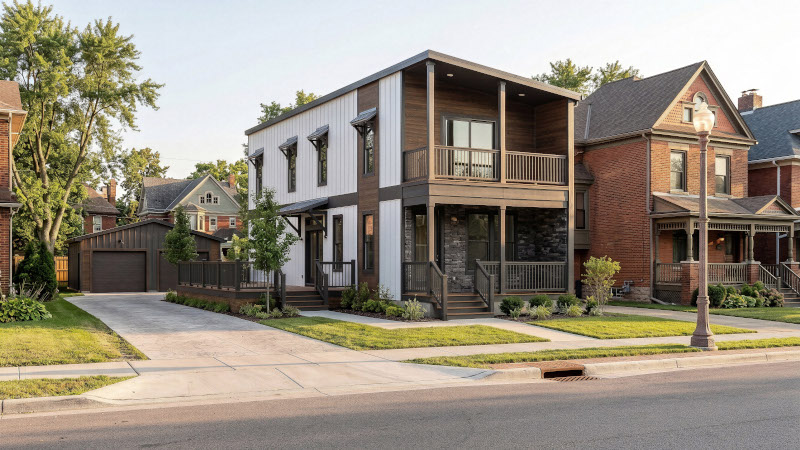
Building HUD-code homes without a permanent steel chassis allows for lower-profile installation of a manufactured home. This ground-set capability provides improved curb appeal for smooth integration into traditional neighborhoods, access to new urban and suburban markets and developments, as well as greater design flexibility, including multi-story construction.
The new frameless display home places two primary suites at opposite ends of the home, private areas that are connected by a shared kitchen, dining, and living space to fit the needs of households looking for multigenerational housing options.
Cavco’s home was built in the company’s Rocky Mount, Virginia, homebuilding facility, the same production team that introduced the first nationally available HUD-approved duplex at the showcase in 2023.
Champion Two-Story Home Rises to the Occasion
The New Horizon, from Champion Homes, is an innovative new two-story manufactured home, on display Sept. 22-24, 2026, on the National Mall in Washington, D.C. Rendering courtesy of Champion.
Champion Homes is taking affordability to new heights for the 2026 Innovative Housing Showcase. With an eye toward urban infill lots in nearly any metro area in the U.S., the New Horizon features a two-story layout and a small building footprint designed for high-density city settings. The company’s first two-story manufactured home with a removed second-floor chassis, the New Horizon leverages the benefits of vertical construction to lower costs for builders, buyers, and renters.
The New Horizon has a front porch, a second-story balcony, and a large deck that’s ideal for entertaining. Families looking for spaces for intergenerational living will love the primary bedroom and en suite bathroom on the first floor, offering an affordable, attainable solution for aging in place.
As land costs are increasingly becoming a barrier to homeownership across the U.S., the New Horizon answers the call with a trailblazing two-story layout and an affordable price point.
What Makes New Horizon Different
The two-story manufactured home with a removed second-floor chassis provides increased curb appeal because there’s substantially less space between the first and second floors, where a second-floor chassis would have been used. It is a 1,698-square-foot home with a dual vanity and shower/tub combo in the primary suite. In addition to the kitchen, living, and dining areas is a dedicated office and half bath. The second floor has a pair of bedrooms, another full bath, a loft space, and access to the upstairs balcony.
The use of two-story homes in a community setting allows for increased square footage on a smaller land footprint, Champion said in its release on the new design. The use of two-story homes by retailers allows for increased livable square footage at an attainable price in historically high-cost real estate areas. This allows retailers who are used to predominantly placing homes on rural land to expand their business into urban markets.
Champion’s New Frontier
The New Frontier, from Champion Homes, is a new ground-level, ranch-style manufactured home, on display Sept. 22-24, 2026, on the National Mall in Washington, D.C. Rendering courtesy of Champion.
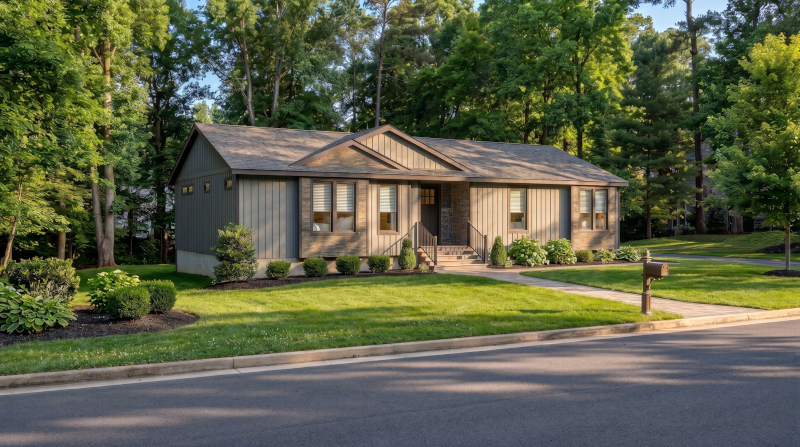
The ranch home from Champion is called the New Frontier and delivers the style homeowners want and the affordability they need. It offers exceptional curb appeal and in-demand features homeowners desire — and its appealing design fits in with existing neighborhoods across the country. It provides a practical solution for single-story living with its classic ranch design, main-floor laundry room, and standalone bathtub in the primary bathroom.
The need for affordable housing has never been greater, Champion stated, and the New Frontier rises to the occasion with a standout design that families can afford. The 1,759-square-foot floor plan features three bedrooms, two bathrooms, island and bar seating in the kitchen, a dedicated dining area, and a primary suite with dual vanity, shower, and standalone tub.
The New Horizon and the New Frontier, Champion stated, are designed for flexibility and will be available in multiple configurations like HUD Code, HUD Code with a removed chassis, and modular.
The 2026 sponsors for the Innovative Housing Showcase are MHI, International Code Council, National Association of Home Builders, Rocket, and Structural Building Components Association. The theme for the 2026 event, while celebrating the nation’s 250th birthday, is “Made in America.”
“Under President Trump’s leadership, HUD is bringing the public and private sectors together to advance bold, practical solutions for housing affordability,” said Secretary Turner. “This Showcase is a powerful reminder of what is possible when free enterprise, American grit, and strong public-private partnerships come together to make the American Dream of homeownership a reality. I am grateful to our incredible sponsors and exhibitors for bringing this experience to the National Mall and giving Americans an opportunity to experience firsthand the innovation emerging across our nation.”
MHI CEO Lesli Gooch said MHI is pleased to again partner with HUD for the Innovative Housing Showcase, and at this historic moment for manufactured housing.
“As we celebrate the 50th anniversary of the HUD Code, the manufactured homes on display will showcase the next generation of housing innovation and the transformative potential of the 21st Century ROAD to Housing Act, legislation that will help unlock greater design flexibility and expand housing supply,” Gooch said. “We are grateful for HUD’s leadership and encouraged by Congress’ embrace of manufactured housing as an essential part of the nation’s housing supply strategy. Together, we are making homeownership attainable for more Americans and delivering high-quality housing options to communities across the country.”
Nearly 5,000 manufactured housing professionals attended the Louisville Show in 2026. Register now!
The Midwest Manufactured Housing Federation announced today that the 2027 Louisville Manufactured Housing Show will take place from Jan. 20-22.
Once again held at the Kentucky Exposition Center in Louisville, KY, the Louisville Show will bring together manufactured housing professionals from all over the country. As the precursor to the spring selling season, the show offers the support and resources needed for industry professionals to make 2027 a strong sales year for their business.
This year’s show is set for more than 425,000 square feet of exhibit space, filling the entire south wing of the facility. With more room to explore, attendees will have even more opportunities to view dozens of the newest model manufactured homes on display and preview the latest industry trends and innovations.
“The Louisville Show has seen significant growth in recent years, and we’re proud to continue that in 2027 by offering more opportunities for exhibiting, networking, and education,” MMHF President Eric Oaks said. “Now, more than ever, the show is THE place to not only view the newest trends in manufactured home design, but connect with thousands of decision-makers at the start of the selling season.”
In addition to the largest collection of factory-built homes, the show also brings out the latest in technological advancements, the best in suppliers’ offerings, and a look at all the newest amenities and system-built options in the industry. Attendees can also benefit from an extensive lineup of educational seminars from industry thought leaders, experts, and innovators.
“We’re always looking for new ways to bring more to the Louisville Show, and 2027 is no exception,” Byron Stroud, Louisville Show chairman, said. “From an exciting and relevant educational program to the massive increase in exhibit space, the show is the must-attend event for any manufactured housing professional.”
Attendee registration for the 2027 Louisville Show will go live in the coming weeks. To receive more information, including sponsorship opportunities and hotel block announcements, visit TheLouisvilleShow.com
Those interested in exhibiting or becoming a sponsor are urged to visit TheLouisvilleShow.com/exhibitors or call (616) 888-8030 today, as exhibitor booths and sponsorships are quickly selling out.
The Louisville Show is an industry trade event not open to the general public. For more information, visit TheLouisvilleShow.com.
About The Midwest Manufactured Housing Federation
The Midwest Manufactured Housing Federation is a trade-association dedicated to the promotion and advancement of the manufactured housing industry throughout Illinois, Indiana, Kentucky, Michigan, and Ohio. The Federation holds the Louisville Manufactured Housing Show annually in Louisville, Ky.
Oct. 6-8 at Avalon Hotel in Alpharetta, Ga.
Manufactured housing community owners have never had more information available to them — or more decisions to...
The Midwest Manufactured Housing Federation has announced that attendee registration is now open for the 2027 Louisville Manufactured Housing Show, returning to the Kentucky...
HUD’s Innovative Housing Showcase, MHI’s Homes on the Hill and Annual Meeting Begin Sept. 22
Two of the country’s largest builders of manufactured homes will...