Suppliers and builders within manufactured housing are now making industry professionals aware of a new vertical anchoring system for factory-built home foundations, aiming to strengthen stability and safety in high-wind areas, though the change is not currently mandatory under federal rules.
The recommendation, introduced in November, encourages installers using a “pan-system” or alternative foundation systems in Wind Zone I to include vertical anchors in new home installations. Companies, including Minute Man Anchors, Oliver Technologies Inc., and Tie Down Engineering, collaborated in the development of the updated guidelines for the approach to improve performance against wind uplift and shifting.
Under the guidance, installers are urged to follow the manufacturer’s instructions, which now include vertical anchoring as an optional enhancement. The approach goes beyond federal requirements set by the U.S. Department of Housing and Urban Development installation and safety standards.
Standard installation practices for homes using traditional block-and-tie-down systems remain unchanged. For pre-owned homes, installers may continue to rely on existing manufacturer or state standards without modification.
Industry experts say the recommendation reflects a growing effort within manufactured housing to promote stronger, more resilient installation practices, particularly in regions that experience periodic high winds.
While the new vertical anchoring guidance is voluntary, many installers and foundation manufacturers are expected to adopt the measure as a best practice in 2026 and beyond.
MSI Surfaces makes an acoustic wall panel that absorbs sound and makes a beautiful, natural-looking backdrop.
Examples of star-shaped designs in earth tone ceramic tile.
Smarter, not harder. That is a phrase my photographer loves to remind me of when I make 10 trips of art and decor into a home when I could have had the same results in five trips… if I had planned properly. It’s the same for manufactured housing. Success relies on finding smarter, more efficient ways to build homes, instead of making it harder.
This is especially true in the design and decor choices we tend to make in our homes. It’s easy to bring a picture of something you saw in a magazine and ask “Why can’t we offer that?” without thinking of the changes that would create in the building process. I know the designers who are on staff for the various manufacturers deal with that every day. A sales person brings in an image or an idea and says a competitor or luxury home builder is doing this, so we need to…, or XYZ is asking for this in our homes. From there, the designer is supposed to help the plant find a source for this product, quickly, that is kept in stock, that can be purchased for $20 instead of the $100 everyone else is paying. We have the best of the best who make miracles like this happen every day. Every year, I am amazed at what innovative, creative design decisions are being made in our homes.
Gone are the days of consumers settling for dog bowl lighting fixtures and plastic faucets. They want what they see on HGTV and on Pinterest, or that item that someone dreamed up using AI. Here are some of the looks and products that I am seeing that are available to our industry, and some that will be coming soon. These are high on style, but efficient in how they can be added to our homes.
Color
Natural light and pendant lighting in a kitchen space with calming, natural colors.
Color is a big story not only in manufactured housing, but in site-built housing as well. The farmhouse white and black interiors and exteriors are quickly fading, and consumers are looking for a warmer, more inviting place to call home. It isn’t possible for consumers to walk all of our homes professionally furnished, so when they walk into a home that has no color, they can’t understand what that home will look like with some accent walls, area rugs, and artwork.
Lighter wood tones with a golden hue, and soft earthy greens are what you will see more of in 2026, and cream or bone colors over harsh white on walls and trim.
Biophilic Design
Photos courtesy of Basic Components.
Incorporating plants and other earthy elements into your homes is no longer a trend, it has become a basis of design. Have you noticed that floor plants and trees are back? But not a $29 faux Ficus — think cactus, olive trees, and fiddle leaf fig trees that might be more expensive, but will keep a home from looking like everyone else’s.
Lifestyled Tip
The natural elements, color, and lighting all contribute to creating a soothing space, such as in this home designed for Palm Harbor in the Pecan Valley floor plan. Photo courtesy of Suzanne Felber/Lisa Stewart Photography.
Invest in a photo of the home when it is properly furnished and “lifestyled” if you can’t afford to stage the home. Have it made into a 36- by 48-inch mounted poster that the potential buyers can see when they enter the home. That will give them a reference point to help them understand where furniture might go, and how color can make the house become a home.
Texture with Tile
A green vertical DalTile accent provides texture and color in a common space.
Texture is one of the biggest stories moving into 2026. You will be seeing a lot more of it on walls and in tiles. Tile is one of those areas where exciting things are happening. In the past, manufactured housing didn’t do enough volume to create tiles just for us, but now, with the continued evolution of the homes we offer, we will see a lot more tile. Going back to the concept that we have to keep the building process efficient, keep a lookout for new tile styles in different sizes. This will make grouting and cutting almost obsolete.
It comes down to a math problem — what size tile can we use to have the fewest cuts? DalTile is supplying more of the smaller-sized tiles with a mesh back that will place perfectly, and are easy to install. Textured wall tiles are becoming even more important, and curves are in. Also, 15-inch by 30-inch and 24-inch by 24-inch tiles are becoming more popular and more affordable. These are ideal for bath spaces and will become more important in the future.
The Mansfield Park tile collection by Basic Components is a tile collection curated specifically for the manufactured housing industry. The colors and sizes are wonderful and very affordable. The company knows the needs of the industry, and is getting ready to launch a very exciting new size that will be a first. I have a feeling other housing sectors will be paying attention and following our lead. This, again, is a great example of knowing the opportunities factory-built housing offers. The industry can bring current design trends to the market in a form that will help efficiency in the plants without giving anything up. You heard it here first!
Curated Collections
Natural tones in a bedroom aided by MSI’s acoustic wall design.
The thing I hear most when I am staging homes in retail center is “My home will never look like this.” I hear that much more often than “Can I afford this?” Our customers love the creativity they see in professionally merchandised homes, but are not sure they can achieve the same look.
An old and new, curated look is what consumers are seeing and trying to achieve in their own homes — not everything matches, but it coordinates. Ask your designers to come up with some “storyboards” that show a collection of your options used in different ways. You can create these easily in Canva, then make Pinterest boards that are easily accessible to consumers looking for design ideas.
Knowledge is Power
Thanks to partners like Basic Components, the manufactured housing industry is finally getting away from being elusive with the knowledge and resources that make us unique. We are getting access to information that helps us gain a better understanding of the trends and ideas from around the world. BCI holds a very well-attended annual design conference that is built around a simple belief: “The designers are the experts. They are the ones shaping the homes, influencing product standards, and ultimately defining how families experience the spaces they live in.”
It is beneficial that a group like Basic Components brings tools, resources, and global material insights that help industry designers continue to lead in the field instead of requiring them to individually go out and gain insight on their own. A highlight of the gathering is always a trend report on worldwide designs by Emily Holle from MSI Surfaces. She attends a lot of the international design shows, and brings back that information for attendees of the design conference.
When we bring the world to our designers, the entire industry thrives.
A rural patch of land in Sheboygan County, Wisconsin, is being transformed into what local organizers hope will be the nation’s first dementia village — a residential neighborhood designed so people living with dementia can “live as usual” while receiving on-site support.
Livasu, pronounced “Li-VAY-Su”, will be built on nearly 80 acres with a plan for 124 individually owned, adaptable homes arranged around a village center with amenities intended to serve homeowners and welcome the wider public. Amenities are to include a restaurant, grocery store, theater, gym, spa, hobby spaces, and walking paths.
The community will have round-the-clock care available, including on-site support staff. Livasu will not look to replace or add health care services, but will be intentional about giving the residents privacy, independence, and family life while providing caregiving services.
‘Living As Usual’
Mary Pitsch, co-founder of Dementia Innovations, said after years of working with county residents — helping to improve public understanding and helping to improve the lives of families impacted by dementia — that she felt there was a lot more to be done. She initiated a public-private partnership focused on dementia crisis situations that then led to the idea for Livasu, a derivation of the phrase “Living as usual.” There were many county residents looking for help with continuing to manage their current lives in unison with managing the cognitive changes. Too many people were left to manage on their own because they weren’t ready for a residential care facility, she said.
“We just weren’t doing a great job as a county responding to the needs of a segment of our population,” Pitsch said. “We changed how we look at those crisis responses. We did a lot of training and changed our emergency protocols. But we knew more could be done. How do we change these situations from even happening?”
The answer was by looking at the environment in which the person with dementia was living.
Organizers say the Sheboygan County village shares concepts of care with a successful dementia-friendly community in Europe — the Hogeweyk village in the Netherlands — and is intended as an alternative to traditional institutional settings.
Pitsch said the focus is to foster a resident’s abilities rather than disabilities.
“We started putting ideas together. We knew what we wanted. We wanted something that feels like a regular neighborhood, but one for people with dementia,” she said. “It gives them an environment that allows the person with dementia to take some risk.”
Backers say the village model allows people with cognitive impairment to keep routines, relationships, and dignity while reducing the need for restrictive interventions. Integrating public amenities and encouraging interaction with the broader community will normalize the lives of those living with dementia and offer family members new choices for long-term living arrangements, including allowing couples to remain together, a frequent challenge in conventional memory-care settings.
One of the early renderings for a unique village concept in Wisconsin. Images courtesy of Livasu.
The Livasu plan grew out of local collaboration that began with a 2018 Dementia Crisis Task Force in Sheboygan County. That grassroots partnerships included law enforcement, emergency medical services, social workers, hospital personnel, and the county 911 emergency call center.
This partnership evolved into a non-profit model, Dementia Innovations, where the mission is education, community collaboration, and supporting a “dignity of risk” lifestyle for people living with dementia.
The Wisconsin Housing Alliance is one of the partners in the project.
“Our logo and tag line says ‘The Voice of Factory-Built Housing.’ With groups like Dementia Innovations utilizing manufactured housing in their projects, we don’t need to speak as loudly,” Wisconsin Housing Alliance Executive Director Amy Bliss said. “I am so proud of Mary and her team of people dedicated to solving a community need. In addition, I am proud of Cavco-Dorchester and North Country Homes for taking on a project that required a good deal of energy, thoughtfulness, and hard work to make these homes tailored to meet the needs of those with dementia.”
Todd Metz from Cavco, said The Ivy is set to serve as the community’s model home and as an office. Site preparation, including extensive construction, has been underway since the fall of 2025, he said.
The goal is to have 20 homes ready for the spring/summer of 2026. In all, the community will have more than 120 homes with a combination of single-section and multi-section homes.
“Many entities would have walked away because it was something new and different,” Bliss said. “In this case, the industry stepped up and found a way to support this cause. I wish all industry members started with a yes when presented with unique projects such as this.”
“It was all about how we could get the most benefit,” Pitsch said. “We wanted to create good walking paths, but in a tighter area. It is winter here much of the year, so longer walks aren’t great and we wanted be realistic about how much of the property would need to be maintained through seasonal weather.”
Why A Village?
A conceptual site plan circulated by the group shows concentric neighborhoods, a centralized village hub, and barrier-free grounds designed for small, familiar routes, and community interaction. The homes — all manufactured homes — are owned by the resident and made adaptable to changing needs.
The $13 million development is being funded through a capital campaign, lining up partners that include regional banks, foundations, architects, and builders.
The village concept has personal roots for many involved. Organizers and early supporters frequently cite family caregiving experiences as motivation. Jim Holmes, whose wife Patti died after a long struggle with dementia, told reporters that the idea of letting people remain “free to do whatever they want” helped inspire the project. Local news coverage has highlighted multiple families and volunteers who say they want better alternatives for their loved ones than the options they have encountered.
Community buildings, infrastructure, a model home, and new resident homes all began coming into Livasu at the end of 2025 and will continue through the year.
“We are building a part of a larger community the same way people build libraries and other community spaces,” Pitsch said. “We are really trying to change the culture for how we care for people with dementia. We’re trying to be as flexible as we can be for the homeowners.”
HR 5184 Continues to Receive Substantial Support, Passes 263-147
The U.S. House of Representatives on Jan. 9 voted 263-147 to pass H.R. 5184, which looks to restore full regulatory authority for manufactured housing to the U.S. Department of Housing and Urban Development.
The bill passed in subcommittee and the House Committee on Energy and Commerce approved the change to the U.S. Department of Energy’s role to an advisory capacity when it comes to energy standards for the construction of manufactured homes.

Rep. Erin Houchin of Indiana and Housing Subcommittee Chairman Mike Flood of Nebraska introduced the bill. The Affordable Housing Over Mandating Efficiency Standards — otherwise known as the Affordable HOMES Act — moves to the Senate.
“As demand for affordable homes has surged, so have unnecessary costs, making the dream of homeownership slip further out of reach for Americans. The Affordable HOMES Act takes a practical approach by cutting red tape and regulations that contribute to pricing American families out of owning a home, which will increase supply and lower costs,” Rep. Houchin said. “I’m proud to see the House take an important step toward restoring the American Dream with the passage of this bill.”
The bill repeals Section 413 of the Energy Independence and Security Act of 2007, and ensures that the DOE’s final rule on Energy Conservation Standards for Manufactured Housing will have no force or effect. Section 413 directed the DOE to establish energy efficiency construction standards for manufactured housing, an abrupt change from the long-standing authority of HUD to decide on federal construction standards for manufactured homes via the HUD Code.
“This legislation is essential to our work to cut red tape and lower costs for hard-working American families. The Affordable HOMES Act cuts redundant regulations to help restore the American Dream of home ownership for millions of families,” Congressman Brett Guthrie (KY-02), chairman of the House Committee on Energy and Commerce, said. “Thank you to Congresswoman Houchin for your work to lead the Affordable HOMES and support our communities.”
Twenty-one members were absent and/or did not vote on the bill, while 206 Republicans voted for the change, and were joined by 57 Democrats.
MHI CEO Lesli Gooch said that today’s manufactured homes are built with advanced, factory-controlled processes and often exceed the energy efficiency of site-built homes. She said modern manufactured homes are built to high energy performance standards, with over 50 percent of new manufactured homes being ENERGY STAR certified and all exceeding current HUD efficiency standards.
“The industry has consistently advocated for meaningful updates to enhanced energy standards that appropriately reflect the unique characteristics of manufactured housing. Restoring a streamlined, effective regulatory framework under HUD will advance those goals and deliver lasting impacts across affordability, energy efficiency and housing access nationwide,” Gooch said. “We, alongside Americans pursuing homeownership, thank Rep. Erin Houchin and Rep. Jake Auchincloss for their bipartisan leadership and support, and we commend the House of Representatives for passing H.R. 5184, a critical step to achieving the dream of owning a home.”
Intends to ‘Use Full Force of the Government’ to Build 4 million Homes
U.S. Senator Elissa Slotkin (D-MI) on Jan. 8, 2026, introduced the National Housing Emergency Act of 2026. The bill requires the President to declare a national housing emergency and invoke the Defense Production Act to incentivize housing production and build 4 million homes.
U.S. Senator Elissa Slotkin, from Michigan, has introduced a bill to declare a National Housing Emergency.
To achieve this, the legislation will boost domestically produced materials to support the construction and rehabilitation of housing, push states and localities to cut red tape that currently stand in the way of building middle-class housing.
“There is nothing more fundamental to the American Dream than owning your own home, and it has become increasingly difficult for middle class Americans to do this,” Slotkin said.“The United States is in a housing crisis, and we need to act now. That’s why my bill declares a national housing emergency, cuts regulations that get in the way and uses the full weight of the U.S. government to increase our housing supply by 4 million homes.”
The National Housing Emergency Act of 2026 declares a housing emergency that will continue until 4 million homes are built. The bill would do the following:
Uses the full strength of the U.S government through the Defense Production Act to direct domestic industries to produce essential materials (lumber, steel, manufactured housing) and services to speed up housing development and rehabilitation.
Creates a new housing standard by choosing how the federal government gives out money. No one gets a blank check: It rewards pro-growth communities with federal dollars and holds accountable communities that refuse to grow.
Pushes states and localities to cut red tape and make way for more housing. It compels state and local governments to change local laws like allowing commercial properties to get turned into housing, eliminating single-family zoning or allowing for accessory dwelling units (“in-law suites” or “granny flats”).
During the emergency, the bill institutes a freeze for states or localities from passing laws, rules or regulations that imposes a burden on the construction or rehabilitation of housing during the period of the emergency.
In the full text, manufactured housing is called out twice. Firstly, that all manufactured homes would continue to be built to the HUD code, and secondly that local governments allow manufactured housing in all residential areas. It also calls for “reducing minimum lot size requirements.”
Michigan Builder to Improve Housing in Urban Locale
Champion Homes has offered to donate the value of a new modular home to Greater Cleveland Habitat for Humanity as part of a joint effort to build more affordable homes in Cleveland.
“Champion Homes is committed to building high-quality, affordable homes using offsite construction,” Champion Homes President and CEO Tim Larson said. “The need is great, and Greater Cleveland Habitat for Humanity has been a fantastic collaborator as we work together to make homeownership a reality for more families.”
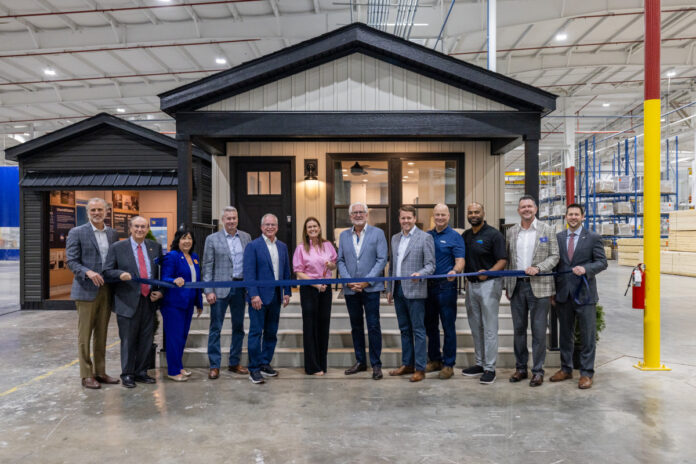
Local stakeholders attended a ribbon-cutting ceremony on Sept. 24 in Cleveland, during which tours were offered to experience the quality of construction and the home’s design aesthetics.
Seven more modular homes, also built by Champion Homes in collaboration with Greater Cleveland Habitat for Humanity, will be available to tour on the same block.
Larson, along with Executive Vice President of Business Development Wade Lyall and Regional Director of Sales Steve Peel, attended the event with Greater Cleveland Habitat for Humanity President and CEO John Litten.
“This home will help a local family build a stronger future,” said Litten. “Together with Champion Homes, we’re helping revitalize this neighborhood and changing people’s living situations for the better.”
Greater Cleveland Habitat will sell the home to a local family at no profit with an interest-free mortgage. The monthly housing payment will be no more than 30 percent of the homeowners’ monthly income.
The 1,493-square-foot home comes from Champion’s Strattanville, Pennsylvania, manufacturing facility. It has three bedrooms and two bathrooms, a covered front porch, ENERGY STAR® kitchen appliances, windows, and doors. Modular homes are built according to local, state, and regional building codes, typically on a faster schedule than site-built homes, and at a reduced cost.
There are 10 homes in the neighborhood near Grovewood Avenue and East 164th Street on the city’s northeast side that show Champion Homes’s history of work with Greater Cleveland Habitat for Humanity. They include four modular homes on West 83rd Street and five others on Matherson Avenue, all built by Champion’s Sugarcreek, Ohio, manufacturing facility.
“Being able to put in 10 new houses at once changes a neighborhood,” Peel said. “That’s 10 new driveways, sidewalks, and garages. Because we’re able to build homes at a faster pace with offsite construction, we can quickly make a real difference in a neighborhood.”
Habitat for Humanity works to eliminate substandard housing locally and worldwide through constructing, rehabilitating, and preserving homes. It also advocates for fair and just housing policies, and provides training and access to resources to help families improve their living conditions. Greater Cleveland Habitat is one of 967 active Habitat affiliates across the country, and has served its community since 1987.
Champion Homes is a leading producer of factory-built housing in North America. It employs more than 9,000 people and operates 46 manufacturing facilities throughout the United States and western Canada. The company has a portfolio of manufactured and modular homes, ADUs, park models, and modular buildings for the single-family, multi-family, and hospitality.
In addition to its core business, Champion Homes provides construction services to install and set up factory-built homes, operates a factory-direct retail business with 82 retail locations in the U.S., and operates Star Fleet Trucking, providing transportation services to the manufactured housing and other industries from several dispatch locations.
Developed in the early 1960s by the Ecke family, longtime ranchers and horticulturists, Lanikai Lane is a 14-acre coastal community with 146 homesites within a very short walk of Carlsbad State Beach.
Jim Joffe, who runs J&H Management and has been responsible for operating the all-ages community for nearly a decade, said the residents benefit from the broad business and hospitality experience of the owners, who continue in partnership with the city to operate the nearby Flower Fields, a global attraction.
Shane Joffe, Jim’s son, led a group of 28 manufactured housing professionals on a tour of the property while in the area for MHI’s Annual Meeting in late September.
“So when they do improvements here, they start from that perspective and move up from there,” Jim Joffe said.
The community has an eclectic array of homes, including quite a number of vintage homes that have undergone extensive renovation and expansion.
It is a unique setting that offers coastal views and access to all the activities on the long, wide strand: Swimming, surfing, fishing, camping, scuba diving, volleyball, and beach-combing. Carlsbad, in general, is one of the most desired leisure and retreat locations in Southern California.
He said the average annual resident turnover in the community is 7.5. During their decade of managing the property, more than 20 homes have been replaced. When a home within the community becomes available, it sells quickly. Recently sold homes at Lanikai Lane have gone for more than $400,000, and homesite rent averages $3,200 per month.
“I know that sounds like a lot, and it is in most settings, but you have to remember all of the other homes around us are multi-million dollar properties,” Shane Joffe said. “These are vacation homes for many people, but we do still have a good number of residents here who are living in their primary home.”
There are great views, particularly from some of the two-story homes. However, in recent years, the owners have limited the allowable height for new or remodeled homes as a matter of preserving sight lines for residents in the smaller homes.
J&H is family-owned and operated. It started in 1986, and now has nearly 60 employees, including about 10 who are related in some way to the ownership. One of the projects they helped manage was the installation of the gate at the front of the property.
“It’s just like the curb appeal for a home. You need that curb appeal with a community, too,” Shane Joffe said. “It just really sets the tone.”
Currently, J&H is looking to expand the pool area at Lanikai Lane. It will be placed further from the clubhouse and will incorporate fire pits, grilling stations, and added landscaping and common spaces.
Inside the clubhouse, there is a game room, library, grand fireplace, and a kitchen. One of the common areas on the prop-erty is a nicely tucked-away and landscaped sitting area with a bocce ball court.
“These owners are very committed to purchasing the right new homes when they need to replace the older homes,” Shane Joffee said. “And they’re a great example of how to create a valuable resident experience.”
The 2026 Louisville Manufactured Housing Show has announced its lineup of educational seminars for the three-day event taking place Jan. 14-16, 2026 at the Kentucky Exposition Center in Louisville.
This year’s Louisville Show will offer an “All-Star” lineup of speakers, consultants, and educators who will share valuable information on how to help grow your business.
Now in its 65th year, the show hosted by the Midwest Manufactured Housing Federation (MMHF) is the precursor to the spring and summer selling seasons. The show once again will bring together thousands of manufactured housing professionals under one roof and offer them the chance to connect with top industry leaders, gain valuable insights, and see the future of manufactured housing up close.
“Our goal this year was to create an educational program that inspires, educates, and empowers,” MMHF President Eric Oaks said. “We listened to the enthusiastic feedback from last year’s attendees to ensure our educational lineup for 2026 is filled with topics they care about most, from AI to the economic landscape.”
Read below for the full schedule of educational seminars:
Wednesday, Jan. 14
8:00 a.m. – State of the Industry: Manufactured Housing Today, Tomorrow, and in the Year Ahead
9:00 a.m. – The Economic Landscape: Key Trends Impacting Housing and the Overall Economy
10:00 a.m. – Building Smarter: Case Studies and Best Practices for Successful Residential Infill
11:00 a.m. – Consumer Lending in 2026: Market Dynamics Shaping Chattel and Land/Home Finance
Thursday, Jan. 15
8:00 a.m. – The National Agenda: Advocacy, Opportunities, and Initiatives for the Future of Our Industry
9:00 a.m. – Unseen Potential: Transforming How We Think, Sell, and Compete in Manufactured Housing
10:00 a.m. – Building What’s Next: A Look at the Trends and Innovations Defining the Modern Factory-Built Home
11:00 a.m. – Opening New Ground: Forward-Thinking Strategies for Development with Factory-Built Housing
12:00 p.m. – AI in Action: Intelligent Solutions to Improve Operations and Enhance the Customer Experience
Friday, Jan. 16
8:00 a.m. – Cover Your Assets: Practical Risk Identification and Mitigation Strategies for Community Owners and Managers
9:00 a.m. – The Future is Virtual: Mastering Digital Platforms to Reach Today’s Tech-Savvy Home Buyer
10:00 a.m. – Advanced Installation: Techniques, Tools, and Best Practices for Home Installation
The MMHF and show manager MHVillage have worked to optimize the educational programming to help attendees navigate the opportunities for manufactured housing in 2026 and beyond.
“The Louisville Show is a must-attend event for every manufactured housing professional, and the educational program is a key part of that,” Byron Stroud, 2026 Louisville Show Chairman, said. “To ensure that you and your business gain a competitive advantage in 2026, the educational seminars should be on your radar.”
The Louisville Show is the Midwest’s premier event for viewing more than 40 of the latest model homes from the top manufacturers in the industry. Attendees at the Louisville Show can tour more factory-built homes than at any other indoor event in the nation. And, they can discover the newest products and services from over 200 exhibitors and gain the insights they need to stay ahead of the competition.
After recent approval in subcommittee, the House Committee on Energy and Commerce has passed a bill to change the U.S. Department of Energy’s role to an advisory capacity when it comes to energy standards for the construction of manufactured homes.

The bill, H.R. 5184, was introduced by Rep. Erin Houchin of Indiana and Housing Subcommittee Chairman Mike Flood of Nebraska. The Affordable Housing Over Mandating Efficiency Standards — otherwise known as the Affordable HOMES Act — passed in subcommittee by a voice vote before being moved to the full Energy and Commerce Committee for consideration, the Manufactured Housing Institute said in recent communications to members.
The bill repeals Section 413 of the Energy Independence and Security Act of 2007, and ensures that the DOE’s final rule on Energy Conservation Standards for Manufactured Housing will have no force or effect. Section 413 directed the DOE to establish energy efficiency construction standards for manufactured housing, an abrupt change from the long-standing authority of HUD to decide on federal construction standards for manufactured homes via the HUD Code.
“Manufactured housing is a proven and cost-effective solution serving first time homebuyers, young families, and seniors,” Rep. Houchin stated during committee discussion. “Yet, Washington has created conflicting regulatory regimes that increase compliance costs and slow production. That’s what the Affordable HOMES Act aims to fix. It is straightforward and common sense. It restores HUD’s longstanding role as the single regulator of manufactured housing construction standards and removes DOE’s overlapping authority.”
The measure passed the committee by a vote of 30-16.
MHI and industry consensus contend that the duplicative agency mandate would create regulatory confusion, and “undermined the goal of advancing practical energy efficiency improvements within the HUD Code,” MHI stated.
In comments supporting the legislation, Subcommittee Chair Bob Latta from Ohio acknowledged that, under current law, DOE and HUD have overlapping authority to set energy efficiency standards for manufactured housing.
“Including DOE in this authority creates redundant unnecessary standards that confuse the regulatory process making it more difficult to construct and ultimately purchase affordable homes,” Latta said.
Rep. Jake Auchincloss of Massachusetts offered an amendment to authorize the Department of Energy to serve in an advisory role to HUD.
“The amendment that I have at the desk is intended to strengthen this bill,” Auchincloss said. “The amendment retains the Department of Energy’s input on energy efficiency standards in an advisory capacity … It is the HUD secretary, the HUD staff that is best positioned to think about and to incorporate feedback from other experts and entities in putting forward regulations that make manufactured housing work at scale.
“Boosting manufactured and modular housing production is an important opportunity for us to build our way out of the current housing crisis, and this is a common-sense set of reforms that will help unleash housing production,” he said.
New Scores Would Include Payment History for Rent, Utilities, Telecom
In mid-2025 a collaborative effort between the three major credit reporting agencies — Equifax, Experian and TransUnion — resulted in a 24-month look at credit history rather than the “snapshot” that’s historically used to determine creditworthiness. Industry stakeholders now anticipate a deal between FICO and the Federal Housing Finance Agency that will allow for the same historic look at creditworthiness, but with added factors, including the consistency of rent, utility, and telecom payments.
The goal for both Vantage Score 4.0, the effort launched in July, and FICO 10T, the deal that seems to be nearing a conclusion, is to create a more competitive, transparent, and inclusive scoring system.
A more comprehensive understanding of risk could result in an increased number of loans for homebuyers, boosting home sales.
“This would be great for consumers and the safety of the mortgage market, to have both FICO 10T Score and VantageScore 4.0,” FHFA Director Bill Pulte stated in a recent social media post.
Assuming FICO T10 is approved to compete with the Vantage Score 4.0 product in the marketplace, it will take several months to implement at Freddie Mac and Fannie Mae, for instance.
More than 1,500 manufactured housing professionals are expected in Las Vegas April 7-9 as the Manufactured Housing Institute’s Congress and Expo returns to the...
With more homes, more exhibitors, and more buzz than ever before, the 2026 Biloxi Show is expanding, and fast.
The Biloxi Manufactured Housing Show &...