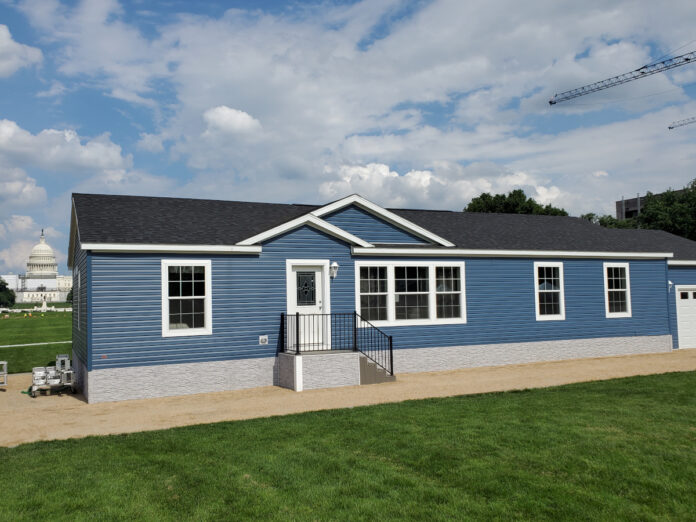
Champion Homes has entered a definitive agreement to acquire the assets of Homes Direct, representing 11 retail locations across the Western U. S. markets.
Founded by Ray Gritton, the retail locations are in Arizona, California, Colorado, New Mexico, and Oregon. The locations represent the majority of Homes Direct’s operating footprint. Champion said the locations align well geographically with its existing manufacturing and distribution presence in the region.
Homes Direct is the largest independent manufactured and modular home dealer in the western region of the United States, with a differentiated business model that engages a broad set of customers, the company stated in a release. It offers a range of options, an elevated purchasing experience, and supports customers through permitting, financing, home selection, and site preparation.
“Through its innovative retail platform and additional go‑to‑market channels, Homes Direct expands Champion’s ability to drive retail growth and sales across key Western markets,” the company stated in a release.
“Homes Direct, led by pioneering industry leader and CEO Ray Gritton, is an outstanding retailer that we’ve admired and worked with for many years,” said Tim Larson, president and CEO of Champion Homes. “Our businesses complement each other well, and Homes Direct’s differentiated retail experience and significant western U.S. presence make this a natural fit.
“We are confident this acquisition strengthens our retail platform and will further our ability to win as a customer-centric, high-performance agile team,” he said.
Gritton said Champion is an ideal long-term partner for Homes Direct, and that he has “significant trust” in its team to take the Homes Direct assets forward.
“We share a strong focus on the customer, delivering a seamless transition for our employees and allowing us to continue delivering a differentiated retail experience while creating a great environment for future growth by expanding our reach across the United States,” Gritton said.
The completion of the acquisition is subject to the satisfaction or waiver of certain customary closing conditions and is expected to close in Champion’s second quarter of fiscal year 2027. Champion said in an effort to ensure a seamless integration process, all Homes Direct employees at impacted locations will be offered employment by Champion following the completion of the transaction.
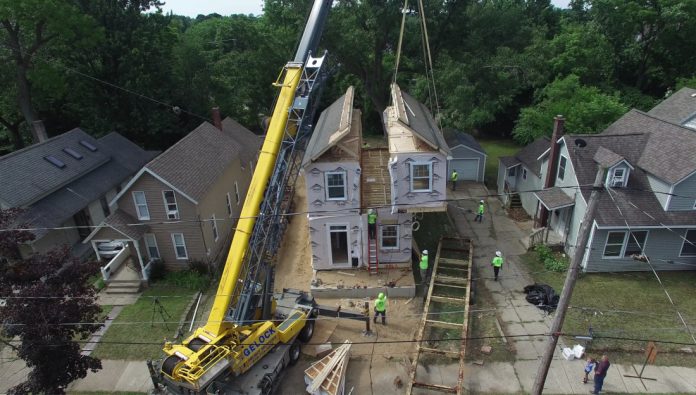
A crane drops one module of a home at a time on the southeast side of Grand Rapids, Mich.
Michigan-based Builder Announces Offsite Construction Event in June
Champion Homes is hosting the Offsite Construction Event 2026, a gathering of home builders and developers offering an in-depth look at how offsite construction can help scale a business.
This event is free to attend and will be held June 16-17 in York, Nebraska.
Organizers said The Offsite Construction Event is the only event of its kind in the factory-built housing industry. It highlights how Champion Homes is leading the way in spreading awareness of offsite construction as an important solution for builders; providing an opportunity to build at a faster pace and provide more homes.
“With the Offsite Construction Event, Champion Homes is proud to lead the industry in highlighting how high-quality factory-built homes are a key solution for builders and developers who want to scale their businesses with cost-effective homes built on faster timelines,” Champion Homes Vice President of Builder Developer Scott Thomas said.
High-value insights from the Offsite Construction Event:
Expert Business Strategies: Learn from offsite construction industry leaders at an educational seminar and expert builder panel focused on how to fast-track projects and maximize return on investment.
In-Person Experiences: See a crane set a modular home in a new development.
Interactive Tours: Get an exclusive look inside a Champion Homes manufacturing facility, and step inside new offsite-built homes designed for different types of developments.
Gather With Other Professionals: Make new connections with builders, developers, government officials, and housing industry decision-makers.
Attendees will learn how offsite construction leverages the unique efficiencies of building homes in factories, offering significant time and budget savings. Builders can reduce their construction time by 12 weeks per average build compared to site-built homes, leading to an average savings of 13 percent per average build.
“I’m extremely excited for the opportunity to educate builders, developers, and municipal officials about how offsite construction can help them build more homes and eliminate a tremendous number of headaches they currently encounter every day,” Thomas said. “Offsite construction can help builders deliver high-quality projects to their markets faster while our team manages as much as 90 percent of their current trades for them, allowing them to significantly scale their businesses.”
Few sectors of real estate have undergone a perception shift as significant as manufactured housing.
For decades, manufactured housing communities operated largely under the radar of institutional investors. The asset class was often misunderstood and viewed as a niche corner of the housing market. Today, that narrative has changed dramatically.
Manufactured housing now sits at the center of one of the most pressing issues facing the United States: the growing shortage of affordable housing. As home prices and apartment rents continue to rise across the country, manufactured housing and manufactured housing communities, in particular, have emerged as one of the few scalable solutions capable of delivering both affordability and stability.
As we move through 2026, the manufactured housing industry appears to be entering a new phase — one defined less by rapid acceleration and more by maturity, discipline, and increasing recognition of the sector’s importance.
Production Still Lags Behind Demand
Manufactured home deliveries have stabilized near the 100,000-unit range annually after several volatile years.
Production slowed in 2023 as higher interest rates and tighter consumer financing weighed on demand before rebounding modestly in 2024 and leveling off through 2025. While stabilization is encouraging, the broader context highlights a much larger issue.
In the late 1990s, the industry produced more than 350,000 homes per year. Today’s output is less than one-third of that level despite a significantly larger population and a dramatically greater need for affordable housing.
The cost of new manufactured homes has also risen alongside broader construction inflation. Materials, transportation, and installation expenses have all increased. Yet even with these pressures, manufactured housing remains one of the most attainable paths to homeownership in the United States.
That affordability advantage continues to anchor the industry’s long-term demand.
Capital Markets Find New Equilibrium
Capital markets have also experienced a meaningful reset.
Between 2020 and early 2022, historically low interest rates and intense investor demand pushed pricing for manufactured housing communities to record levels. Cap rates compressed significantly as institutional capital entered the sector in search of durable yield and recession-resistant assets.
Between 2020 and early 2022, historically low interest rates and intense investor demand pushed pricing for manufactured housing communities to record levels, and cap rates compressed significantly.
Today, the market is beginning to find equilibrium. Cap rates have expanded modestly from historic lows, but the core investment thesis remains intact: manufactured housing communities continue to offer durable occupancy, predictable cash flow, and strong long-term fundamentals. In many cases,there are signs of values moving back in line with past seller expectations.
Operational Excellence Becomes Critical
Operational performance across manufactured housing communities remains among the strongest in residential real estate. Occupancy levels remain consistently high, and resident turnover tends to be relatively low compared with other housing sectors.
However, expectations for ownership and management are evolving.
As the industry gains greater attention from policymakers and residents alike, professional management and responsible operations continue to be important. Many manufactured housing communities across the country were developed prior to 1980, making infrastructure planning and capital investment critical for long-term sustainability.
Operators are increasingly focused on infrastructure improvements, strengthening community standards, implementing technology, and filling vacant sites with new homes. Infill remains one of the most effective strategies to both increase housing supply and enhance property value.
Global Forces Still Shape the Landscape
And as the industry gains greater attention from policymakers and residents, professional management and responsible operations remain important.
More importantly, energy spikes can fuel inflation, pushing Treasury yields higher and increasing borrowing costs across the housing sector, which could impact transaction activity and pricing expectations.
For manufactured housing professionals, the effects can be mixed. Higher interest rates may slow transaction activity while demand for more affordable housing options increases.
An Industry Becoming Essential
The long-term outlook for manufactured housing and the communities we operate remain highly compelling.
The United States continues to face a structural shortage of affordable housing, and few sectors are as well-positioned to address that challenge as manufactured housing. The combination of affordability, scalability, and operational resilience makes the asset class uniquely valuable within the broader housing ecosystem.
Manufactured housing communities are no longer viewed simply as an alternative housing option or a niche investment strategy. This shift is evident in the continued technological advancements in community operations.
Today, manufactured housing is emerging as an essential component of the nation’s housing infrastructure. As affordability remains one of the most pressing issues in the housing market, the role of manufactured housing will only continue to grow in importance in the years ahead.
Enon Winkler is an executive managing director with Sunstone Real Estate Advisors with more than 20 years of brokerage experience and more than $3 billion in successful sales. Winkler is a seasoned investor, entrepreneur, and business leader skilled in navigating transactions ranging from straightforward to highly complex.
Zoning Shift is a Positive Step Toward Housing Affordability
By DJ Pendleton and Rob Ripperda
Pendleton
The Texas Legislature has passed the state’s most significant expansion of manufactured housing rights in decades. Senate Bill 785, which TMHA supported, takes effect Sept. 1. It will require most Texas cities with zoning regulations to permit new HUD-code manufactured homes as a by-right use in at least one residential zoning district. An estimated one-third of Texas’ 1,200-plus cities need to update their zoning codes to comply with the new law.
As cities learn about the new legal mandate, some will begin to review and write new ordinances to change their zoning maps to comply with the law. Others might not become aware until the language of SB 785 is presented to them.
The passage of SB 785 was a major state-level legislative victory and finally fulfilled TMHA’s key legislative priority, one it has advocated for decades. But the state-level law was just the start; the outcome depends on how cities choose to implement the law.
Ripperda
What Manufactured Housing Professionals Can Do
Manufactured housing professionals in Texas have a unique opportunity before September 2026 to advocate for the allowance of new manufactured homes in areas of the city where they were previously banned. But it will be on each of us, within local communities, to seek out, engage, and advocate for more manufactured housing.
TMHA has asked its members to get active, or more active, in specific ways before the September change.
Firstly, know your cities. Identify municipalities that do not have a by-right zoning district.
Check for exemptions. Does the city lack any industrial or commercial zoning? Or are all residential lots in the city subject to pre-existing deed restrictions against MH? These carve-outs are narrow, but try to verify if they apply.
Reach out to staff. Introduce yourself as a trusted resource to planning staff and council members for all things manufactured housing and offer to work with them on SB 785 compliance.
Bring the map. Get a copy of the city’s zoning map and flag candidate districts that make sense to be zoned by-right under the new law.
Host an open house. Invite staff and council to tour a new HUD-code home on your lot or community. SB 785’s success was significantly helped by getting policymakers inside new manufactured homes.
Speak up at council and planning meetings. Short talking points at a hearing can influence a vote, but if they hear nothing from the industry, public officials may do only the minimum to meet the requirement.
Find friends. Employers, realtors, bankers, developers, and community leaders all understand the need for new attainable housing units. Ask them to join in requesting a wider expansion of property owner rights.
TMHA is interested in hearing back from members about their experiences in cities and towns across Texas. Report back and help inform other members and us on what is happening in an area where you work, live, or serve. L et us know what you’re hearing in your markets, and we’ll help support you. We’ll collect and distribute what is and what is not working to move the ball forward in Texas for manufactured housing.
The interior of a new Cavco home installed in an interurban Indiana neighborhood. Photos courtesy of Turnkey Communities.
What Is The State of the Manufactured Housing Industry? 2026 Updated Industry Facts and Figures
This post highlights some of the top-line trends in the manufactured housing industry, updated on an annual basis each spring. Manufactured homes continue to be a crucial solution to the affordable housing crisis, filling the gap in the middle housing market for many customer segments. Based on the numbers in our 2026 “State of the Industry” report on manufactured housing trends and statistics, the industry continues to show positive signs of growth.
Competitive Advantage
What is the cost for a new manufactured home?
The average cost for a new manufactured home in 2025 was $115,557, up nearly 5.33 percent from the previous year. For a multi-section home, the average cost was $156,170, and the price of a new single-section home averaged $95,074. For an existing manufactured home, the average sale price in 2025 was $73,326, up 2.31 percent from the previous year.
What is the cost per square foot for manufactured homes?
The average cost per square foot for a new manufactured home is $101.20. For a multi-section home, the price per square foot averages $110.26 and the price per square foot of a single-section home averages $95.17.
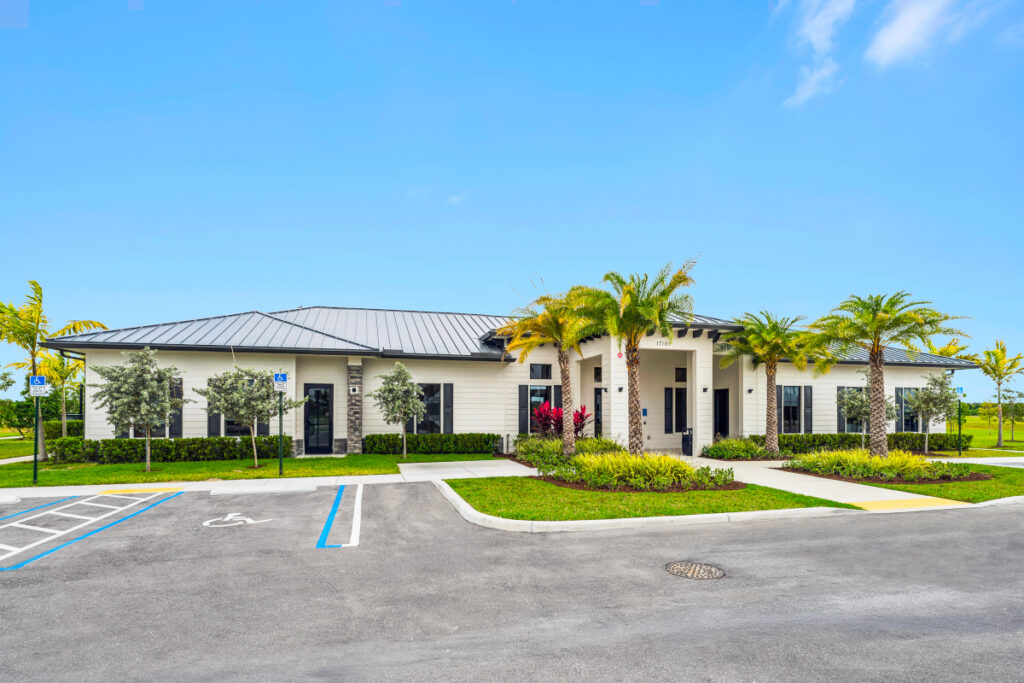
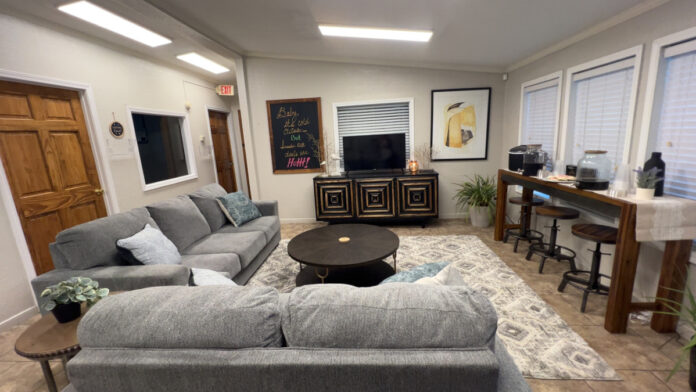
The new clubhouse at Cottage Grove, an all-ages community in Miami, Florida. Courtesy of RHP Properties.
Community Living
How many manufactured homes are there, and how many go to communities?
There are an estimated 4.3 million manufactured home sites in the United States. Approximately 30 percent of new manufactured homes are placed in a community. The U.S. has approximately 44,000 manufactured home communities. Approximately 18 percent of known communities in the U.S. were constructed prior to 1970. More than 60 percent were built during the 1970s and 1980s. About 5 percent of known communities have been built since 1991. Approximately 61 percent of known communities have an unknown, undocumented, or unclear construction date.
Communities by Size
About 29.7 percent of known communities are in a size category of 25 to 99 homesites. The next largest group is shared at 16.2 percent, with the communities that have one to 24 homesites and communities that have 100 to 299 homesites making up more than a third of the market. Three percent of the market is comprised of communities with between 300 and 499 homesites. About 1.1 percent has between 500 and 999 homesites. Only 0.2 percent of communities have 1,000 homesites or more. An estimated 33.5 percent of communities in the U.S. are listed as “unknown” size.
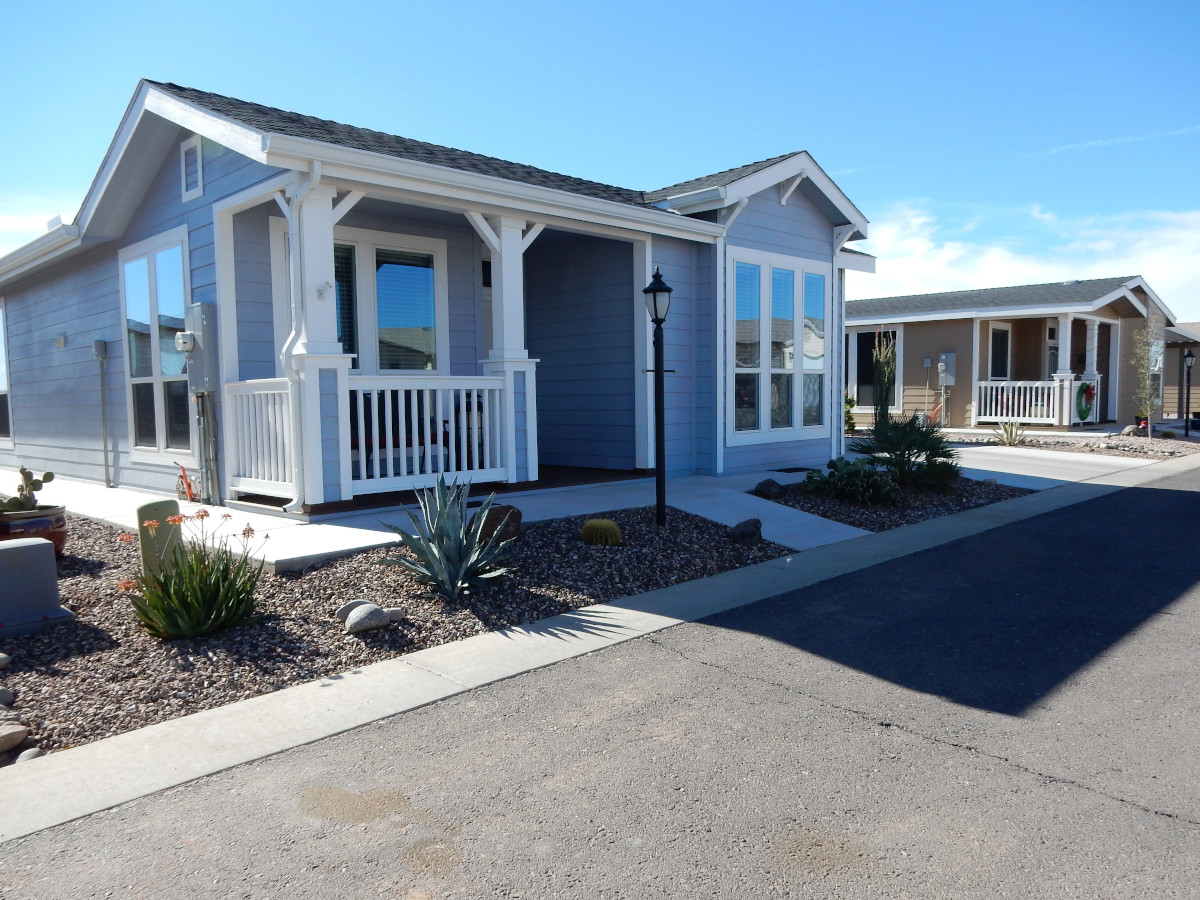
New manufactured homes at a land-lease community in Arizona.
How Many People Live in Manufactured and Mobile Homes?
MHInsider’s review of annual manufactured housing industry trends and statistics shows about 20 million people in the U.S. live in a manufactured or mobile home. Manufactured homes make up 9 percent of annual new home starts. About 70 percent of new manufactured homes are titled as real estate on private land.
Who Are the Residents, Where Are They?
Residents of manufactured home communities are split evenly between Boomers and those who are older, versus Generation X and those who are younger. Forty-seven percent of residents report being located in a suburban area, while 33.2 percent are in rural settings, and 19.2 percent are in urban settings.
Resident Satisfaction
How much do residents and owners of manufactured homes appreciate their purchasing decision?
A 2025 study reveals 78 percent of people are satisfied with their mobile or manufactured home, and 68.5 percent of those who live in a manufactured home in a land-lease community report they are satisfied with the decision. About 73 percent of respondents said they made the home and land-lease decision, intending it to be the place they stay. More than 70 percent said they intend to stay for more than six years, and the average resident stay is more than 10 years. About 86 percent of residents said they own or are buying their home. Seventy-two percent of respondents said they would recommend living in a manufactured home, 61.1 percent said they would recommend living in a manufactured home community, and 81.4 percent of buyers said they had a favorable impression of manufactured housing.
More than 65 percent of residents said their home value has increased or stayed the same since purchase.
Builders work on a new home at Cavco’s Durango facility in Phoenix.
Rent and Occupancy
The average site rent in a manufactured housing community in the U.S. in 2025 was $782, and the average for an all-ages community was $751 and $841 for 55+ communities. The occupancy rate in manufactured home communities in 2025 average 95 percent, 97 percent in 55+ communities, and 94 percent in all-ages communities. Site rent increased in 2025, averaging 6 percent, 6.1 percent in all-age communities, and 5.9 percent in 55+ communities. Occupancy increases in all communities averaged 0.3 percent, and 0.4 percent in all-ages communities, and 0.2 percent in 55+ communities.
The U.S. markets with the highest site rent are all in California, with all-ages rents highest on average in Orange County ($2,155), San Luis Obispo ($1,800), and Sonoma County ($1,681). Santa Cruz ($3,674), Sonoma ($2,000), and Ventura ($1,623) counties average the highest site rent for 55+ communities.
The markets with the lowest site rent for all-ages manufactured homes are in Lynchburg, Virginia ($232), Hendry-Okeechobee, Florida ($339), and Hidalgo, Texas ($379). The lowest average site rent for 55+ communities are in Lynchburg, Virginia ($246), Cincinnati ($312), and Madison, Wisconsin ($352).
Manufactured home communities with the highest average occupancy rates are all in California, all at or very near full capacity. The communities with the lowest average occupancy are in Bay County, Florida (66%), Genesee County, Michigan (69%), and Wichita, Kansas (77%) for all-ages communities. The lowest average occupancy rates in the U.S. for 55+ communities are in Gary, Indiana (47%), Gettysburg, Pennsylvania (67%), and Tyler, Texas (78%).
Markets with the greatest year-over-year increase in occupancy for all-ages communities were Gillette, Wyoming, Topeka, Kansas, and Indian River, Florida. Markets with the greatest year-over-year increase in occupancy for 55+ communities were in Des Moines, Iowa (6.9%), Allegan-Muskegon-Ottawa counties, Michigan (5.8%), and Brownsville, Texas (3.4%).
Manufactured Housing Production
How many manufactured homes were built during 2025?
The manufactured housing industry produced 102,738 housing units during 2025, a slight decrease from the year prior. The homes derived from 147 plants in 28 states. The economic impact of manufactured home production is felt throughout the economy. In 2025, the industry was responsible for 61,389 jobs paying out more than $3.3 billion in wages in factories, retailers, land preparation, transportation, and utility connections. The industry created about $12.7 billion in sales and contributed $6.3 billion to the U.S. gross domestic product.
Top Marketplaces with Home Listing Price Above Average
New Homes Listing Price Above Average
New single-section homes for sale at a manufactured home retail center in Tucson, Ariz.
What’s The State of the Manufactured Housing Industry?
MHlnsider updated its annual manufactured housing industry trends and statistics infographic, originally published in the May/June 2026 State of the Industry edition of MHInsider magazine. The following infographic includes data provided in summary earlier in the post and expands on information gathered from our surveys, including insight on rent and occupancy and average days on market.
2026 Manufactured Housing Industry Trends and Statistics Infographic
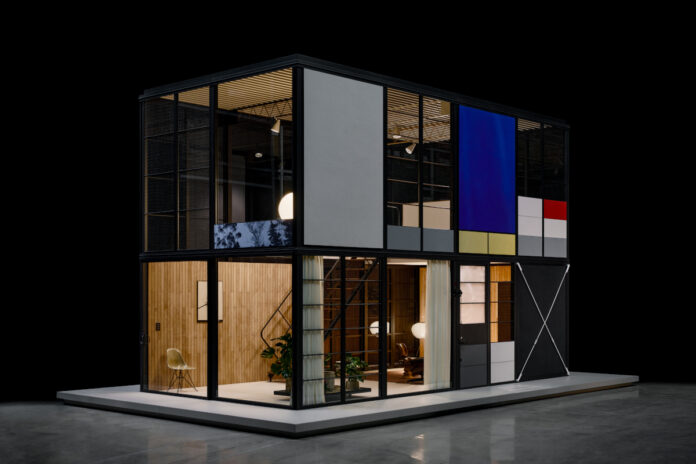
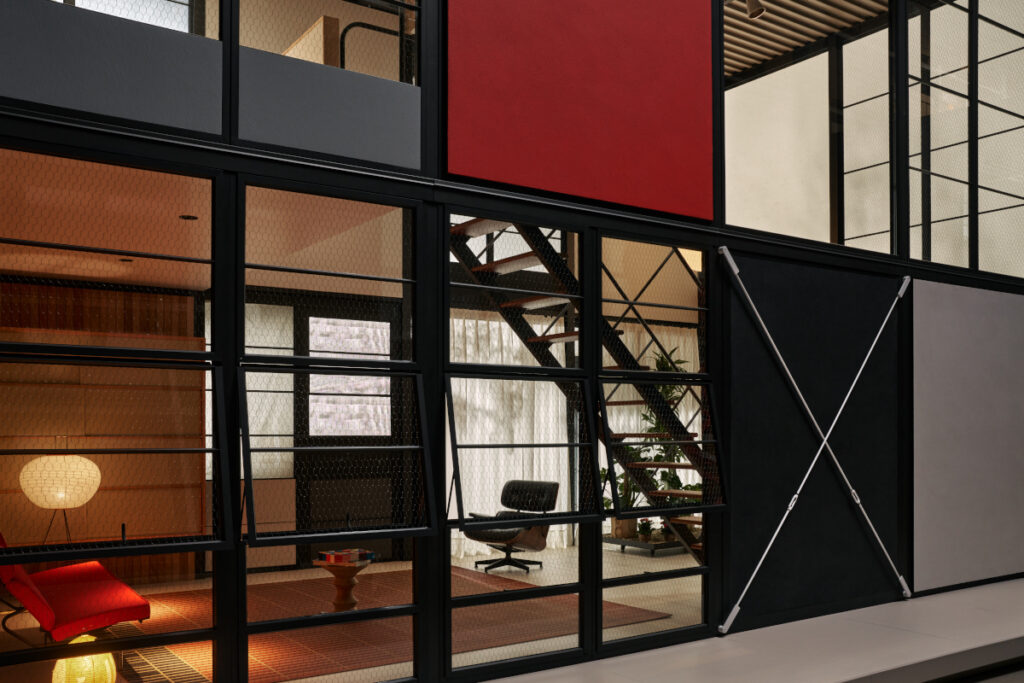
The two-story Eames Pavilion System, as debuted at Triennale Milano during Milan Design Week 2026.
Eames Vision for Factory-Made, Modular Living Hits the Market Following Debut in Milan
For decades, design enthusiasts have gazed at the glass-and-steel perfection of the Eames House in Pacific Palisades, California, and asked the same unanswerable question: Can I have one? The answer, for over 75 years, has been a polite but firm no. The house was a prototype, not a product. A demonstration, not a deliverable. Until now.
At Milan Design Week 2026, the Eames Office made the announcement that an entire generation of modernism lovers had quietly been waiting for. Unveiled at the Triennale Milano alongside an ambitious new exhibition, the Eames Pavilion System is the long-imagined transition of Charles and Ray Eames‘ prefabricated residential vision from archive to reality — a fully engineered, globally available modular construction system developed in partnership with Barcelona manufacturer Kettal.
It is not a replica. It is not a collector’s edition. It is, by the account of Eames Demetrios — grandson of Charles and Ray and current director of the Eames Office — something far more significant: the fulfillment of a design intent that was always meant to scale.
The popular imagination of Charles and Ray Eames tends to begin and end with furniture: the lounge chair and ottoman, the molded plastic shell chairs, the plywood work that defined a midcentury aesthetic still referenced in every design school on earth. But according to the curators and researchers behind this project, furniture was never the whole story.
Exhibition curator and author Eckart Maise spent nearly three years conducting an in-depth investigation of the Eames Office Archive, uncovering published and unpublished residential projects spanning the decade from 1945 to 1954. What emerged was, by his own account, a surprising revelation: architecture was not peripheral to Charles and Ray’s practice. It was central to it.
“Through rigorous, in-depth archival investigation, we uncovered a wealth of material — drawings, studies, and proposals — that had remained largely unseen,” Maise said. The research forms the backbone of both the new exhibition and an accompanying Phaidon publication, the first comprehensive sourcebook devoted solely to the Eameses’ residential architecture.
The source material for the Pavilion System draws on a constellation of projects beyond the famous Eames House (Case Study House No. 8), including Case Study House No. 9 (the Entenza House), two designs for director Billy Wilder, and a series of timber-frame experiments including the Shelter House and the De Pree House. Taken together, these projects reveal a consistent architectural grammar: a rational structural grid, maximum volume from a modest footprint, and a framework designed for flexibility rather than permanence.
From Prototype to Product
Translating that grammar into a contemporary product was not a simple matter of scaling up the blueprints. The Eames Office had long recognized the challenge. Since Ray Eames’ passing in 1988, the organization had been searching for a manufacturing partner capable of industrializing the prefab vision without sacrificing the spatial quality that made the original houses so remarkable.
The barriers were significant. Modernizing the prototypes required adapting proportions, joints, and materials to meet present-day regulatory standards. Components needed to be engineered for both outdoor and hybrid use, addressing complex technical requirements around sealing, UV resistance, and durability. And there was the fundamental tension of prefabrication itself: historically a local industry, constrained by geography and logistics, while the Eames legacy was emphatically global in its appeal.
Kettal, the family-owned Spanish manufacturer headquartered in Barcelona, emerged as the answer to all three challenges. Founded in 1966, the company has spent decades developing expertise in aluminum structures, modular architectural systems, and outdoor environments — precisely the technical vocabulary required to bring Eames-era prototypes into the twenty-first century.
“Going from prototype to product means standardization and industrialization… it is through this discipline that a system becomes more usable and the possibilities actually increase.”
— Kettal Creative Director Antonio Navarro
The result, after nearly three years of intensive research and development, is what Kettal Creative Director Antonio Navarro describes as a system that balances original intent with contemporary innovation — high-precision aluminum profiles, engineered decking, bioclimatic roofing, integrated lighting and HVAC, and digital configurators layered onto the Eameses’ foundational architectural logic.
“The goal is evolution, not stylistic reproduction,” Navarro said.
A Kit of Parts
The Eames Pavilion System is, at its heart, a disciplined modular kit. Repeatable structural modules combine with interchangeable roof types, facade infills, glazing options, textiles, and accessories to produce configurations ranging from a compact single-story pavilion of just 16 square meters up to a fully equipped two-story residence. Components are produced through factory-controlled processes at Kettal’s Barcelona facilities and finished on site — a balance between industrial precision and human craft that would have resonated deeply with the Eameses’ own manufacturing philosophy.
The structural palette speaks the language of the original houses: aluminum, glass, polycarbonate, and wood, assembled into single units, double modules, and multi-bay configurations. The system is designed explicitly for worldwide availability, and with repairability, longevity, and reconfigurability built into its core logic — a direct echo of Charles and Ray’s conviction that architecture should serve as a living backdrop for human experience rather than a fixed monument to a single moment in time.
The use cases are deliberately broad. Residential applications include studios, accessory dwelling units, vacation homes, garden pavilions, and poolside structures. The system also addresses hospitality and resort environments, workplace configurations, and retail or exhibition installations — an acknowledgment that the Eameses themselves never drew hard lines between domestic life and the spaces of culture and commerce.
The Exhibition
Running at the Triennale Milano from April 21 through May 10, 2026, the exhibition that accompanies the system’s launch is itself a substantial architectural event. Spread across 800 square meters, it places full-scale, walk-in Eames Pavilion installations alongside archival drawings, films, photographs, and newly commissioned scale models of eight Eames houses — several of which have never before been published or publicly exhibited.
The effect is to reframe the entirety of Charles and Ray’s practice, revealing architecture as a continuous thread running through their work in furniture, exhibitions, toys, photography, and film. The same systemic thinking that produced the lounge chair produced the Case Study Houses. The same belief in industrial production as a vehicle for human dignity informed both the molded plywood experiments and the steel-frame residential prototypes.
For those who cannot make it to Milan, Phaidon’s accompanying publication offers an extensive record of the research, running to 288 pages with approximately 1,000 images. Authored by Eckart Maise with contributions from Catherine Ince of the Charles & Ray Eames Foundation, and forewords by Norman Foster and Eames Demetrios, it constitutes the first dedicated sourcebook on the Eameses’ residential architecture and is available from May 2026.
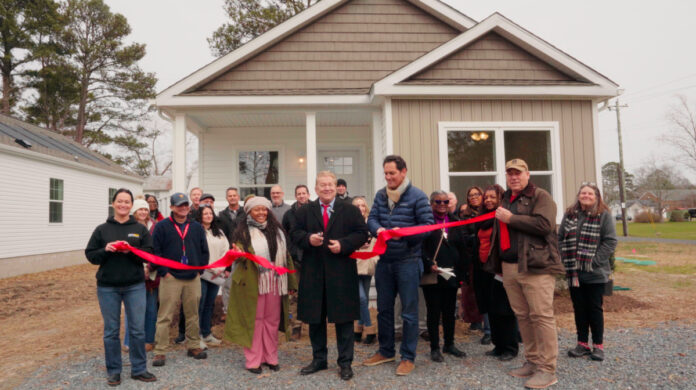
On Dec. 12, 2025, a grand opening was held in Parksley, Va., for the Innovation Cottages, an energy-efficient, off-site-built home project built in collaboration between Champion Homes and iUnit Communities.
Two newly unveiled cottages on Virginia’s eastern shore are offering a glimpse into how factory-built housing could play a larger role in meeting the nation’s growing demand for energy-efficient and attainable homes.
Champion Homes Inc., one of North America’s largest producers of factory-built housing, recently marked the opening of the Innovation Cottages, a pair of off-site-built homes designed to highlight the energy efficiency and design flexibility of modern manufactured and modular construction. The homes were developed in collaboration with iUnit Communities, a long-time partner focused on sustainable housing solutions.
Company leaders and local officials gathered in Parksley, Virginia in December for a ribbon-cutting ceremony and public open house, celebrating what they described as “a model for future residential development.”
“The Innovation Cottages are a marquee example of the incredible capacity of offsite-built homes to be an energy-efficient, leading-edge housing solution,” said Bryan Phelan, Champion Homes’ director of business development. “When forward-thinking collaborators put their heads together, amazing things happen.”
The project consists of two three-bedroom, two-bathroom homes, each built to different construction standards to demonstrate the range of offsite housing options available to communities and consumers.
One home is a 1,200-square-foot modular residence constructed to the International Residential Code at Champion’s manufacturing facility in Liverpool, Pennsylvania. The second is a 1,387-square-foot manufactured home built to the federal U.S. Department of Housing and Urban Development code at the company’s Claysburg, Pennsylvania, plant. Both homes are ENERGY STAR certified and feature custom floorplans designed by Champion.
The cottages include architectural elements commonly associated with site-built housing, including front porches and 7/12 roof pitches. Developers said those details were intentionally included to ensure the homes blend seamlessly with the surrounding neighborhood.
Local officials said the project aligns with Parksley’s interest in innovative housing approaches.
“I can’t tell you how excited the Town of Parksley is to be a part of this incredible endeavor,” Mayor Frank Russell said during the ceremony.
The homes were funded in part through the Virginia Housing Innovation Grant Program, which supports new approaches to housing affordability and services, particularly for low- and moderate-income households across the state. Representatives from Virginia Housing, Accomack County, and Champion Homes attended the event.
iUnit Communities plans to list the cottages for sale in early 2026 and use the project as an educational tool to help prospective buyers better understand the long-term cost savings and environmental benefits of energy-efficient construction.
“The Innovation Cottages help us continue to push the boundaries of what’s possible with offsite construction as we build energy-efficient housing,” said Brice Leconte, founder of iUnit Communities. “Champion has been a collaborator with iUnit in this journey for more than 10 years, and we appreciate their continued support of this joint mission.”
Advocates of factory-built housing say projects like the Innovation Cottages demonstrate how off-site construction can address multiple challenges facing the housing market, including affordability, labor shortages, and energy efficiency. Homes built in controlled factory environments can reduce material waste, improve construction consistency, and shorten build times, while advanced insulation systems and energy-efficient designs can lower monthly utility costs for homeowners.
Champion Homes operates 46 manufacturing facilities across the United States and western Canada and employs more than 9,000 people. Its portfolio includes manufactured and modular homes, accessory dwelling units, park models, and modular buildings serving single-family, multifamily, and hospitality markets. Beyond home production, the company also provides installation services, operates a factory-direct retail network with 82 locations nationwide, and runs Star Fleet Trucking, which transports manufactured housing and other freight across the country.
iUnit Communities focuses on developing sustainable neighborhoods that combine technology and environmentally conscious building practices, encouraging residents to make informed choices about energy use and daily living. Virginia Housing is a public-private partnership that supports housing affordability initiatives statewide through financing programs, grants, and partnerships with local governments and developers.
Health Care, Transportation Lead Hiring — Home Sales Flat Year-Over-Year
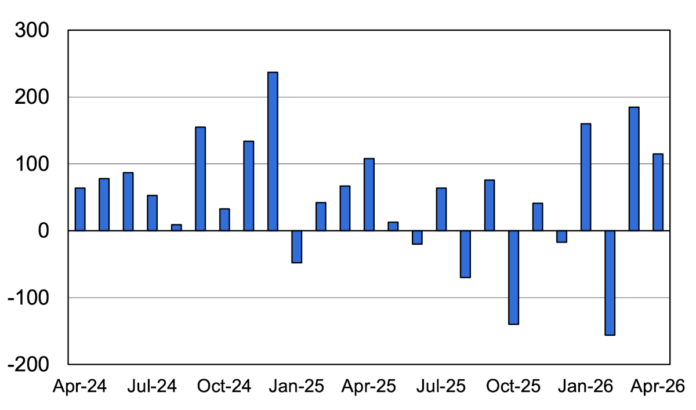
The U.S. economy added 115,000 jobs in April and the unemployment rate held steady at 4.3 percent, the Bureau of Labor Statistics reported — a result that blew past Wall Street expectations amid an uncertain economic backdrop.
Analysts anticipated a gain of 65,000 jobs, making April’s number notable. The report follows a revised March gain of 185,000, which was the strongest month in job gains since December 2024.
“I’m looking through the report trying to find problems, and it’s fairly bulletproof this month,” Allianz North American Senior Economist Dan North said. “The numbers overall aren’t impressive — they’re still pointing toward a softening job market, but certainly not a collapse.”
Areas of the Economy Producing Jobs
Health care led all sectors for the month, adding 37,000 jobs, roughly in line with its 12-month average of 32,000 per month. Most of those gains came from nursing and residential care facilities and home health care services.
Transportation and warehousing was the second-biggest contributor, adding 30,300 jobs. Couriers and messengers drove that gain, adding 37,900 positions — though the sector overall remains about 105,000 below its February 2025 peak.
Retail trade added 21,800 jobs, aided by warehouse clubs, supercenters, and other general merchandise retailers, along with building material and garden supply dealers.
Construction added 9,000 jobs in April, with nonresidential specialty trade contractors gaining 12,600 positions, partially offset by a decline in residential specialty trade contractors. Construction has shown little net change over the past year.
Unemployment Picture
The 4.3 percent jobless rate has remained above 4 percent since June 2024. The number of people working part-time for economic reasons — those who would prefer full-time work — jumped by 445,000 to 4.9 million in April, a figure that weighed on the broader “real” unemployment measure.
Long-term unemployment — those jobless 27 weeks or more — was essentially unchanged at 1.8 million, accounting for 25.3 percent of all unemployed people. The labor force participation rate edged down to 61.8 percent, and the employment-population ratio fell to 59.1 percent.
Wages Increase Slightly
Average hourly earnings for private-sector workers rose 6 cents, or 0.2 percent, to $37.41 in April. During the past 12 months, wages are up 3.6 percent — a smaller gain than the 3.8 percent annual pace economists had expected, and a sign that wage pressures may be easing.
Prior Month Revisions
The BLS revised February’s already-weak reading down by 23,000, bringing the total job loss for that month to 156,000 — far steeper than the initial reported decline of 92,000. March was revised up by 7,000 to 185,000. Combined, the two-month revision left employment 16,000 lower than previously reported.
Fed Implications
The April report lands at a complicated moment for the Federal Reserve, which has kept its benchmark interest rate on hold as policymakers weigh a labor market that is slowing but not collapsing against inflation that remains elevated. In March, consumer prices rose at an annual rate of 3.3 percent, driven largely by higher gasoline costs tied to conflict in the Middle East.
With the jobs market holding steady, the Fed is broadly expected to stay on the sidelines. The next employment report, covering May, is scheduled for release on June 5, 2026.
Recent Housing Statistics
New single-family home sales increased 7.4 percent in March to a 682,000 annual rate, beating the expected 652,000. Sales are up more than 3 percent from a year ago.
Sales in March rose in the Northeast and South but fell in the Midwest and West. Existing home sales increased 0.2 percent in April to a 4.02 million annual rate, lagging the consensus expected 4.05 million. Sales are flat year over year.
Your next buyer may have just driven by your retail center, without even noticing that you were there. How many times do we drive the same roads to work or home, and after a week or two we don’t even notice what we are driving by? Unless there is a new fence, signage, or a “Call to Action” we may just stop seeing what is right in front of us.
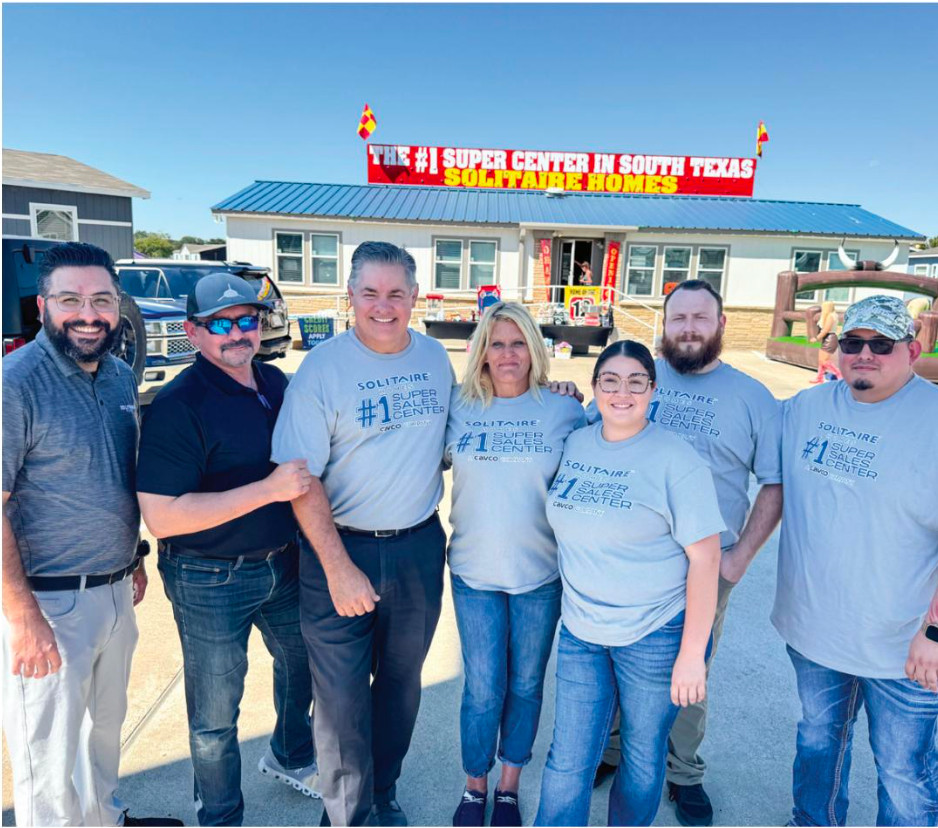
Solitaire Homes of Victoria, Texas has a great location on a busy road that is one of the main approaches to Victoria. Traffic had fallen off to the retail center, and as someone who was driving by it constantly, I stopped noticing it. When Bryan Rogers, a Regional Vice President for Cavco Homes asked if I was familiar with the center, it took me a while to remember where it was, because in the years I have driven by it, nothing much had changed.
The center had a new general manager that I had worked with in the past, and if anyone could breathe new life into this retail center, Stephanie White was the person to do it. She has an excellent reputation in the community, and is active in a lot of the non-profit organizations nearby. So when she asked for their help, they were more than happy to be a part of this retail center renewal. Stephanie is always the first to arrive, and the last to leave, and truly leads by example.
The first thing that she did was move the houses around, so they were easier to see from the street. By using a horseshoe type staging of the homes, they could then be seen (and noticed) from every direction as people drove by. She also added lighting in the homes, inside and out. Now on those dark winter days, the homes shine like beacons, and it makes you pay attention to them.
Signage at the center was faded, and there was minimal landscaping. It made the homes look temporary.
Steps looked like something that you would be afraid to use. In the first few weeks new signage was ordered, steps were built to order for each home, all homes were skirted, and HVAC units were added to the main homes. People started stopping Stephanie at the grocery store to ask what was happening, and cars started driving into the center to see what all of the excitement was about.
Stephanie also added landscaping around the homes, some as simple as potted plants that added a feeling of belonging to the homes. Seasonal decors were added to the exteriors, and a Halloween photo opportunity was put in the front that anyone was welcome to use. Stephanie decided to have a grand re-opening of the retail center, and even though her budget was tight, she pulled in favors from the community members and the trades to make it something special.
Model home furniture was pulled out of storage to reset the sales office, new model home staging was ordered, and everyone picked up a paint brush to freshen up the fences, and give this retail center a facelift.
And it worked. The City of Victoria ambassador came to have the honor of doing the ribbon cutting, the local Antique Car Club brought their cars, and their members. There was a DJ, and even live entertainment. My favorite feature, though, was the bull riding — perfect for this market, and everyone wanted to take a spin (including this Lifestylist!). There were lots of foods, giveaways that vendors provided, and sales associates were clearly identified by their special T-shirts so they could give visitors tours of the homes.
New Perspective, New Sales
The retail center was able to offer special pricing on older stock models, which made space for fresh, new model homes. Things were finally starting to happen here. The excitement continued when Stephanie offered to have an Angel Tree at Christmas, and people stopped by to pick up their own angel, and to tour the homes. This was a great way to give back, and Stephanie hopes to incorporate a similar program in the homes that will be all year long. Here are five easy ways that you can keep your retail center fresh and a magnet for new visitors, and new sales.
Change is Great!
Your next sale may have been driving past your retail center for years, but stopped noticing it when it always looked the same. Create a goal to change something monthly to the front of your center. Fresh new banners, new lighting, seasonal decorating will all get people’s attention as they are driving buy, and hopefully motivate them to stop and see what’s new.
Host a Grand Re-Opening
People love a party, and if traffic has been slow, think about hosting a “Grand Re-Opening” to rebuild the excitement. Think about doing this when you have new homes coming in, or you have a sale on older models. It will help you create excitement, and let people know that great things are happening at your retail center.
Seasonalize Your Homes
Collect decor items off-season at craft stores or estate sales that you can use to seasonalize your sales office and model homes. It will add that extra festive touch to the experience that buyers (and their kids!) will appreciate. Be sure to have Easter candy out for Easter, and Valentine’s cards that you can offer to send for them for Valentine’s Day. Have Christmas trees like Stephanie did, in your office or homes, that highlight local non-profits that can use a little help.
Community Outreach
Being involved with the local community is always the best way to connect with potential buyers. Offer to let your local sports teams or 4H Club have a car wash at your retail center — the parents will really appreciate your support, and will be happy to send potential buyers your way as a thank you.
Merchandise from the Outside In
A lot of retail centers focus on the interiors of their homes, but overlook the areas of our homes that tend to look the most basic; the exteriors. Design wreaths for each home that reflect the decor in the home. A woodlands home can have a wreath with ferns, a garden home can have a wreath of Spring flowers. If the home has a porch, stage it with a table and chairs, or a glider. It will add personality and charm to your home.
Legacy Housing Corporation has acquired the assets of AmeriCasa Solutions, LLC and its proprietary sales management platform, FutureHomeX®.
The company also has appointed AmeriCasa CEO Norman Newton as Legacy Housing’s new chief revenue officer.
Legacy Housing is among the nation’s largest producers of manufactured homes, distributing homes through a network of more than 100 independent retailers and 12 company-owned stores, as well as directly to manufactured housing communities.
A press release on the acquisition states that Legacy is implementing a strategic shift to accelerate revenue growth. The three-pronged approach includes:
Expanding the number of its company-owned retail locations
Increasing sales volume through company-owned stores and affiliates by leveraging advanced technology and sales support
Adding a chief revenue officer to its leadership team
Legacy Acquisition of AmeriCasa All-Cash Transaction
The technology component, FutureHomeX®, is expected to “enhance the homebuying experience and drive sales growth across retail dealerships and communities through a more systematic, consistent, and automated process,” according to the release.
Also included in the deal are a high-performing retail dealership in Houston, a chattel mortgage loan portfolio, an insurance agency, and a services center located in Bogotá, Colombia.
Newton joins Legacy under a five-year employment agreement. He has more than 30 years of senior executive experience in both public and private companies across domestic and international markets. He is the founder of Newton Vision Corp, LLC, a private investment and professional services firm based in Austin, Texas. He holds a degree in finance from the University of Texas at Austin.
AmeriCasa is based in Austin and was founded in 2016.
Legacy Housing, based in Bedford, Texas, and AmeriCasa Solutions have a longstanding relationship. Most recently, Legacy Housing engaged FutureHomeX® to accelerate sales at company-owned retail locations. Concurrently, AmeriCasa Solutions was seeking a strategic partner to scale the FutureHomeX® Platform across the manufactured housing industry.
“We’ve spent years developing and refining the FutureHomeX® Platform, and we were looking for the right partner to scale its deployment and impact,” Newton said. “Legacy Housing’s extensive network of affiliate retailers, park operators, and company-owned stores provides the ideal environment for growth. We’re thrilled to be joining the Legacy Housing team.
“Our vision was simple: build a technology platform — centered on artificial intelligence and automation — that transforms the manufactured home buying experience across retail dealerships, communities, and factory-direct channels,” he said. “Legacy accelerates the execution of that vision.”
Legacy Housing co-founder and board member Curt Hodgson said the company has known the AmeriCasa Solutions team for years and has consistently been impressed with their innovation and execution.
“Acquiring AmeriCasa Solutions and FutureHomeX®, and bringing Norman onto our management team, is a natural and strategic fit for us,” Hodgson said.
Oct. 6-8 at Avalon Hotel in Alpharetta, Ga.
Manufactured housing community owners have never had more information available to them — or more decisions to...
The Midwest Manufactured Housing Federation has announced that attendee registration is now open for the 2027 Louisville Manufactured Housing Show, returning to the Kentucky...
HUD’s Innovative Housing Showcase, MHI’s Homes on the Hill and Annual Meeting Begin Sept. 22
Two of the country’s largest builders of manufactured homes will...