Eames Vision for Factory-Made, Modular Living Hits the Market Following Debut in Milan
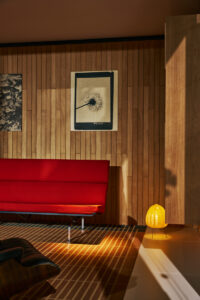
For decades, design enthusiasts have gazed at the glass-and-steel perfection of the Eames House in Pacific Palisades, California, and asked the same unanswerable question: Can I have one? The answer, for over 75 years, has been a polite but firm no. The house was a prototype, not a product. A demonstration, not a deliverable. Until now.
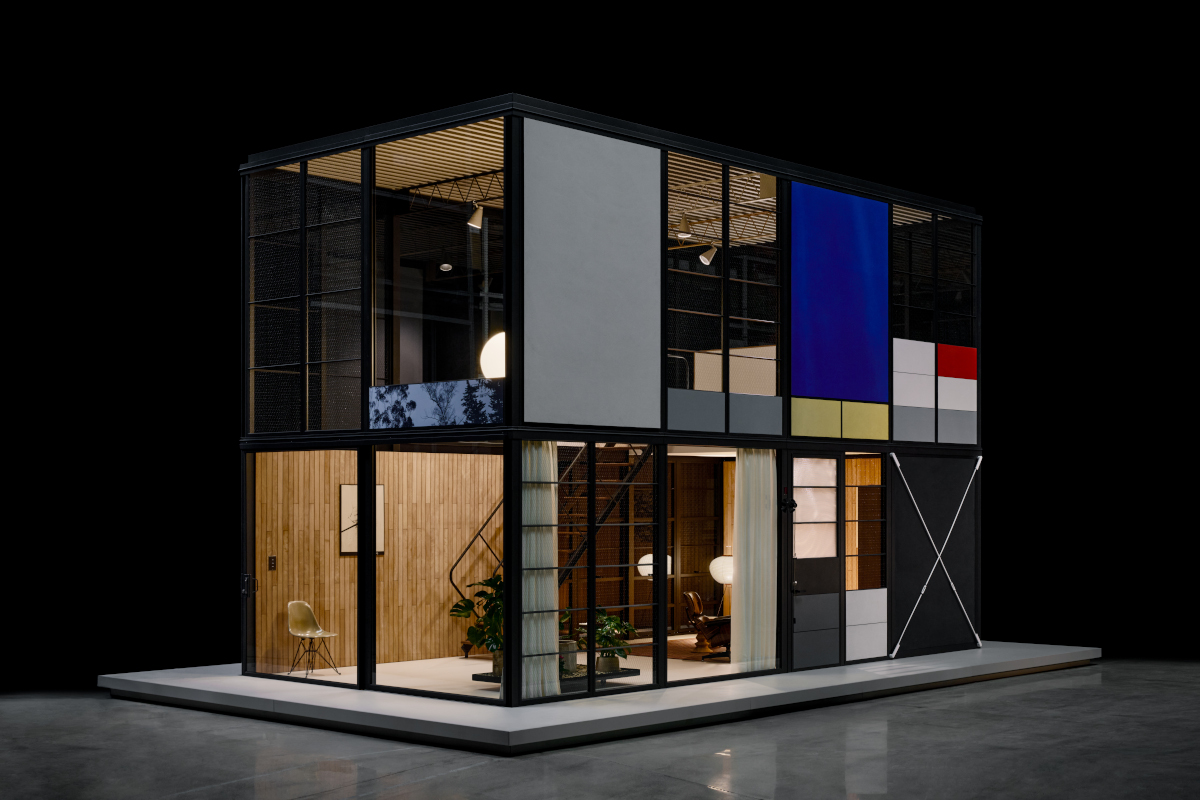
At Milan Design Week 2026, the Eames Office made the announcement that an entire generation of modernism lovers had quietly been waiting for. Unveiled at the Triennale Milano alongside an ambitious new exhibition, the Eames Pavilion System is the long-imagined transition of Charles and Ray Eames‘ prefabricated residential vision from archive to reality — a fully engineered, globally available modular construction system developed in partnership with Barcelona manufacturer Kettal.
It is not a replica. It is not a collector’s edition. It is, by the account of Eames Demetrios — grandson of Charles and Ray and current director of the Eames Office — something far more significant: the fulfillment of a design intent that was always meant to scale.
The popular imagination of Charles and Ray Eames tends to begin and end with furniture: the lounge chair and ottoman, the molded plastic shell chairs, the plywood work that defined a midcentury aesthetic still referenced in every design school on earth. But according to the curators and researchers behind this project, furniture was never the whole story.
Exhibition curator and author Eckart Maise spent nearly three years conducting an in-depth investigation of the Eames Office Archive, uncovering published and unpublished residential projects spanning the decade from 1945 to 1954. What emerged was, by his own account, a surprising revelation: architecture was not peripheral to Charles and Ray’s practice. It was central to it.
“Through rigorous, in-depth archival investigation, we uncovered a wealth of material — drawings, studies, and proposals — that had remained largely unseen,” Maise said. The research forms the backbone of both the new exhibition and an accompanying Phaidon publication, the first comprehensive sourcebook devoted solely to the Eameses’ residential architecture.
The source material for the Pavilion System draws on a constellation of projects beyond the famous Eames House (Case Study House No. 8), including Case Study House No. 9 (the Entenza House), two designs for director Billy Wilder, and a series of timber-frame experiments including the Shelter House and the De Pree House. Taken together, these projects reveal a consistent architectural grammar: a rational structural grid, maximum volume from a modest footprint, and a framework designed for flexibility rather than permanence.
From Prototype to Product
Translating that grammar into a contemporary product was not a simple matter of scaling up the blueprints. The Eames Office had long recognized the challenge. Since Ray Eames’ passing in 1988, the organization had been searching for a manufacturing partner capable of industrializing the prefab vision without sacrificing the spatial quality that made the original houses so remarkable.
The barriers were significant. Modernizing the prototypes required adapting proportions, joints, and materials to meet present-day regulatory standards. Components needed to be engineered for both outdoor and hybrid use, addressing complex technical requirements around sealing, UV resistance, and durability. And there was the fundamental tension of prefabrication itself: historically a local industry, constrained by geography and logistics, while the Eames legacy was emphatically global in its appeal.
Kettal, the family-owned Spanish manufacturer headquartered in Barcelona, emerged as the answer to all three challenges. Founded in 1966, the company has spent decades developing expertise in aluminum structures, modular architectural systems, and outdoor environments — precisely the technical vocabulary required to bring Eames-era prototypes into the twenty-first century.
“Going from prototype to product means standardization and industrialization… it is through this discipline that a system becomes more usable and the possibilities actually increase.”
— Kettal Creative Director Antonio Navarro
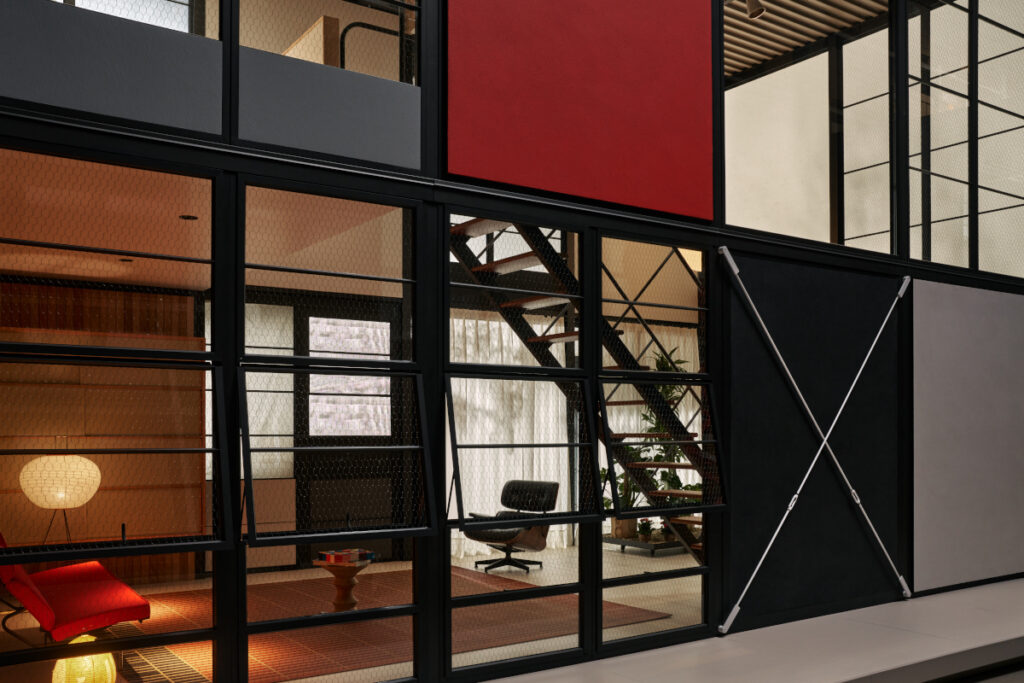
The result, after nearly three years of intensive research and development, is what Kettal Creative Director Antonio Navarro describes as a system that balances original intent with contemporary innovation — high-precision aluminum profiles, engineered decking, bioclimatic roofing, integrated lighting and HVAC, and digital configurators layered onto the Eameses’ foundational architectural logic.
“The goal is evolution, not stylistic reproduction,” Navarro said.
A Kit of Parts
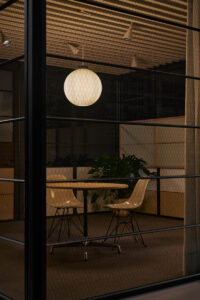
The Eames Pavilion System is, at its heart, a disciplined modular kit. Repeatable structural modules combine with interchangeable roof types, facade infills, glazing options, textiles, and accessories to produce configurations ranging from a compact single-story pavilion of just 16 square meters up to a fully equipped two-story residence. Components are produced through factory-controlled processes at Kettal’s Barcelona facilities and finished on site — a balance between industrial precision and human craft that would have resonated deeply with the Eameses’ own manufacturing philosophy.
The structural palette speaks the language of the original houses: aluminum, glass, polycarbonate, and wood, assembled into single units, double modules, and multi-bay configurations. The system is designed explicitly for worldwide availability, and with repairability, longevity, and reconfigurability built into its core logic — a direct echo of Charles and Ray’s conviction that architecture should serve as a living backdrop for human experience rather than a fixed monument to a single moment in time.
The use cases are deliberately broad. Residential applications include studios, accessory dwelling units, vacation homes, garden pavilions, and poolside structures. The system also addresses hospitality and resort environments, workplace configurations, and retail or exhibition installations — an acknowledgment that the Eameses themselves never drew hard lines between domestic life and the spaces of culture and commerce.
The Exhibition
Running at the Triennale Milano from April 21 through May 10, 2026, the exhibition that accompanies the system’s launch is itself a substantial architectural event. Spread across 800 square meters, it places full-scale, walk-in Eames Pavilion installations alongside archival drawings, films, photographs, and newly commissioned scale models of eight Eames houses — several of which have never before been published or publicly exhibited.
The effect is to reframe the entirety of Charles and Ray’s practice, revealing architecture as a continuous thread running through their work in furniture, exhibitions, toys, photography, and film. The same systemic thinking that produced the lounge chair produced the Case Study Houses. The same belief in industrial production as a vehicle for human dignity informed both the molded plywood experiments and the steel-frame residential prototypes.
For those who cannot make it to Milan, Phaidon’s accompanying publication offers an extensive record of the research, running to 288 pages with approximately 1,000 images. Authored by Eckart Maise with contributions from Catherine Ince of the Charles & Ray Eames Foundation, and forewords by Norman Foster and Eames Demetrios, it constitutes the first dedicated sourcebook on the Eameses’ residential architecture and is available from May 2026.
MHInsider is the leader in manufactured housing news and is a product of MHVillage, the top marketplace for manufactured housing.