JLT Market Reports from Datacomp with updated information on rent and occupancy trends for manufactured home communities in Maryland, New Hampshire, and New York are available for order, including immediate download today.
JLT Market Reports provide detailed research and vital information on communities in 183 major housing markets throughout the United States. Along with the latest rent trends and occupancy statistics, the manufactured home community market reports include information on home types, amenities, community infrastructure, as well as management insight.
Datacomp is the nation’s top provider of manufactured housing data. JLT Market Reports are recognized as the industry standard for manufactured housing community market analysis.
March 2020 JLT manufactured housing market data includes information on 192 “All ages” and “55+” manufactured home communities in Maryland, New Hampshire, and New York.
Altogether, the reports include data representations for 35,661 homesites, including a new report for Orange and Ulster counties in New York.
State-by-State Trends from March 2020 JLT Rent & Occupancy Market Reports
Maryland adjusted rent for all-ages communities increased by 3.6% year-over-year
Occupancy in those communities from year-to-year rose to 99%
New Hampshire adjusted rent for 55+ communities increased by 2% year-over-year
Occupancy in those communities from year-to-year rose slightly by four homesites
New York adjusted rent for all-ages communities increased by 3% year-over-year
Occupancy in those communities from year-to-year rose slightly by eight homesites
“Among the manufactured home communities in the northeast region of the country published in our March reports, state-to-state trends for adjusted rent continue as we’ve seen them at about 3%,” Datacomp Co-President and Chief Business Development Officer Darren Krolewski said. “Additionally, most markets within the three-state report were stable with only a few down-trending in occupancy, most notably among 55+ communities.”
More About JLT Market Reports
Each JLT manufactured home community rent and occupancy report from Datacomp has detailed information about investment-grade communities in the major markets. The detailed information includes:
Number of homesites
Occupancy rates
Average community rents, and increases
Community amenities
Vacant lots
Repossessed and inventory homes, and much more
JLT Market Reports also include management insights that rank communities by the number of homesites, occupancy rates and highest to lowest rents. Established reports show trends in each market with a comparison of March 2020 rents and occupancy rates to March 2019, as well as a historical recap of rents and occupancy from 1996 to present date in most markets.
The March 2020 Maryland, New Hampshire, and New York JLT Reports for manufactured home communities are available for purchase and immediate download online at the Datacomp JLT Market Report website, or they may be ordered by phone in electronic or printed editions at (800) 588-5426.
Each fully updated report for mobile home communities is a comprehensive look at investment-grade properties within a market, enabling owners and managers, lenders, appraisers, brokers, and other organizations to effectively benchmark those communities and make informed business decisions.
Over the past five years, the manufactured housing industry has been one of the hottest multi-family housing investments. An influx of community investors/owners has caused consolidation among operators in the country while increasing their market share. In 2015, the largest 50 operators owned and managed 500,000 sites while, in 2018, the largest 50 operators owned and managed 700,000 sites.
Times have changed.
I’ve seen this industry’s evolution firsthand from the vantage of virtually every job in the business. Today, as president of Blank Family Communities, a third-party property management company based in Michigan, and over a career that dates back 15 years. My family successfully owned and operated Franklin Communities for 35 years before selling their 2,500 site Michigan portfolio in August of 2018.
‘Boots on the Ground’
Steven Blank walks a property in Michigan.
I was taught and learned a “boots on the ground” approach to operating, and that it takes industry knowledge, people skills, accountability and follow-up to be profitable in the near- and long term.
I have operated with three of the top 10 largest operators in the country and have consulted, acquired and/or sold with another 50 operators. I have seen the good, the bad, and the ugly.
With industry consolidation comes new players with new ideas. After attending the Michigan Manufactured Housing Association (MMHA) expo in Novi, Mich., and speaking to several longstanding operators, I realized that there is a disconnect between new and traditional operators’ views on how to be successful.
At the same time, our industry is being moved forward by state and national associations that have everyone’s best interests at heart. That’s a very good thing as the fights we are all are facing need to be faced together.
I have operated and seen methodologies, strategies and approaches to our industry on both sides of the old-new equation and I firmly believe that bridging the gap between the two needs to occur.
The Old Way
Ronald and Steven Blank talk details of the property during a visit to a manufactured home community.
How many times have you heard, “There’s no need to reinvent the wheel?” That comment is a long-time staple of our industry, which has had relatively the same business model for the past 50 years: Having a community that is filled with resident-owned homes and residents who pay monthly site rents in exchange for community maintenance, and operating the land on which the home sites reside. The maintenance on the land traditionally is low compared to the revenue that is brought in, so the community, if well if occupied, is a great investment and source of cash flow.
This scenario is becoming less and less common as it is no longer easy to sell manufactured homes, post-recession. Moreover, many MH loans, in the Midwest and other major pockets across the country, require community owner recourse. The recession also created the need for communities to pivot their business model to also include rental homes. The impact of this business model shift cannot be understated.
It changed the landscape of the industry.
In the past, bringing in and selling a new home was simple. There was little liability to the community owner. With recourse loans and rental homes, the community owner is never free of liability as they have a financial stake in the success and/or failure of the residents.
The days of passively collecting rent from manufactured home communities at scale are over – unless you already have a stabilized portfolio.
This shift has made the refined operation of communities much more critical and labor-intensive. The result is that there are a dramatically reduced number of communities that can be operated efficiently with a passive management style.
Today’s Value-Add Approach
Value-add is the most common buzz word I hear in the industry today. I believe the term has lost some of its merit. Because manufactured housing communities lost occupancy and revenues during the recession, many communities currently being purchased still have vacancies, deferred maintenance needs and in some cases are below market rent. Ideally, when purchasing such a community, an operator will infill the community with new homes, sell some and rent the rest. They will revitalize the community by completing deferred maintenance, and, once value is added and the resident base is happy, the rents are raised, sometimes incrementally, to market value. In this situation, you now have a stabilized asset that will yield positive cash flow – if the operating system can sustain the new changes.
Focus on the the Operation
The biggest difference between the new companies and the traditional players is their operating structure and the stability of their portfolios – meaning, many communities acquired and owned by traditional operators paid significantly less aggressive capitalization rates. New players need to be more efficient with their value-add and operations, as the profit margins on communities purchased today will be lower due to the high capitalization rates that have become the norm.
Along with acquisition advantages, old school operators documented operating systems and continually trained and supported corporate and field staff, all of whom contributed to these companies enjoying sub 5% delinquency and high occupancy numbers. Newer companies, on the other hand, focus far too much on the acquisition and not enough on the operation. That’s simply not a great recipe for long-term success.
As an industry, we are facing more attention and scrutiny than ever. As such, it is important that all of us make sure that we are operating our communities profitably and efficiently while providing value to our residents. That way, we can remain the most viable form of affordable housing in America and continue to gain popularity across wider demographics.
HUD Secretary Ben Carson will speak at MHI's annual Congress & Expo in April.
U.S. Housing and Urban Development Secretary Ben Carson to Keynote April 8 in Las Vegas
For the third consecutive year, U.S. Housing and Urban Development Secretary Ben Carson will be the keynote speaker at the annual Congress and Expo organized by the Manufactured Housing Institute.
Carson, an outspoken proponent of manufactured housing since taking the cabinet leadership position three years ago, will make his remarks at MGM Grand at 9:45 a.m. on April 8, MHI announced.
“We’re extremely honored that Secretary Carson will be joining us for a third consecutive Congress and Expo. It’s been very exciting to see the progress HUD has made toward reducing regulatory barriers and elevating manufactured housing within the department under his administration,” MHI CEO Lesli Gooch said. “Secretary Carson has been a champion for our industry and has demonstrated a commitment to supporting initiatives that create more affordable housing.
“Whether he’s touring the country visiting manufacturing facilities on a bus or joining us for Congress and Expo, Secretary Carson has taken every opportunity to interact with and better understand our industry,” Gooch said. “We appreciate his efforts, involvement, and recognition of the potential solution manufactured housing presents to creating more quality, affordable housing opportunities across the country.”
More Information on HUD Secretary Ben Carson
HUD Secretary Ben Carson.
Carson is the 17th HUD Secretary with his swearing-in on March 2, 2017. For nearly 30 years, Carson served as director of pediatric neurosurgery at the Johns Hopkins Children’s Center, a position he assumed when he was 33 years old.
He has received dozens of honors and awards in recognition of his achievements including the Presidential Medal of Freedom, the nation’s highest civilian honor. He also is a recipient of the Spingarn Medal, the highest honor bestowed by the NAACP.
The Manufactured Housing Institute works to create an increasingly cooperative and productive regulatory environment for manufactured housing, working closely with Carson, HUD and other agencies and offices in Washington.
The 2020 Congress & Expo runs April 6-8 and is open for attendance by manufactured and modular housing professionals.
‘YIMBY Act’, ‘Small Dollar Mortgages’ Support Move to Senate
The U.S. House of Representatives on March 2 voted unanimously to pass the “Yes In My Backyard Act,” as well the “Improving FHA Support for Small Dollar Mortgages Act of 2020”.
The Manufactured Housing Institute has worked side-by-side with a non-partisan group of lawmakers as well as nearly 20 affordable housing advocacy and consumer protection organizations to urge action on the affordable housing bills.
“The YIMBY Act is bipartisan legislation, introduced by Reps. Heck (D-WA), Hollingsworth (R-IN), Clay (D-MO), Foxx (R-NC), Quigley (D-IL), and Herrera Beutler (R-WA), that is intended to eliminate local land use policies preventing the development of affordable housing,” MHI stated in a housing alert distributed the day following the vote.
H.R. Bill 4351 calls for “allowing manufactured homes in areas zoned primarily for single-family residential homes”. The YIMBY Act creates a reporting requirement under the existing Consolidated Plan Reporting that would require localities that receive Community Development Block Grant (CDBG) funds to report the extent to which they are implementing specific pro-affordability and anti-discriminatory housing policies.
‘Small Dollar Mortgages’
H.R. 5931, the “Improving FHA Support for Small Dollar Mortgages Act of 2020” requires the Federal Housing Administration to review its policies and identify barriers to supporting mortgages under $70,000, as well as report to Congress within a year regarding a removal plan for any barriers.
During Committee discussion, Rep. Al Lawson, D—Fla., requested clarification that the legislation also would be applicable to manufactured home loans. Rep. William Lacy Clay, D—Mo., who authored the bill, confirmed that manufactured home loans would be included in the review. Rep. Steve Stivers, R—Ohio, added that the legislation would be a positive step forward for manufactured housing financing.
Who would have ever thought five years ago that manufacturers would be able to affordably offer ceramic tile, stainless steel farm sinks, and large, walk-in showers in their homes?
It’s increasingly common for manufactured home professionals to have a photo album on their phones of amazing homes they’ve seen, or been a part of bringing to market. My regular rounds provide a nice album of merchandised interiors for Clayton Homes. A sweep through five or six images can change even the most jaded opinions of our homes.
Why Not Find A Way?
Patriot Homes had heard about my work from some of the leading site builders and invited me to work on their homes. As an introduction, the plan was to attend The Tunica Show and walk every home, come back with suggestions on products that could aid the designs. The purchasing agent at the time had other plans. The reason?
Because “We don’t do things that way in our industry”. The plan came together after getting to know each other, and with some give and take on both sides, we provided some innovative but still cost-effective looks for consumers who are influenced by HGTV and the home decor magazines. Add to that, our project gained the attention of Home Depot, which designed some product lines just for us.
The Louisville Show
The Louisville Manufactured Housing Show.
Among the greatest places to get inspired is the professional seminars at manufactured housing trade shows. It’s a great place to hear the valuable success stories, and to learn from some great experiences.
Last year it was a real treat to speak at the Louisville Show and to see the evidence of how far we have come as an industry.
Typically at shows we get to see the best of the best, but it’s an industry show and not a consumer show. So, how do we share who we are now? How do we share with potential customers who think we are still the mobile home of the 1970s?
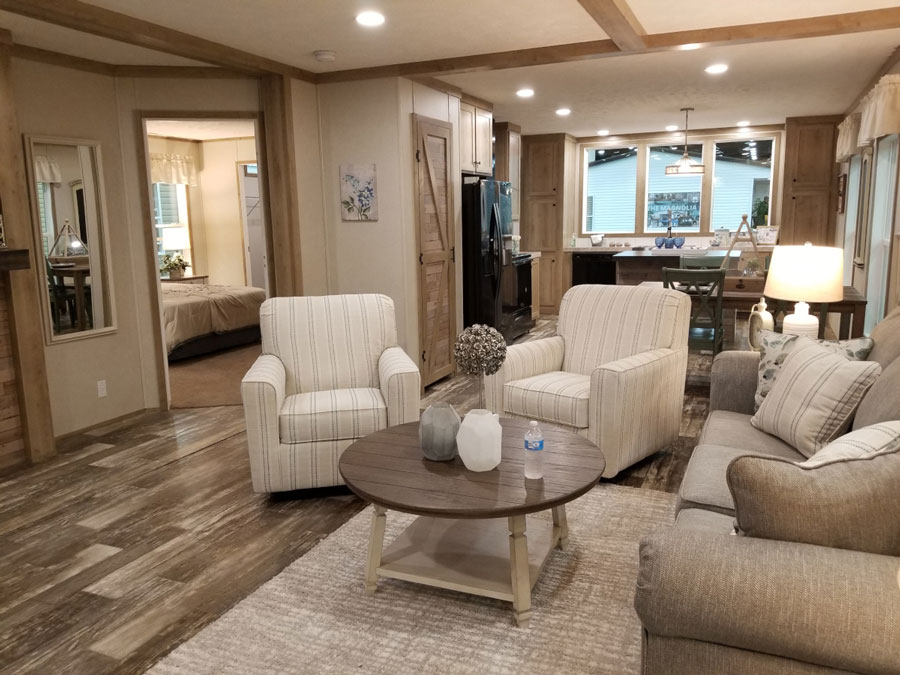
More than 90% of consumers now start their home search online, and if homes aren’t professionally staged and photographed, it will be harder to convince that consumer to come to see the place in person. Many of the major manufacturers provide photography to help you sell homes. But what if the customer falls in love with the home they see online ad? If they come to your community or retail center and see something with no skirting, dated furniture, and no electrical power, they are going to feel deceived. So for practicality, and for progressive business practices, we are tasked with creating masterfully staged home that can be photographed and made availabe for tours.
But Why Luxury Brands?
You would think spending time researching luxury brands and how they do business would be a waste of time, but that couldn’t be further from the truth.
Many of the trends and products that consumers want start at the luxury side of the business, then filter down to affordable design. Progressive manufactured home builders have recognized this. You’ll see some of their team members walking shows like the International Builders Show, The Kitchen and Bath Show and the High Point Furniture Market. They are learning about new trends that connect with consumers now – many at price points way above what our customers expect to spend. But they take these ideas home.
They do some research on how to get this look for less, then incorporate it into their homes.
Something that many luxury brands are good at is listening. They don’t tell their customers “we can’t do that,” they say let’s figure out how we can make your dreams come true.
Luxury wine and lifestyle brand The Boisset Collection traveled to cities coast to coast and hosted “The Alchemy Series”. Photo courtesy of Lisa Stewart Photography.
The Fruit That Makes The Wine
Jean-Charles Boisset is the perfect example of this. When he was 11 years old his schoolteacher grandparents brought him on vacation to the United States from France, and as someone who grew up in wine country, he fell in love with Napa Valley – especially the Buena Vista Winery. He said right then that someday he was going to own that winery. After coming back to the U.S. for college, he did buy it and restored it to its original grandeur. The Boisset Collection is now 27 wineries in the U.S. and France and has expanded into a luxury lifestyle brand. After listening to his customers, he discovered their frustrations with buying at home the wines they discovered when they traveled, and how many stores wouldn’t even try to help them get what they wanted. They tried to sell the customer something else.
Sound familiar?
If you think our industry has a lot of rules and regulations, you should research the wine and spirits world!
But, not one to take no for an answer, Boisset kept asking questions, kept researching, and discovered a way to sell directly to consumers through “ambassadors”. These were and are friends and neighbors in the community who could assist on wine journeys and get the best value for customer tastes. Customers can go online and buy wine from the wineries and it’s delivered right to their home, cutting out the middle man, and also making sure that the wine has been stored correctly. A brilliant move for everyone, but few people are as brave as Boisset. He alone completely changed an industry.
The Value of Listening
Think about what listening more to our customers could do for our industry as well.
LG Appliances is one of the most highly respected appliance and electronics companies in the world. Based in Korea, the company understood other markets but were having trouble understanding, and selling to the luxury buyer in the U.S. Wisely, they hired a well-known and respected leader in the luxury appliance world here, and started Signature Kitchen Suite. One of the first things they did was to build and open their Experience and Design Center in Napa. When asked why Napa, the answer was that “it’s the destination for the culinary world and close to Silicon Valley, the hub for the tech world.” Since they build smart technology appliances for their Technicurean® customers (a word they came up with and trademarked), the location made sense. They design appliances that have never would have been available in the consumer market. And now LG is the company that keeps the pace for others trying to reach those heights. Customers are invited to the EDC to be hands-on with the LG and SKS appliances. It helps them understand all of the technology and features the brand offers.
When is the last time you asked customers or potential customers for an open dialogue on what they want? What’s important to you? Or are we price selling or value selling? Do we just assume our customers are on a particular budget? Do we educate them first and see what upgrade or home can be something they want and will pay to have?
One impressive interaction recently came from Bryan Rogers, regional vice president for Clayton Homes. We had a day with the sales team in Desoto, Texas. Rogers was inside the homes, showing the teams all of the special features each offered. He covered how to show the homes to potential customers. We all learned a lot listening that day, and as the merchandiser of these homes, it helped me understand the features I needed to highlight with my designs.
What To Do Next?
I’m going to break the rules (again) and offer some suggestions – And I would love to hear your ideas as well.
1. Press Tours and a guided consumer tour of our homes at shows
It’s understandable that we want to avoid having non-industry people in our homes at trade shows where pricing is shown and conversation can go in a lot of different directions. But what about doing a pre-show or something after hours at a specified time that allows media, bloggers, influencers, and potential homeowners to take guided tours through our beautiful homes? Tour them like Bryan with the Desoto sales team, showing them what makes our homes such a great value. Let them take a lot of photos that they could show to friends and share on social media. Pricing could be removed, and we could show them what we want them to see.
2. We expect the customer to always come to us – why don’t we go to the consumer?
Jean-Charles Boisset is doing this by hosting the “Alchemy of the Senses” tour. He has gone coast to coast renting luxurious estates that happen to be for sale, and brought his team of chefs, designers, sommeliers, and marketing people with him to create an experience of a lifetime. People tend to remember tasting experiences more than visual ones, and an event like this proves that point. Teaming with retailers and communities in an area where the consumer lives, and creating a unique sensory experience where they could see, touch and understand our homes sounds like an “out there idea”, but it would set us apart. Food actually cooking in our kitchens, people tasting and chatting in our dining rooms, playing and cajoling in our family rooms, gathering in our flex or outdoor spaces.
3. Get social
Yes, the mention has been made, but social media is more important than ever because this is truly where your customers are spending their time. Creating a Pinterest account and sharing unique design details in your home, or recipes that can be cooked in your kitchens, or lifestyle shots and ideas really can make people rethink their perceptions about manufactured housing.
4. Sell it, Don’t Save It
Shari McLellan and her team atClayton Homes of Victoria have figured out that it makes a lot more sense to sell her lot models furnished than to move everything into storage and try to reuse it later. This gives them the advantage of saying “yes!” to that customer who wants a home that looks as good as the model – they can own the model home and everything in it. And, The homes on their lot are always fresh and up to date.
When you are attending and touring our industry shows, or some of the shows for other industries, don’t forget to take many, many photos. Pick up the literature. Ask the questions. All of them. Challenge yourself to take home at least one great idea every day.
Spencer Roane of Pentagon Properties explains how to finance new homes during a 2019 talk in Tunica.
The Tunica Show, March 24-26 in Tunica, Miss., will offer attendees a series of highly educational speaker panels and seminars to kick off the three-day trade show.
Tunica 2020 will include four opening day seminars designed to keep manufactured housing professionals current on news and trends. Speakers include leaders in state and national advocacy, as well as seasoned sales professionals, marketing experts, and leading manufacturers. The Tunica 2020 educational seminars are relevant to all attendees and particularly suited for professional manufactured home retailers.
Business Building at The Tunica Show
Tuesday, March 24
8 – 8:45 a.m. — State of the Industry
Presenters Doris Hydrick, of Alabama, Jennifer Hall, of Mississippi, Dr. Lesli Gooch, from MHI, and Sam Huffman, representing multiple states, will have a discussion on trends, opportunities, and challenges in today’s manufactured housing market.
8:45 – 9 a.m. — 2020 Hot Manufacturer Trends
Representatives from some of the nation’s leading home manufacturers will cover hot new trends, new homes for generational customers, finding the right mix of model types, selecting custom features that sell, and partnering with your manufacturers.
9:30 – 10:15 a.m. — The Essentials of Internet Marketing Success
Darren Krolewski, co-president and chief business development officer for MHVillage and Datacomp, leads attendees through strategies and tactics that will create more business success online, including conversations on website best practices, digital advertising insights, and direction on social media strategy and automation tools.
10:15 – 11 a.m. — Producing the Ultimate Open House
Industry sales professional Ken Corbin provides an eight-week plan on what to do and not to do in planning and messaging to create an open house that will garner dozens of applications and deposits in just three days.
Register for Tunica 2020 Today
The Tunica Show is ideally timed for the spring selling season. It is a great place for networking with an estimated 2,400 manufactured housing professionals in attendance. Registration for Tunica 2020 is open now!
Tour all of the latest model homes, view the design, materials, technology trends, and catch expertly programmed industry seminars and panels.
Attendees will appreciate a more central location in 2020 compared with previous years. All model homes will be adjacent The Hollywood Hotel and Casino. More than 25 manufacturers will have fully outfitted homes ready to tour.
Additionally, better than 100 service and supply exhibitors are confirmed for The Tunica Show, including six first-time exhibitors. The 2020 Tunica Show is an essential element for the retailer, builder-developers, owners and operators of manufactured home communities.
Book Your Room at Hollywood Casino and Resort
Registered attendees of The Tunica Show canstay onsite at The Hollywood, and at a discounted event rate. When contacting the hotel, use the room block code HOME20 for special pricing.
Industry Research Points to ‘Manufactured-Housing Regulations and Restrictions’
The White House released a new report on the economy that dedicates a chapter on housing affordability and availability. Within the White House economic report is a list of regulatory burdens that includes “manufactured-housing regulations and restrictions”.
“Incomes in the United States are rising, but home prices are rising much faster in some highly regulated markets,” chapter 8 of the White House economic report begins. “While overall homeownership rates have increased since 2016, some disadvantaged groups lag behind.”
The 2020 report, conducted in cooperation with President Trump’s Council of Economic Advisers, was published Feb. 21. It includes a list of highly regulated areas of the economy that have a negative impact on affordable housing, as well as a list of the 11 most hard-hit metro areas.
Highly Regulated Areas that Negatively Impact Affordable Housing
Cover of the economic report published Feb. 21 by the White House.
“Research has linked higher home prices and lower housing supply to many of these regulations,” the White House economic report notes.
In addition to direct manufactured housing regulation and restriction, many of the other burdened areas of the economy add further negative impact on the manufactured housing industry’s ability to speed new entry-level and middle-range homes to the market.
“Excessive regulatory barriers to building more housing in these specific areas also have broader negative effects beyond those imposed on lower-income Americans,” the White House economic report states. “State and local housing regulations reduce labor mobility by pricing workers out of several of the nation’s most productive cities, which stunts aggregate economic growth and increases inequality across regions and workers. Excessive regulatory barriers also reduce parents’ ability to access neighborhoods that best advance their children’s economic opportunity.”
Datacomp has published the February 2020 Michigan JLT Market Reports for manufactured home community rent and occupancy trends, available now for order and immediate download.
JLT Market Reports provide detailed research and information on communities in 181 major housing markets throughout the United States. These include the latest rent trends and occupancy statistics, as well as a variety of other useful management insights.
Datacomp is the nation’s #1 provider of market data for the manufactured housing industry. JLT Market Reports are recognized as the industry standard formanufactured home community market analysis.
February 2020 Michigan JLT manufactured housing market data includes information on 406 “All ages” and “55+” manufactured home communities.
Altogether, the Michigan reports include data representations for 123,702 homesites, including a new report for Berrien County, Michigan.
“Adjusted rent throughout Michigan increased an average of 3.5%, with only one market showing a decrease in adjusted rent,” Datacomp Co-President and Chief Business Development Officer Darren Krolewski said. “Occupancy also increased in all but three Michigan markets.”
More About JLT Market Reports
Each JLT manufactured home community rent and occupancy report from Datacomp has detailed information about investment-grade communities in the major markets. The detailed information includes:
Number of homesites
Occupancy rates
Average community rents, and increases
Community amenities
Vacant lots
Repossessed and inventory homes, and much more
JLT Market Reports also include management insights that rank communities by the number of homesites, occupancy rates and highest to lowest rents. Established reports show trends in each market with a comparison of February 2020 rents and occupancy rates to February 2019, as well as a historical recap of rents and occupancy from 1996 to present date in most markets.
Each fully updated report for mobile home communities is a comprehensive look at investment grade properties within a market, enabling owners and managers, lenders, appraisers, brokers, and other organizations to effectively benchmark those communities and make informed business decisions.
Tunica attendees stream into a model home from Champion on display at The Tunica Show in 2019.
Join 2,400-plus Manufactured Housing Industry Professionals, Register for Tunica Today
Manufactured housing industry professionals who want to attend the nation’s premier outdoor manufactured home show can register for Tunica today.
The Tunica Manufactured Housing Show takes place March 24-26 in Tunica, Miss.
Tunica kicks off the spring selling season for more than 2,400 manufactured housing professionals each year. Tour all of the latest model homes, view the design, materials, technology trends, and catch expertly programmed industry seminars and panels.
The Tunica Show will be more centralized compared with previous years, with all of the model homes being shown immediately adjacent The Hollywood. Nearly 20 manufacturers representing about 30 brands will have fully outfitted homes ready to tour, as well as sales representatives on hand to answer questions.
The showcase of homes is an essential element for the retailer, builder-developers, owners and operators of manufactured home communities, and installers as they head into the spring selling season.
The interior of a NXT home from Clayton, shown in Tunica for 2019.
The Tunica Show Schedule
Attendees talk with exhibitors during The Tunica Show.
Tuesday, March 24
8 – 11 a.m.: Pre-Show Seminars
9 – 10 a.m.: Sponsored Breakfast for Suppliers
11:30 a.m. – 2 p.m.: South Central Manufactured Housing Institute’s Hospitality Luncheon
11 a.m. – 5 p.m.: Exhibits Open
Wednesday, March 25
9 a.m. – 5 p.m.: Exhibits Open
9 a.m. – Bloody Mary Mixer in the Service & Supply Exhibit Area
11 a.m. – 1:30 p.m.: SCMHI’s Hospitality Luncheon
Thursday, March 26
9 a.m. – 1 p.m.: Exhibits Open
Educational programming, including moderated panels, will cover insights on the state of the industry, top manufacturer trends for 2020, internet marketing essentials, and a presentation on how to throw the ultimate open house event.
In addition, several dozen service and supply exhibitors are confirmed for The Tunica Show, including six first-time exhibitors.
Attendees talk outside a new Champion home on display at Tunica during 2019.
Book Your Room at The Hollywood Casino & Resort
Registered attendees of The Tunica Show can stay onsite at The Hollywood, and at a discounted event rate. When contacting the hotel, use the room block code HOME20 for special pricing.
Service Animal Clarification for Manufactured Housing Professionals
The U.S. Department of Housing and Urban Development recently provided guidance to clarify how housing providers can comply with the Fair Housing Act when assessing a person’s request to have a service animal.
The Fair Housing Act prohibits discrimination in housing against individuals who have disabilities that affect a major life activity. The act requires housing providers to permit a change or exception to a rule, policy, practice, or service when necessary to provide people with disabilities that affect a major life activity an equal opportunity to use and enjoy their home.
In most circumstances, a refusal to make such a change or exception, known as a reasonable accommodation, is unlawful.
Exceptions to No-Pet Policies
A common reasonable accommodation is an exception to a no pet policy. A person with a disability that affects a major life activity may require the assistance of an animal that does work, performs tasks, or provides therapeutic emotional support because of the disability.
If not readily apparent, housing providers may confirm whether the requested accommodation is needed because of a disability that affects a major life activity and is a reasonable request.
This new Assistance Animal Notice will help housing providers by offering step-by-step guidance for service animals. It covers what accommodations should be made when a person asks about a disability-related need for the accommodation, including supporting information from a health care professional.
“Countless Americans rely on assistance animals to fill a void, providing individuals with disabilities with the means to have a home that supports their quality of life,” stated Secretary Ben Carson. “In my many discussions with housing providers and residents impacted by the need for assistance, I recognized the necessity for further clarity regarding support animals to provide peace of mind to individuals with disabilities while also taking in account the concerns of housing providers. Today’s announcement responds to the ambiguity surrounding proper documentation for assistance animals with clarity and compassion to provide an equal opportunity for a person living with a disability to use and enjoy their home.”
Fair Housing and Added Guidance for Service Animals
Anna María Farías is HUD’s assistant secretary for fair housing and equal opportunity.
“For decades, HUD has recognized the rights of individuals with disabilities to keep an assistance animal in the home where it is a reasonable accommodation,” Farias said. “Housing is unique, and a person with a disability that affects a major life activity might need an animal that provides support in ways that is not readily apparent to housing providers.”
For example, veterans or senior citizens may need the assistance or therapeutic support of an animal to help them cope with the symptoms of a disability that affects a major life activity. This guidance will help housing providers to recognize the important way assistance animals can improve the lives of persons with disabilities and to meet their obligation to grant such accommodations.
“With the Assistance Animals Notice, both housing providers and individuals with disabilities will better understand their rights and obligations under the Fair Housing Act regarding assistance animals, particularly emotional support animals,” HUD General Counsel Paul Compton added. “For housing providers, this is a tool that can be used to help them lawfully navigate various sets of sometimes complex circumstances to ensure that reasonable accommodations are provided where required so that persons with a disability-related need for an assistance animal have an equal opportunity to use and enjoy their housing. The guidance will help ensure that these important legal rights are asserted only in appropriate circumstances.”
How to Respond to Requests on Non-Customary Service Animals
Additionally, this new notice provides information on the types of animals typically used as service animals. It also provides information for both housing providers and persons with disabilities regarding the reliability of documentation of a disability or disability-related need for an animal obtained from third parties, including internet-based services offering animal certifications or registrations for purchase.
Because they apply to more types of facilities than housing, the laws applicable to public accommodations and government-funded facilities, including Americans with Disabilities Act and Section 504 of the Rehabilitation Act of 1973, while sometimes overlapping with the Fair Housing Act, have different, and sometimes narrower, requirements.
Similarly, public transportation and common carriers, such as airlines, also are subject to differing rules. The notice refers only to scenarios regarding fair housing.
More than 1,500 manufactured housing professionals are expected in Las Vegas April 7-9 as the Manufactured Housing Institute’s Congress and Expo returns to the...
With more homes, more exhibitors, and more buzz than ever before, the 2026 Biloxi Show is expanding, and fast.
The Biloxi Manufactured Housing Show &...