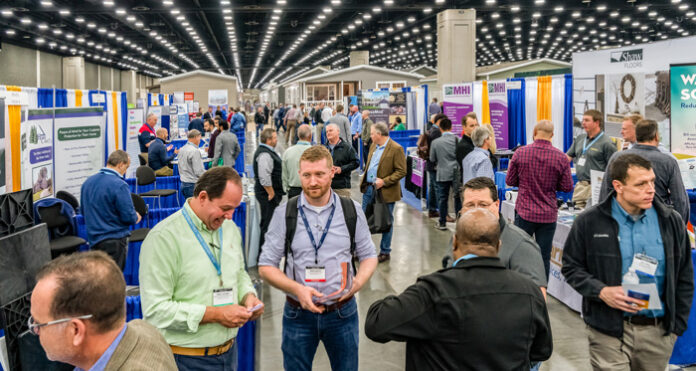
The Midwest Manufactured Housing Federation announced today that attendee registration is now open for the 2025 Louisville Manufactured Housing Show, returning to the Kentucky Exposition Center in Louisville, KY. from Jan. 15-17.
For over 60 years, the Louisville Show has brought together manufactured housing professionals from all over the country. The precursor to the spring selling season, the event offers individuals from all corners of the industry the support and resources needed to make 2025 a strong sales year for their business.
“Thousands of industry professionals flock to Louisville every January to tour the latest model homes on display and connect with fellow builders, developers, retailers, community owners, operators, and installers,” MMHF Chairman Eric Oaks said. “Last year was one of our biggest events ever, and we’re excited to invite everyone back to Louisville for an even more momentous year celebrating the latest our industry has to offer.”
The event will take place at the Kentucky Exposition Center in Louisville where industry professionals can view dozens of the latest model homes from the top manufacturers in the industry. Louisville Show attendees can view more factory-built homes than at any other indoor event in the U.S, as well as learn from industry leaders as they share their expertise and insights for 2025 and beyond.
“This year is going to feature a bigger show with more homes, more exhibitors, more networking opportunities, and expanded educational opportunities,” Darren Krolewski, Co-President and Chief Business Development Officer of show manager MHVillage, said. “If you’re a professional in the industry, the 2025 Louisville Show will be a can’t-miss event for you and your business.”
Attendees can visit TheLouisvilleShow.com/Register to register to attend the event, as well as to sign up to receive more information about The Louisville Show, including sponsorship opportunities and hotel block announcements.
Those interested in exhibiting at the event are urged to visit TheLouisvilleShow.com/exhibitors or call (616) 888-8030 today, as exhibitor booths are quickly selling out.
The Louisville Show is an industry trade event not open to the general public. For more information about the event, visit TheLouisvilleShow.com.
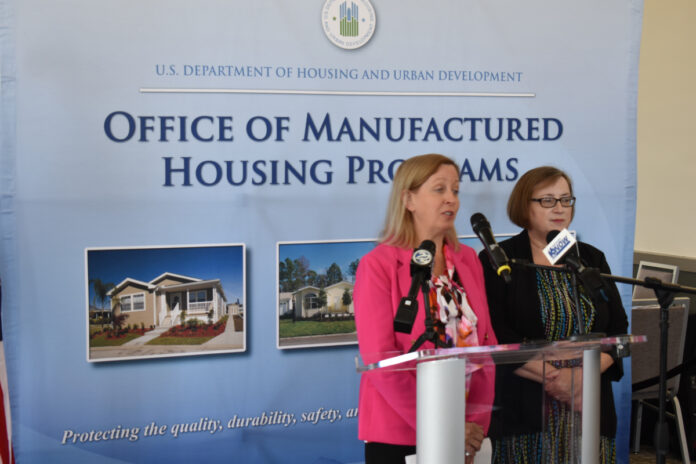
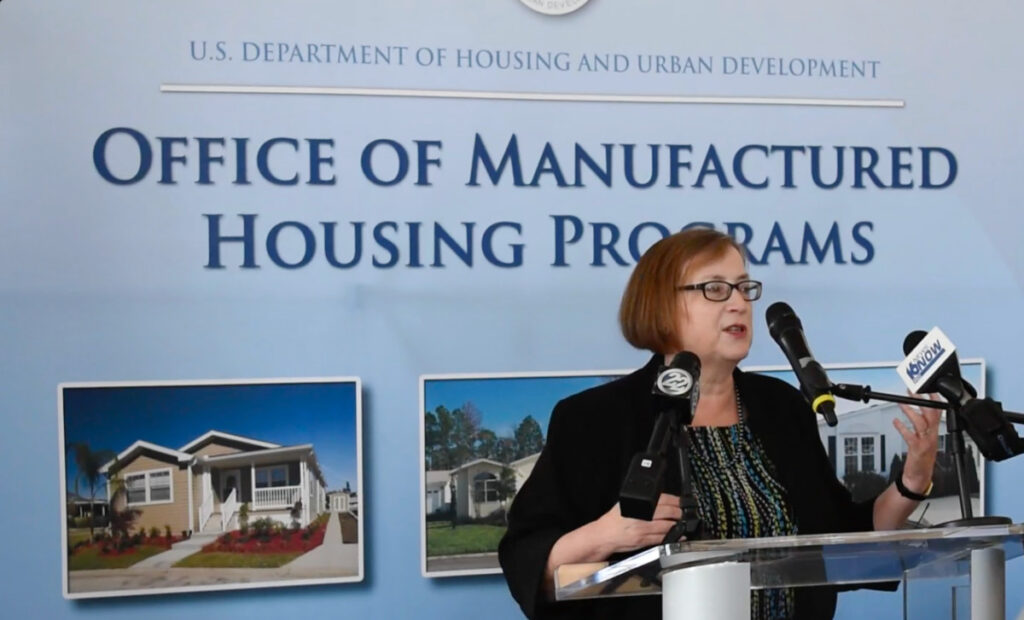
HUD Office of Manufactured Housing Programs Administrator Teresa Payne and FHA Commissioner Julia Gordon answer questions during a press conference on expansive HUD code changes Sept, 11, 2024 in Elkhart, Ind.
Most Comprehensive Update to the ‘HUD Code’ in Decades
The U.S. Department of Housing and Urban Development held a press conference in Elkhart, Ind., to announce the most comprehensive update to the manufactured home construction and safety standards in nearly three decades, with 87 changes in whole, most notably the expansion of the HUD code to include multi-residential structures — duplex, triplex, and quadplex homes.
A majority of the updates will be effective in 180 days, though industry builders can begin construction of the multi-residential manufactured homes immediately.
“There is a waiver which allows manufacturers to start immediately making those multi-unit products that we talked about,” Teresa Payne, administrator of the office of manufactured housing programs at HUD, told the audience at Hotel Elkhart in Northern Indiana. “Because we know the market is demanding those and we want to get those out as quickly as possible.”
Federal Housing Administration Commissioner Julia Gordon said the expansion of home types allowable within the HUD code provides the ability to supply factory-built homes nationwide in a greater variety of settings.
“You want to be able to match the type of housing that’s in those communities,” Gordon said. “Whether it’s having homes that can have kind of zero lot line and can just fit into a particular area, or having an actual home with two separate living quarters.”
Industry professionals have expressed an interest in having multi-residential homes to increase density in a variety of settings, including manufactured home communities, on or near college campuses, for workforce housing, or blended into housing developments along side traditional single-section or multi-section manufactured homes and standard site-built homes. Similar to the usage of an ADU, the units within a primary residence also can be used to lease, or provide housing for an aging relative.
The increased variety of home types along with the industry’s long-held advantage in speed to market, Gordon said, can play a major role in “closing the gap” on the U.S. housing shortage. Current estimates on the U.S. housing shortage vary between 3-5 million in deficit. Gordon said the inclusion of duplex to quadplex residences will provide homes where their needed, and employment opportunities too.
To use site-built construction in development means an elongated process, and labor pools that move from market to market in teams rather than the stability of community and a single work site. Factory jobs are more stable and predictable and the use of homes from the factory eliminates the wait.
“Manufactured homes are an affordable housing option for Americans across the country,” HUD Acting Secretary Adrianne Todman said. “This update of the HUD Code is long overdue and will help increase production while also ensuring modern designs to suit the needs of families.”
Payne emphasized work with municipalities in saying site-built homes take “multiples of the amount of time it’s going to take to have this whole new neighborhood right there… right near jobs and good schools and all sorts of things people think about when they think about where they want to live and when they want to buy a house.
FHA Commissioner Julia Gordon details the impact manufactured housing can have on availability and affordability in the U.S. market.
“We want to be giving that federal voice, that imprimatur, if you will, to what is happening out in this exciting sector,” Gordon said. “We’re missing millions of homes right now. We have lots of young families, for example, who aren’t moving out from their parents and forming a household because they simply cannot find, let alone afford, a place live.
“This is something we can scale,” she said. “Building them in a factory rather than on site, you can really develop your workforce in an area, you can really be a force for jobs and we’ve seen more and more localities interested in ‘Well, could we locate one of those plants here?’ It’s really exciting but it just takes raising this up over and over in the national conversation.”
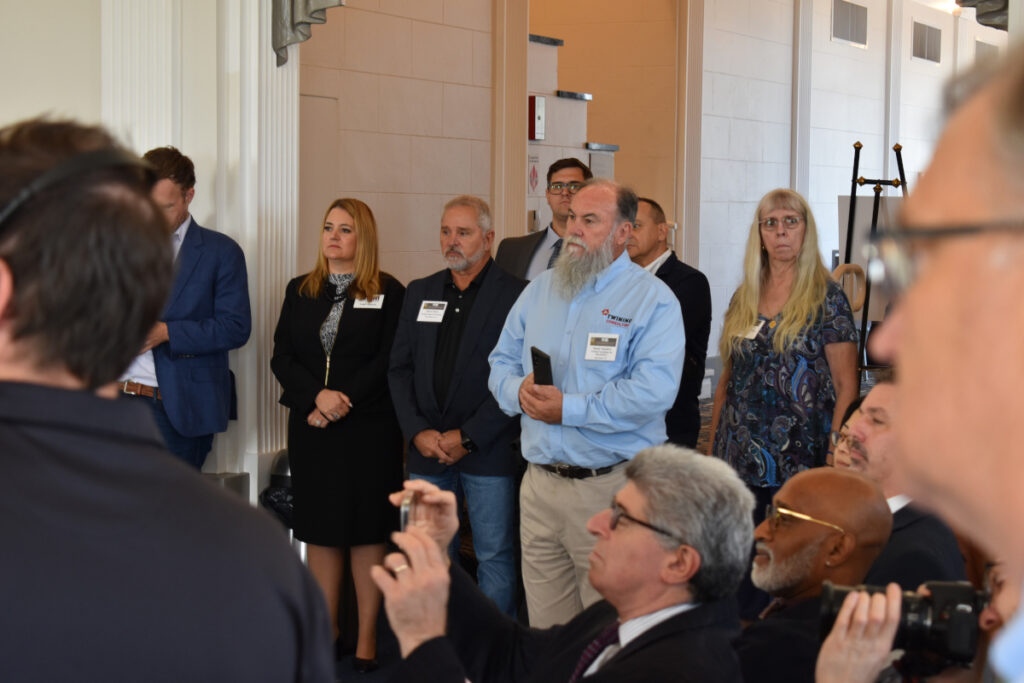
The construction and safety code, commonly referred to as the HUD code, was signed into law 50 years ago, and Elkhart is the birthplace of the manufactured housing and RV industries. Elkhart, the location of the RV/MH Hall of Fame, hosted the Manufactured Housing Consensus Committee’s September meeting, at which the code updates were announced.
“Every rule regarding manufactured housing starts here, at MHCC meetings,” Payne said. “We continue to play a critical role in increasing the affordable housing stock. Today’s manufactured homes are durable, efficient, sustainable, safe, and, most importantly, affordable. That’s why our program is essential to providing housing to everyday Americans whether it’s for purchase, for rent, for a first-time homebuyer, or a senior looking to downsize. And for families seeking to build generational wealth.
“The HUD code, as we call it, has continued to evolve to meet the needs of modern consumers, which has increased the acceptance of manufactured housing,” she said.
More Key Changes to the HUD Code
Open floor plans, truss designs, and specifications for attics
The updated requirements for exterior door separation and structural design enable open floorplans that maintain fire safety, clarify unclear provisions, and enable optimization of truss design. In addition, the final rule provides clarity regarding structural design requirements for attics.
Ridge roof designs
Revised definitions and regulatory language allow certain specified roof ridge designs (peak cap and peak flip roof assemblies) without a requirement for specific on-site inspections by a HUD-approved agency, except for certain exclusions. This type of roof installation is common through the industry and uses technology that is time-tested. This update is beneficial for manufacturers and consumers by incorporating more recent design practices into the regulations and eliminating unnecessary inspections and associated costs.
Materials that facilitate modern design approaches and improve quality
Updates to reference standards for materials (wood, steel, piping) and products align with other building standards, allow the use of more modern design approaches and installation of alternative materials, and improve the quality and safety of homes for consumers.
Accessibility improvements
Modifications to standards for accessible showers comply with national disability standards for roll in showers. This eliminates the need for HUD alternative construction approval and reduce cost and burdens for manufacturers and consumers.
Modern and energy-saving appliances
Updated and newly added standards allow for the use of more modern and energy efficient appliances, including gas-fired tankless water heaters, eliminating the need for HUD alternative construction approvals for use of such appliances.
Additional process efficiencies that save time and reduce costs
Improved language stipulating prerequisites for the process of obtaining installation licenses increase flexibility for installers; updates to water system piping testing procedures decrease on-site testing time; and utilization of appliance QR codes for manuals and information will reduce paperwork and bookkeeping.
The Manufactured Housing Institute issued a statement commending the U.S. Department of Housing and Urban Development for its long-awaited updates to the Federal Manufactured Home Construction and Safety Standards. As the nation navigates an affordable housing shortage, manufactured housing offers quality and affordability to Americans who need and deserve both.
“Today’s updates to the construction code for manufactured housing will support the industry in delivering homes with innovative designs and modern features, bringing attainable home ownership to more people across the country,” MHI CEO Lesli Gooch said.
Gooch said she applauds the administrative waiver for the production and immediate delivery of in-demand one- to four-unit manufactured homes as “a vital move toward addressing housing challenges in high density areas.”
MHI expressed concern about the “tight 180-day timeline to enact these substantial new changes” including 74 updates to reference standards, 16 new standards, and three regulatory text changes.
The proposed revisions and updates to the HUD code are critical, MHI stated. They clear out the backlog of items previously approved by the Manufactured Housing Consensus Committee, which have been pending HUD approval and implementation for years. To avoid future backlogs, MHI urges HUD to provide more regular updates to the HUD code to alleviate construction challenges and streamline attainable home ownership nationwide.
Atlanta Show Sept. 17-19 Includes Model Homes, Exhibits, Educational Panels
The SECO Conference of Community Owners in 2024 returns to Atlanta’s Cumberland neighborhood, a bustling section of the metro that, among other things, hosts Truist Field, the home park for Major League Baseball’s Atlanta Braves.
Open to all manufactured housing industry professionals, the event runs Sept. 17-19 with a Management Monday add-on.
SECO 24 will have an expanded collection of model homes in a village setting that shows the latest design developments, structural improvements, architectural features, and “oh wow” technologies that are driving the manufactured housing industry.
Homes from Cavco, Clayton, Skyline Champion, Legacy, and Live Oak will be on display throughout the week.
Management Monday is a full day of operational insights for manufactured housing community professionals. The schedule includes a 9:30 a.m. discussion “Mitigating Risk On-Site”, a talk on “How to Manage Property Reports”, “Using Technology to Improve Operations”, and an afternoon panel on “Preventative Maintenance”. The day finishes with a discussion on social media promotion and then instruction on site prep and home installation.
SECO24 kicks off in earnest Tuesday morning with a breakfast, welcome reception, opening remarks, and introductions.
Registrants and other guests of SECO 2024 will get the experience of staying at the Renaissance Atlanta Waverly Hotel, which is a short walk from the ball field and entertainment district with many area attractions including some of Atlanta’s best eateries.
Approximately 400 manufactured housing professionals are expected to attend SECO 24. The event includes a golf outing on Monday morning. The Braves host the Los Angeles Dodgers for a four game set that ends on Monday evening.
Researchers from Louisiana State University and the LSU AgCenter in Baton Rouge are exploring strategies to make resilient homes more affordable for Louisiana residents in a project funded by the U.S. Department of Housing and Urban Development.
The effort — using the previously established FORTIFIED® building standard — is led by a cross-campus, collaborative team of professors from industrial engineering, biological and agricultural engineering, and oceanography and coastal sciences. The goal is to collaborate with industry professionals to identify pathways and limitations to incorporating the standard and elevation criteria into the manufactured housing market.
“These homes help meet the need for affordable and resilient housing in underserved communities across Louisiana,” LaHouse Research and Education Center Assistant Director of Research Bin Mostafiz said. “This project will help low-resource and underserved communities with sustainability, housing, and emergency recovery.”
The Louisiana State Hazard Mitigation Plan found that natural hazards will cost the state $50 billion by 2050, with wind and flood hazards making up the majority of this cost. As severe weather raises home insurance costs and disrupts local economies, the need for cost-effective and resilient strategies in Louisiana is pressing.
One of the biggest barriers to homeowners incorporating more resilient features is the initial cost, but manufactured homes can reduce these costs without sacrificing safety.
FORTIFIED, a voluntary, code-plus building standard developed by the Insurance Institute for Business and Home Safety, has been rigorously tested and is shown to reduce damage from high speed winds, as well as wind-driven rain and hail. Additionally, opting to build to the FORTIFIED standard can reduce a homeowner’s wind insurance premium by more than 50 percent.
Elements of the FORTIFIED Roof
Stronger Edges
Roof damage often begins when wind gets underneath the roof edge and rips it away from the home. To help protect this vulnerable area, FORTIFIED requires specific materials and installation methods “including a wider drip edge and a fully adhered starter strip, that when used together create a stronger system.”
Sealed Roof Deck
If wind rips off a roof covering, whether it’s shingles, metal panels, or tiles, the home is exposed to wind and water. FORTIFIED requires roof decks to be sealed to prevent this type of damage.
Better Attachment
Rather than common smooth nails, FORTIFIED requires ring-shank nails, installed in an enhanced pattern, to help keep a roof deck attached to the home in high winds. The use of ring-shank nails “nearly doubles the strength of your roof against the forces of winds.”
Impact-Resistant Shingles
The FORTIFIED standard provides a Hail Supplement for homeowners in hail-prone areas. Shingles must score Good or Excellent on the IBHS Hail Impact Ratings, which outperform standard Class 4 shingles when tested against realistic hailstones and will better protect a home from hail up to two inches in diameter.
The Silver standard adopts the roofing standard and adds structural integrity qualities to damage prone areas of a home, including chimneys, gables, other attached structures, and garage doors. The Gold standard provides the previously mentioned standards and requires an engineered continuous load path that is specific to an individual home. The load path ensures the roof is properly affixed to walls, and that weight on the walls is spread across the structure, with walls properly affixed to the foundation.
Research conducted at the LSU AgCenter LaHouse Research and Education Center has shown that implementing strategies from the FORTIFIED roof requirements reduced wind loss by up to 38 percent. FORTIFIED Silver standard elements decreased wind loss by up to 73 percent, and the FORTIFIED Gold standard reduced loss due to high wind by up to 80 percent.
This research will also look at reducing flood hazards for homeowners. Freeboard, additional elevation above the base flood elevation has been proven to reduce flood risk. Previous research from the LSU AgCenter found that raising a home two feet above the 100-year flood elevation level can reduce flood risk by 99 percent.
The overall goal of this project is to increase resilience of communities while maintaining lower costs for homeowners. In order to achieve this goal, the researchers have four main priorities. First, they will conduct research on trends and benefits of FORTIFIED and elevated homes in the manufactured housing market. Additionally, they will examine barriers and areas for improvement in the manufactured home supply chain as well as differences in life cycle costs between off-site versus on-site FORTIFIED and elevated manufactured homes. Lastly, the researchers will establish protocols to measure operational and cost efficiency.
“The project’s findings and tools can serve as a valuable resource for HUD researchers, policymakers and government officials, and industry partners, including construction professionals, guiding them toward the adoption of resilient construction practices,” LSU Industrial Engineering professor and project leader Isabelina Nahmens said.
In his invitation to the inaugural Cole Accolades Ceremonial, founder Barry Cole, a long-time community owner and insurance provider, acknowledged the “hundreds of luncheons” he’s had mainly with his male colleagues in the industry.
“Now I want to personally thank you and express to you how much you all mean to me, and especially what you all have meant to the MH industry,” Cole stated. “Recognition is deserving.”
On June 21, about two dozen women gathered at noon at the Park Club in Costa Mesa, Calif., to be honored for their years of dedicated service.
“You are among the many important achievers in the manufactured housing industry who I have either known and admired for a long time or who have helped me so much in the short time that you are invited to a special VIP luncheon,” Cole said in welcoming guests.
Festivities began with a champagne and tea mingle, followed by introductions of the approximately 30 professionals. Several of the honorees had prior engagements and were unable to attend, but all were honored.
After the introductions, a lunch and dessert was served. Cole also provided the honorees with a personalized gift, an inscribed silver serving tray. The appreciation for the recognition, the event, and the gift was apparent.
“I am proud to stand among outstanding women recognized for their achievements in manufactured housing,” Sherrie Clevenger, who works for Zywave, said of the honor. “It was a truly inspiring event celebrating important achievers and leadership in our industry.
Inaugural Honorees at Cole Accolades Ceremonial
Elvia Alaniz, American Modern Elizabeth Alex, Monarch Home Sales Debbie Baldwin, retired Golden West Realty Suzie Beed, retired finance Cheryl Bohrer, U.S. Financial Sherrie Clevenger, Zywave Donna Cole, partner Natalie Costaglio, Mobile Community Management Debbie Custance, retired finance Vicky Derieg, CMHE Sheila Dey, retired WMA Peggy Domasin, retired NU Trend Homes Lauren Fischer, Fischer Investment Group (not in attendance) Heidi Franzoni, Family Homes Lesli Gooch, MHI (not in attendance) Shela Holley, Triad Financial Maria Horton, Newport Pacific Joan Karsten, Golden West Realty (not in attendance) Connie Lamphere, retired CMHI (not in attendance) Kim Lear, retired CMHI (not in attendance) Cindi Lilly, Santiago Financial Sandi Marple, Claraben Homes (not in attendance) Aimee Molsberry, Santiago Communities Deann Pancheri, community owner (not in attendance) Vicki Postolka, retired finance Jamie Perez, CMHI (not in attendance) Eva Raleigh, Lake Park Communities (not in attendance) Belen Ramirez, Express Escrow Regina Sanchez, WMA (not in attendance) Margie Shook, retailer Laura Slobojan, Star Communities Cindy Su, Advantage Homes Vickie Talley, Talley & Assoc./MHET Jana Tobey, U.S. Financial (not in attendance)
Water submetering for manufactured housing communities is increasingly important for fair cost recovery, leak detection, and conservation. A relative newcomer to the space is working on ways with innovative technology to transform the water submetering market.
Innovative Solutions for an Age-Old Challenge
Led by a seasoned team from the IoT (Internet of Things) space, Dune is solving traditional water submetering challenges with a new, disruptive approach. Patented technology accurately measures flow without any direct contact with water, eliminating the need for pipe-cutting or even shutting off the water supply in most cases. The non-intrusive approach eliminates the need for plumbers or highly-skilled labor, lowering property owner risk and reducing installation cost and tenant disruption.
Where traditional inline submeters have mechanical components that water flows through, the Dune solution is completely solid-state with no moving parts to wear out, making them immune to extreme weather damage.
Connected IoT Solution
From inception five years ago, Dune created an IoT-based solution where each meter connects directly to its cloud-based platform via cellular networks. Meters are read remotely and usage data can be integrated with a third-party platform to further simplify monthly billing for tenants.
“Property owners and managers can monitor water usage data from anywhere,” said Dune founder and CEO Garo Sarkissian said. “This level of monitoring and control represents a significant advancement over traditional water submetering methods, which often rely on manual readings and can be prone to delays and inaccuracies.”
Leveraging machine learning to analyze usage patterns, the solution has advanced leak detection capabilities that can quickly identify problems, isolate the issue, and alert the property owner, manager, or any designated person when water-use anomalies appear.
The real-time detection picks up subtle use-cases in water patterns much in the same way a human ear can tell the difference between kitchen appliances and potential water problems.
“With advanced analytics, we are often able to isolate and identify the source of a leak,” Bruce Buchan, Dune’s co-founder and head of product and engineering, said. “For example, a leaking toilet has a distinctive data signature that differs from a ruptured pipe or other water-using appliance anomalies.”
This real-time data also provides a way to proactively maintain a community. Property managers can address potential issues before they escalate, reducing the likelihood of significant water damage and the associated costs, which may even be leveraged to lower insurance premiums.
Continuous Innovation
Dune recently improved its submeter design, further simplifying installation, expanding compatibility, and enhancing durability. Additionally, with more processing power and integrated sensors, the solution offers new features and capabilities sought by the market.
The new streamlined enclosure includes an integrated clamp with an additional tamper-proof mechanism that enhances security.
“The new integrated clamping mechanism is ground-breaking,” Buchan said. “It literally makes installation a snap.”
Further optimized for long-term durability and harsh outdoor environments, the new package boasts a rigorous IP-67 rating. This standard validates the design has a high degree of immunity from both dust and moisture ingress, which provides more options for installation, even below grade.
With enhancements to its patented water flow sensing technology, compatibility has been expanded enabling a single submeter variant to work across a broader range of pipe sizes and types. Coupled with more processing power and optimized battery management, the new submeter is designed for expanded functionality and an even longer service life.
“Dune has always relied on its customers for inspiration,” Sarkissian added. “For example, even though our meter is not susceptible to freezing, we added a temperature sensing feature that can alert residents, property owners, and managers when pipes become dangerously cold. With advanced leak detection, we will quickly catch a pipe bursting but it’s a lot better for everyone if an issue can be avoided altogether.”
The Right Time for Water Submetering
Increasing water costs and the growing emphasis on water conservation are driving demand for advanced submetering solutions. As utilities and local governments continue to introduce measures and incentives to reduce water use, the adoption of innovative solutions is only going to increase. Driven by leak detection and real-time alerting requirements, some municipalities already offer rebates specifically for technologies that reduce water use and waste, which can significantly offset the initial cost for deploying qualified solutions.
Justin Schmid is the executive vice president and COO for Dune. He has 30-plus years of experience in technology and the wireless IoT space. As a leader at companies of various scale, Schmid has been instrumental in significant business growth and corporate transformations. He has run businesses with complete P&L responsibilities at multiple public companies and has deep domain-area experience in sales, marketing, business development, product management, customer success management, and operations. Schmid holds a B.S. degree in electrical engineering from U.C. Santa Barbara.
‘Embrace the mantle of professionalism and redefine the standard of excellence’
By César Mascorro, Jr
We’ve all been there – that dreaded moment when a simple shopping excursion turns into a high-pressure sales pitch, leaving us feeling manipulated and dissatisfied. Whether it’s a pushy car salesman or an overly assertive retail associate, encountering a self-serving salesperson can quickly sour the entire shopping experience. In the housing industry, where major investments and life-changing decisions are being considered, the stakes are even higher. That’s why the distinction between a professional housing consultant and a run-of-the-mill salesperson is more crucial than ever.
In the dynamic landscape of the manufactured housing industry, the role of a housing consultant extends far beyond merely closing deals. To truly excel in this field, one must embrace the mantle of a professional consultant, dedicated to fostering trust, empathy, and long-term relationships with clients. In this article, we delve into six key steps that take us on the transformative journey from salesperson to consultant, exploring how a commitment to trust, empathy, and integrity can redefine the client experience and elevate the standards of professionalism in the housing industry.
1. Cultivating Trust and Empathy
A professional housing consultant understands that building trust is paramount in establishing lasting relationships with clients. This goes beyond simply pitching a home; it involves actively listening to clients’ needs, concerns, and aspirations. By demonstrating genuine empathy and understanding, consultants can build connections based on mutual respect and trust, laying the foundation for fruitful partnerships.
2. Commitment to Continuous Improvement
In an ever-evolving industry with the housing market being what it is, complacency is the enemy of progress. A professional housing consultant is committed to continuous improvement, constantly seeking ways to enhance their knowledge, skills, and expertise. This may involve staying informed of industry trends, participating in training programs, or seeking mentorship opportunities. By investing in personal and professional growth, consultants not only elevate their own capabilities but also enhance the value they bring to clients and the company alike.
By prioritizing client satisfaction and well-being, consultants foster trust and loyalty, paving the way for long-term success.
3. Prioritizing Client Needs
While closing sales is undoubtedly important, a professional housing consultant places equal emphasis on serving the best interests of their clients. This means taking the time to understand clients’ unique circumstances, preferences, and financial constraints. Consultants should offer personalized solutions tailored to meet clients’ specific needs, even if it means steering away from a particular home or deal if it’s not in the best interest of the client. By prioritizing client satisfaction and well-being, consultants foster trust and loyalty, paving the way for long-term success.
4. Integrity and Transparency
Professionalism in the housing industry is synonymous with integrity and transparency. Consultants must conduct themselves with honesty, integrity, and transparency at all times, adhering to ethical standards and industry regulations. This includes providing accurate information, disclosing relevant details, and managing expectations realistically. By upholding these principles, consultants not only earn the trust of clients but also safeguard the reputation of the company they represent.
5. Balancing Client and Company Interests
While serving clients’ needs is huge, a professional housing consultant must also balance these interests with those of the company. This requires striking a delicate balance between achieving sales targets and acting in the best interest of clients. Consultants should seek win-win solutions that benefit both parties, fostering a mutually beneficial relationship built on trust and transparency. By aligning client satisfaction with company goals, consultants contribute to the overall success and reputation of the organization. We will definitely dive more into how to accomplish this in a future article.
6. Embracing the Role of Advisor
Ultimately, a professional housing consultant transcends the role of a mere salesperson to become a trusted advisor and advocate for their clients. This means offering valuable insights, guidance, and support throughout the home buying process, from initial consultation to post-sale service. Consultants should empower clients to make informed decisions by providing comprehensive information, addressing concerns, and offering expert advice. By assuming this advisory role, consultants become indispensable partners in their clients’ journey toward homeownership.
Overall, the transition from a salesperson to a professional housing consultant requires a mindset shift toward enhancing the customer buying experience by building trust, prioritizing client needs, and committing to continuous improvement. By embodying qualities such as integrity, empathy, and transparency, consultants elevate their role from transactional to transformational, fostering long-term relationships and driving sustainable success for both clients and the company. It’s time to embrace the mantle of professionalism and redefine the standard of excellence in the manufactured housing industry sales culture.
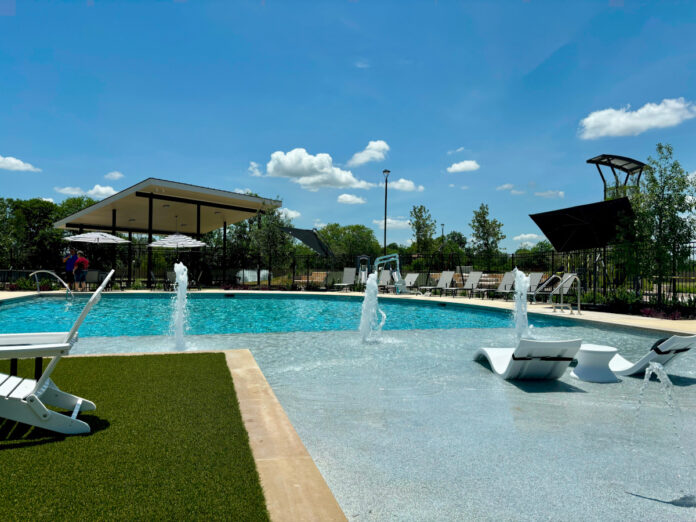
The pool area at Yes' Dwelling at New Braunfels in Texas.
Yes Communities has opened its newest ground-up development project, Dwelling at New Braunfels, in New Braunfels, Texas.
Dwelling at New Braunfels is set to redefine attainable housing in the region, addressing a critical need in the Texas housing market.
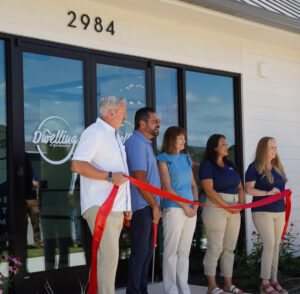
Yes Communities CEO Steven Schaub said Dwelling is an innovative manufactured home community that offers an exceptional living experience with modern amenities, attainable housing options, and a welcoming environment. The grand opening celebration featured a ribbon-cutting ceremony, guided tours of the model homes, and an array of activities, including catered food, live music, and giveaways.
The grand opening welcomed the larger public, civic leaders, local businesses, and the residents during the event.
“This is a historic unveiling day as it is our first ground-up development that will provide the New Braunfels community with a new standard of attainable, quality living,” Schaub said. “Our goal is to create a thriving and vibrant neighborhood in the heart of Central Texas.”
Dwelling offers a range of amenities designed to enhance residents’ lifestyles, including:
Event Center: A modern, spacious facility for community events and private gatherings.
Swimming Pool: A resort-style pool perfect for relaxation and recreation.
Multi-Generational Playspace: A place for the entire community to gather and play.
Fitness Center: A state-of-the-art gym equipped with the latest exercise machines.
Pet-Friendly Areas: Designated spaces for pet owners to enjoy time with their furry friends.
Dock and Pond: Pond dotted with native wetland plantings and surrounded by a loop trail that supports healthy lifestyles and creates touchpoints for residents to come together.
Dwelling offers a variety of home styles and floor plans to suit diverse needs and preferences, with competitive home prices. Each home is built with high-quality materials and energy-efficient features, ensuring long-term comfort, sustainability, and energy cost savings.
With Tips from ‘How to Win with Internet Marketing for Manufactured Housing’
Are you keeping up in the digital marketing race for manufactured housing? In a digital age that waits for no one, the manufactured housing industry often finds itself lagging behind other segments and playing catch-up. This lag can be the thin line between getting a future homeowner on board or not getting one at all. In his book, “How to Win with Internet Marketing for Manufactured Housing,” Brandon Meek, an industry professional since 2007, reveals new approaches to putting a community on the digital map and converting leads into buyers.
Winning Strategy for Online Success
Meek’s book emphasizes that it is crucial to coordinate different online tools and platforms to achieve desired marketing results. Online marketing is a complex process that needs:
Chat widgets for a convenient conversation
Visible and easily accessed contact information
Featured reviews and feedback
Clear, detailed photographs and videos
Fast loading
Mobile-friendly design
A clear, strong call to action
These features make a site easy to use so that it can be most effective in turning visitors into customers.
What is the Future of Digital Marketing in MH?
The author expects some big shifts in the industry marketing of manufactured homes. The marketing is becoming sharper and better organized. Ноwever, even though there’s a lot of chatter about AI in marketing, he reassures us it is actually here to assist us and nоt to take over the job of marketers. Моreover, he firmly believes that AI саn speed things up and bring new ideas.
Still, text messages remain the best way to communicate in a snap, while emails can create better connections with potential buyers. Quick conversations through chat widgets or social media plus fast responses are also critical. Having a robust online presence is more important than ever as people look for homes across various digital platforms.
How Can You Jumpstart Your Digital Marketing?
Create your home listings on main industry directories and sites, like MHVillage, that are visited by potential buyers who are already aware of the benefits of manufactured housing. Video marketing is another strategy that Meek recommends to increase exposure and generate leads. For instance, record simple videos with a cell phone and use them to present available homes on social media platforms, especially YouTube. Remember to optimize them for local search results and make them a part of any marketing campaigns that have already been launched.
Ready to Transform Your MH Marketing?
Meek’s bооk encourages community operators and managers to improve their marketing tactics. It doesn’t matter if you’re starting from scratch or want to enhance what you already have. The potential of digital marketing is incredible. To take your marketing efforts to new heights and make a real impact, don’t miss the practical strategies from “How to Win with Internet Marketing for Manufactured Housing,” available for purchase on Amazon.
In a White House statement released Aug. 13 on allowing more housing types under HUD Code:
“Enabling more housing types to be built under the HUD Code. HUD anticipates finalizing a rule to update its Manufactured Home Construction and Safety Standards. Manufactured housing provides an essential path to increasing overall housing supply and offers significant savings over site-built housing. The HUD Code creates economies of scale for manufacturers, resulting in significantly lower costs for buyers. In addition to making changes that will increase the quality, energy efficiency, and resilience of manufactured homes, the new rule, if finalized, would enable duplexes, triplexes, and fourplexes to be built under the HUD Code for the first time, extending the cost-saving benefits of manufactured housing to denser urban and suburban infill contexts.”
HUD’s Challenge to Governors, Mayors
At the same time HUD announced the launch of a $250 million “Legacy Challenge” for transformative housing investments. Communities that receive direct annual awards through the Community Development Block Grant program to leverage low-cost, low interest loans for transformative housing investments. This program is a key lever that enables communities to take on legacy projects that will transform and revitalize neighborhoods. Up to $250 million in funding will be made available through the Section 108 Loan Guarantee to make transformative housing-forward changes in local communities across America.
HUD Acting Secretary Todman stated that “I’m challenging our nation’s mayors and governors to use this unique funding mechanism to build new housing.”
The funding can be used to make transformative changes in local communities through:
Adaptive reuse, including commercial-to-residential conversion
Preservation and rehabilitation of existing units
Infrastructure to support housing production such as utility installation or upgrades
Eligible housing uses within mixed-use or transient oriented development projects
Revolving loan pools to support local housing development
For communities that express interest by Nov. 1, 2024, HUD will offer additional repayment flexibilities, up to three years of interest-only payments, and waivers to streamline program requirements. HUD will invite applicants to participate in a technical assistance cohort and provide tools to support application development. On Aug. 29, 2024, HUD will host a kickoff webinar to share more about the Legacy Challenge.
Oct. 6-8 at Avalon Hotel in Alpharetta, Ga.
Manufactured housing community owners have never had more information available to them — or more decisions to...
The Midwest Manufactured Housing Federation has announced that attendee registration is now open for the 2027 Louisville Manufactured Housing Show, returning to the Kentucky...
HUD’s Innovative Housing Showcase, MHI’s Homes on the Hill and Annual Meeting Begin Sept. 22
Two of the country’s largest builders of manufactured homes will...