Tim Taylor has worked alongside the National Center for Construction Education and Research for more than a decade, but just at the beginning of this year, he came on in a newly formed position to conduct research and provide solutions to repair the vital craft and trade work that for decades has been ill-supported.
NCCER, based in Alachua, Fla., dates back to the early 1990s when leading contractors came together to standardize training and provide industry-recognized credentials. Over time, NCCER has expanded to become the industry’s source for training, assessments and certification. NCCER continues to evolve beyond the construction and maintenance industries both domestically and globally. Today, NCCER develops curricula for over 70 craft areas that have been used in all 50 states and in 20 countries.
Taylor is the organization’s new director of research, heading up the continued effort to build a safe, productive, and sustainable workforce of craft professionals as well as expanding its comprehensive workforce development system and curricula selection.
He had been at the University of Kentucky, in the civil engineering department, with a focus on the craftworker shortage in his research, innovating, providing solutions that other groups, like NCCER, would carry out. In 2018 he and NCCER published “Restoring the Dignity of Work”.
“We do some really cool things here,” Taylor said of NCCER. “I’ve worked with them for a long time and some of the programs are new even to me, it’s very exciting.”
Extended Research, Work in the Trades
Taylor said his mindset and that of the staff and partners at NCCER is to address the problems that affect as many people as possible, including the trade workers, their families, and the families they build for and help support.
“In my mind, the craft worker shortage is the number one challenge we have in construction,” Taylor said. “We look at this from the standpoint of how to study the trades, and we want to study the questions that construction professionals care about.”
Revisiting Questions of the Past
One solution to the craft shortage that has been put forward in the past is the idea of multi-skilling. Multi-skilling is when craft professionals gain training and experience in multiple trades. In a recent research project, the group re-asked a 20-year old question around the reasons for multiskilling and found that the answers had changed. In the late 1990s tradespeople said they were getting added training, additional certificates, or taking advantages of other career development opportunities because they might be able to earn additional hours, get paid overtime, or would be kept on a job site longer through the phasing of a project.
In 2022, “I don’t want to move,” was the answer, Taylor said.
NCCER found that with many households enjoying a dual income, it made it more difficult to pull up and leave if a job moved from one part of the state to another, or to a different state altogether. A second certification, another skill, might mean the difference between a contract job and full-time employment, or extended full-time employment.
“They need to stay on in a geographic region,” Taylor said.
Another observation NCCER plans to address is the demographics of its entry-level workers versus the typical age of a college student. The average age of a college student is 20, and the average age of a construction trades apprentice is 28.
“There is something happening in that time in between,” Taylor said. “We’re missing 8-10 years that are important in getting tradespeople moving into and up in the industry.” More information on NCCER and its research efforts can be found at www.nccer.org. NCCER’s plan for restoring the craft workforce is available at https://www.nccer.org/news-research/research/rt335
MHInsider is a product of MHVillage and is the source for all of your manufactured housing news. Check back regularly for updates on industry trends, events, and more!
A Quarterly Overview of Manufactured Housing Industry Real Estate Investment Trusts
The research team at Hoya Capital Real Estate is excited to continue our quarterly column published in partnership with MHInsider to provide insight and commentary on publicly-traded manufactured housing stocks. Every quarter, we’ll publish an update to discuss the stock performance, earnings results, and major news and events reported by manufactured housing real estate investment trusts, or MH REITs.
Overview of MH REITs
There are three U.S. exchange-listed Manufactured Housing REITs that collectively account for roughly $35 billion in market value: Equity LifeStyle (ELS), Sun Communities (SUI), UMH Properties (UMH). Additionally, newly-listed Flagship Communities (FLGMP) trades on the Toronto Stock exchange.
Manufactured Housing REITs collectively own roughly 350,000 manufactured housing and RV sites across the United States with a portfolio skewed toward higher-end communities with a more “retiree-oriented” demographic than the all-ages community.
Through a series of acquisitions, Equity LifeStyle and Sun Communities have recently expanded into boat marinas as well while the smaller UMH Properties and newly-listed Flagship Communities continue to focus primarily on traditional manufactured housing communities.
Manufactured housing REITs have emerged over the past decade from relative obscurity into several of the largest publicly-traded owners of real estate in the world. Beneficiaries of the lingering housing shortage across the United States resulting from a decade of underbuilding, manufactured housing REITs have been the single-best performing REIT sector since the start of 2010, delivering an incredible 24.3% annual compound total returns from 2010 through 2021.
With total returns of 42.0%, Manufactured housing REITs outperformed the broad-based Equity REIT Index for a remarkable ninth-straight year in 2021, the longest streak of outperformance for any property sector since the dawn of the “Modern REIT Era” in the early 1990s.
From an investment perspective, despite their high growth rates, MH REITs are a traditionally defensive and countercyclical sector due to the “sticky” nature of MH demand and cash flows. While these REITs are not known for their high dividend yields, these REITs have delivered some of the strongest rates of dividend growth of any REIT sector.
Recent MH REIT Fundamental Performance
Symptomatic of the lingering housing shortage in the United States, rents are soaring at the fastest pace on record in essentially every segment of the residential rental market across the country. Interestingly, manufactured housing renters have so far escaped the double-digit rates of rent growth seen in apartment and single-family rental markets, as MH REITs raised rents by just 3.9%, on average, in 2021 which was only a bit higher than the average annual increase of 3.5% over the past decade.
Manufactured Housing REITs still managed to deliver their strongest year on record across nearly all critical earnings metrics. Driven by strong performance in their RV segment and occupancy increase in their core manufactured housing parks, the three major MH REITs – ELS, SUI, and UMH – delivered same-store NOI growth of 10% for full-year 2021 and these REITs are expecting NOI growth of another 8% in 2022 at the midpoint of their initial financial outlook.
Growth in funds from operations (“FFO”) – the earnings per share “equivalent” for REITs – is driven by the combination of same-store “organic” growth and by external growth through acquisitions and new development. Manufactured housing REITs delivered incredible FFO growth of over 22% in 2021, which was significantly above their earlier estimates and was the strongest year of FFO growth on record for all three of these REITs. The initial outlook for 2022 calls for average FFO growth of 8.1%, but these REITs have historically provided conservative estimates in their initial outlook and raised their growth targets throughout the year, so another year of double-digit earnings growth is certainly achievable.
Utilizing a strong cost of equity capital, these REITs have continued to grow externally by adding units to existing sites and by growing via acquisitions and site expansions. MH REITs acquired $2.15 billion worth of properties in 2021 – the largest full-year total on record. The most significant deal in 2021 was Sun Communities’ $1.3B purchase of Park Holidays, which is the second largest owner and operator of holiday communities in the UK, with 40 owned and operated communities and an additional two managed communities. The acquisition, which is expected to be accretive to 2022 Core FFO per share, will represent approximately 7% of the Company’s properties and 8% of its total real estate asset value.
Manufactured Housing Industry Data Points
MH REITs’ amplified focus on analogous asset classes – RV parks and marinas – was perfectly-timed, providing an added external growth tailwind as the “Work-From-Anywhere” era has fueled soaring RV, boat, and vacation home sales. The RV Industry Association (“RVIA”) reported in January that despite supply chain issues and labor shortages, 2021 was the best year on record for shipments of recreational vehicles with shipments of 600,240 RVs last year — beating 2017’s record by 19 percent. The RVIA sees the momentum continuing into 2022, predicting another record year with 614,000 shipments anticipated by the end of the year.
The National Marine Manufacturers Association (“NMMA”), meanwhile, reported last month that following record sales in 2020, powerboat sales exceeded 300,000 units for only the second time in 15 years. As of early January, the NMMA is projecting new boat sales to exceed the 300,000 unit mark for a third straight year and surpass 2021 totals by as much as 3%. Sun Communities has been the most active of the four MH REITs in growing their marina business, which now accounts for nearly 20% of its annual revenues. Marinas offer substantial operating parallels to the RV business and SUI is now the largest owner of marina slips in the United States, followed closely behind by Equity LifeStyle.
MH REITs Key Takeaways
While the share prices of MH REITs have uncharacteristically lagged through the first two months of 2022 as the sector has been pressured by concerns over rising rates, inflation, a broader rotation from growth into value, the long-term fundamental outlook for the sector remains highly promising given the lingering undersupply of housing units across the United States and these REITs’ position as leading providers of affordable housing.
Consistent with the trends across the residential REIT sectors over the past twelve months MH REITs delivered their strongest year on record in 2021 across essentially every critical earnings metric, and the momentum is expected to continue into 2022. Low supply and strong demand have driven stellar fundamental performance for MH REITs over the past half-decade, and shareholders have been rewarded with a record-setting nine consecutive years of outperformance relative to the REIT sector average.
MH REITs REPORT Terms Defined
FFO (Funds From Operations): The most commonly accepted and reported measure of REIT operating performance. Equal to a REIT’s net income, excluding gains or losses from sales of property and adding back real estate depreciation.
AFFO (Adjusted Funds From Operations): A non-standardized measurement of recurring/normalized FFO after deducting capital improvement funding and adjusting for “straight line” rents.
NOI (Net Operating Income): Typically reported on a “same-store” comparable basis, NOI is a calculation used to analyze the property-level profitability of real estate portfolios. NOI equals all revenue from the property, minus all reasonably necessary operating expenses.
Hoya Capital Disclosures
I am/we are long ELS and SUI. I am not receiving compensation for it. It is not possible to invest directly in an index. Index performance cited in this commentary does not reflect the performance of any fund or other account managed or serviced by Hoya Capital Real Estate. Nothing on this site nor any published commentary by Hoya Capital is intended to be investment, tax, or legal advice or an offer to buy or sell securities. Information presented is believed to be factual and up-to-date, but we do not guarantee its accuracy and should not be considered a complete discussion of all factors and risks. A complete discussion of important disclosures is available on our website www.HoyaCapital.com.
Tammac, a Wayne, Pa.-based business, has made a strong re-entry into manufactured housing lending, with a goal of providing $700 million in financing over the next three years.
“We have a long history and are ready to offer a full-spectrum offering to the manufactured housing community and retailer networks,” Tammac Senior Vice President and National Sales Manager George Ewing said. “We are presently active in 17 states including Texas and Florida and we will be expanding into South and west of the Mississippi this year. We will then be targeting expansion in the Midwest and on the west coast.
“There is a need in every community for affordable housing and we are committed to helping families own a home of their own,” Ewing said of the estimated three-million-unit home shortage in the country.
New Investor Piques Industry Interest
Tammac has been in business for 46 years and returns after slowing originations due to the Great Recession.
“When the credit crisis hit, the decision was made to pause lending and focus on servicing the existing portfolio of loans. A private equity group based in Philadelphia, Pa., purchased the company in late 2018, re-energizing Tammac’s origination and growth strategy” Ewing said.
Tammac Vice President of Lending Operations Christine Bowers has more than 25 years of experience in underwriting.
“We want to see every application from any individual who has the intent and ability to buy a home,” Bowers said. “We’re looking to do as much for the buyer as possible and help them attain their goal of affordable homeownership.”
Responding to the Market
Tammac lends to both individuals and manufactured housing community investors. They consider the stability, ability, collateral, and history of every lending opportunity they are presented.
“We are flexible and nimble, and can quickly respond to market changes and needs,” Bowers said. “Our approach can be seen as aggressive, but we describe it as logically aggressive. We want to make an impact in the marketplace to help homebuyers.”
Opening New Headquarters
A new headquarters recently opened in Wayne, Pa., a jaunt down the Pennsylvania turnpike from Tammac’s legacy office in Wilkes-Barre.
“Proximity to a national transportation hub and access to the talent to augment today’s team, will bring new vibrance to our traditional customer-centric philosophy. We’re in the midst of really shaking things up and innovating the industry. We will now have the right facilities to buttress that goal,” Ewing said.
“Even with our 46 years of experience, we consider Tammac a ‘start-up” because of all of the advances in our vision and technology,” Ewing said. “Our new headquarters embodies this with its “open” office concept” and the space is technologically-enabled and truly state of the art”.
The company seeks to create an employee-centric culture, part of which is providing perks such as a popcorn machine, snow cone maker, dartboard, cornhole toss, and complimentary snacks and beverages, available for all team members.
Tammac’s mantra is “All in All the Time”, which underscores the importance of commitment and dedication to their internal and external customers.
“We want to ensure that customer success in achieving affordable homeownership is maximized, while we all have lots of fun making it happen. We want fun, excitement, and pride to be palpable across the Tammac work environment,” Ewing said.
Clayton Home Centers in the South provide a multi-state system of retail locations for a variety of homebuyer preferences and business throughout the Pandemic continues to grow in both the land and community segments.
Eric Boehm, a regional vice president for Clayton Homes, oversees 29 home centers throughout Alabama, Mississippi, and the panhandle of Florida.
“You have a lot of people who are looking to rural settings,” Boehm said. “There are a lot of places to go in Alabama, and Mississippi, especially, and still in the panhandle as well.
“It all comes together and is a very viable option,” he said of the diverse offerings manufactured housing provides.
“Our region’s community business has started to grow slightly, too,” the Clayton exec said. “Pools, community centers, paved streets, people are looking for that more often.”
The business region-wide settles into thirds, land-home, land-in-lieu, and chattel. The region has also seen an increase in all-cash purchases.
Boehm concedes that there are pain points.
“We’ve all waited on refrigerators and stoves, waited on windows, but you roll with that,” Boehm said. “The morale is great; the culture is strong. We have fantastic employees who can really get things done.
“Customers have been really good too,” he said. “They may love a smooth top stove or a certain range hood, and they’ll take a coil top or a similar hood if you provide the overall experience that they want. Each time they leave happy, we make sure that happens.”
The living room in Clayton’s Hampton Bay model. All photos courtesy of Clayton Homes.
Homebuyers Seek Open Space, High-End Finishes
When it comes to floorplans, buyers are looking for a home that flows and fits the needs of their families.
“We are selling a lot of open floorplans with the kids’ rooms on one end of the home and a primary suite tucked away on the other side of the home,” Boehm said. “These are floorplans that are great for gatherings, and each one of our homes has an element of customization. The list grows as you get into the upper-end homes.”
Most customers are looking for hardwood or linoleum flooring throughout the home, with a small segment of buyers asking to upgrade to carpet in the bedroom.
Sourcing Homes in Alabama
Nearly everything the Clayton Home Centers sell in the three states comes from homebuilding facilities in north Alabama. They sell Southern Homes from Russellville, Tru from Hackleburg and Lynn, Southern Estates, Southern Energy from Addison, Buccaneer from Hamilton and Epic from Addison.
“A lot of the people who are buying homes from us live out in the country, they have dogs, many people hunt and fish, they play sports,” he said. “Hard flooring is a lot easier to maintain.”
DuraCraft cabinets come in each Clayton home and upgrades within that line are among the other primary options customers enjoy.
“DuraCraft has the look and feel of a very high-end cabinet,” he said. “But it’s very light, very durable, and will last for years and years.
“If I’m the customer, I want to know if I’m buying a home that it’s very energy efficient, too,” he added. “A lot of our customers were asking for additional energy features like digital thermostats, that can be controlled from anywhere. A lot of people were asking for energy-efficient homes, and it was loud and clear.”
All Clayton Built® homes come with an ecobee smart thermostat. Additionally, Clayton Homes® in many markets offers an EnergySmart® Home package, which includes a variety of energy-efficient upgrades such as upgraded insulation, low-E windows and a dual element water heater.
“They are very efficient, and it’s very residential,” Boehm said. “Our customers come in and they really like what they see, it flows beautifully. You can be in the kitchen at the stove or sink and still be able to watch TV and keep an eye on the kids.”
The Emma Jean has a large kitchen with a center island and plenty of individualized options.
Home Choices and Settings
The mix of homes sales is nearly an even mix between single-section and multi-section, with multi-section homes tipping the scales just slightly. Boehm’s retail centers sell some modular homes, but it’s predominantly HUD code.
“It’s a very similar demographic from state to state in the region and down into the panhandle of Florida,” Boehm said. “There are some cost differences when you get down into the coastal regions for setup largely because of wind zone requirements.”
However, despite added costs for wind zone regulations, rising material costs, or the added time it may take to get a manufactured home, homebuyers in the region are undeterred, largely due to the increasing demand for affordable housing.
“The time frames are reasonable because our building group has worked really hard to fill on allocation what we need,” Boehm said.
“There are some different factors, run rates, but we’ve been able to keep our customers supplied with a product, keep them happy, and keep the homes moving,” he said. “This is one of the most challenging times I’ve been through, don’t get me wrong. But the problem is one we can deal with when there is huge demand, and you know you can meet it. That’s better than the opposite problem.”
The Steady Growth of CrossMod
CrossMod, the HUD code home that is made for R1 residential developments and supported by lending programs offered through Fannie Mae and Freddie Mac, have been slow to develop, but the 29 Clayton home centers in the South, and throughout the country, remain committed to it.
“It’s taken some time to build up that business, but it’s taking shape,” Boehm said. “There is a ton of interest and it evolves as we learn how to set the home and build the on-site additions.
The Biloxi Manufactured Housing Expo is set to host its opening panel on Tuesday, March 29 with a major gathering of nine of the manufactured housing industry’s top manufacturers, during a discussion panel titled “The Reality of Doing Business in the Post-Pandemic New Normal.”
This in-person panel discussion, the first of its kind in 2022, will discuss the challenges and opportunities facing the manufactured housing industry, including production backlogs, supply chain challenges, the state of the workforce, and other topics to help industry professionals navigate 2022.
The panel is set to feature the following manufacturers and company representatives:
Kyle Bennett, General Manager, Vice President of Operations, Kabco Builders
Rick Bostick, Director, Sales and Business Development, Deer Valley Homebuilders
Rick Boyd, President, Manufacturing Operations, Clayton Homes
Brent Cappaert, Vice President of Operations, Cappaert Manufactured Housing
Wade Lyall, Executive Vice President Business Development, Champion Home Builders
“Devoting our opening session to the industry’s manufacturers is a prime opportunity for manufactured housing professionals to hear directly from those companies,” Mississippi Manufactured Housing Association Executive Director Jennifer Hall said. “As industry demand booms, this session will be a highlight of the Biloxi Expo as they outline the state of doing business in 2022 and beyond.”
The manufacturer’s panel will take place on Tuesday, March 29, at 9:30 AM in Studio A of the IP Casino Resort Spa.
Exclusive Industry Programming to Take Place at Biloxi Expo
The Biloxi Manufactured Housing Expo, which takes place from March 28 – 30, 2022, will offer three days of programming, receptions, and events for manufactured housing professionals, including a golf tournament on Monday, March 28.
In addition to the opening manufacturer’s panel, attendees can attend sessions such as:
Connecting with the Next Generation of Community Residents – They’re Not Just for Seniors Any More
Sales Management 3.0: You Can’t Manage Sales Like It’s 1980
From Rent-Collector to Sales Superstar – The Enhanced Role of Community Managers
Virtual Selling: Competing for Buyers in a Digital World
Insights from the Front Line: State Association Executive Directors Panel
Smarter, Faster, Cheaper Park Management
Attracting New Talent to Your Workforce
New to Manufactured Housing or Want to Keep Up with Current Developments? What Everyone in the Industry Should Know and the Department of Energy’s Proposed Regulation Means for Your Bottom Line
And more!
Register Today for the 2022 Biloxi Expo
Registration to attend and exhibit at the Biloxi Manufactured Housing Expo is underway. For more information on the Expo or to register online, visit biloxihomeshow.com/register. Registration is free for retailers and community owners and managers. Housing for the event is available at the IP Casino Resort Spa in Biloxi.
The Biloxi Manufactured Housing Expo is an industry conference for manufactured housing professionals and is not open to the general public.
Ohio’s largest land trust Western Reserve Land Conservancy purchased the 28-acre Euclid Beach Mobile Home Park on the shores of Lake Erie at Cleveland’s east edge.
The historic community and the strip of land that surrounds will connect to public lands on each side.
Officials at the land conservancy learned the owner of the property since 1988 might sell and worked with City Councilman Mike Polensek to secure the land from going to private development.
“For me, this immediately became a rescue mission. There’s no chance the community would have supported high-rise apartments or commercial development, and neither would I,” Polensek said in a statement put out by the trust.
“I reached out to the Land Conservancy and other nonprofits because it was critical that the property be in the safe hands of an organization that values the region’s best interests and also respects the current park tenants,” he said. “I am confident that the Land Conservancy will proceed thoughtfully and with a full appreciation for how this historic property best fits into our neighborhood’s future.”
“Determining the best path for the future will be a long-term process. If there are any notable changes for the tenants, they won’t happen for at least one year.”
Western Reserve Land Conservancy Senior Vice President Matt Zone
Matt Zone, senior vice president at Western Reserve Land Conservancy, said the land conservancy has reached out to nearly a dozen public and nonprofit organizations to assist in planning and redeveloping the waterfront. The conservancy also has contracted with Blank Family Communities as an adviser for the park and its residents.
“This is a once-in-a-generation opportunity to intelligently create a long-term strategy that could be transformational for the North Shore Collinwood neighborhood and the Cleveland-Euclid border,” Zone said.
The Euclid Beach Mobile Home Park once had nearly 300 homes and now has about half that. Currently, it has approximately 150 rental units in the community. It also needs an immediate upgrade to its water utilities.
“We intend to make these repairs as quickly as possible, improve the quality of life for these residents and treat them with compassion and respect,” Zone said.
Euclid Beach Mobile Home Park is adjacent Euclid Beach, a former amusement park site that is now run by Cleveland Metroparks. Photos courtesy of Western Reserve Land Conservancy.
Euclid Beach Mobile Home Park Initially Used for Workforce Housing
Euclid Beach Mobile Home Park has a unique history. The property once housed temporary employees of Euclid Beach Amusement Park, which closed in 1969. In the 1980s it was converted to a year-round land-lease community.
In a brief history of the park, Collinwood Nottingham Historical Society said that for many just hearing the name Euclid Beach brings back fond memories, dating back as far as 1895.
The amusement park housing was established in the 1930s and by 1948 it was home to 100 families. Renters also used the 160 tent dwellings and some log cabins, as well as the “Tourist Kitchen” building on site.
Another popular feature of the community was the Auto Train, a “people mover” built by the Fadgl Bus Company in 1916 that operated on concrete paths in the amusement park as well as between the mobile home park and beach. It ran for years, and was discontinued when the amusement park closed, now the site of the beachfront Cleveland Metropark.
Rate Hikes to Continue Through ’22 to Ease Inflation
The Federal Reserve raised its benchmark interest rate by 0.25, a measure it has indicated will re-occur four or more times through the year as a matter of keeping inflation at bay. Fed Chairman Jerome Powell told reporters following the meeting that board will meet seven times through the year, and a quarter-point could be added again at each of those meetings as needed.
“The committee acutely feels the responsibility to restore price stability, and is willing to use all of its tools to do so,” Powell said.
First Trust Advisors Chief Economist Brian Wesbury stated in a recent newsletter to subscribers that the “futures market in federal funds appears split roughly 50/50” on whether the Fed will raise rates by 25 or 50 (0.25 or 0.5) basis points in May.
“Instead, we think the Fed should raise short-term rates to 2.0% and do it immediately,” Wesbury said. “No, we are not being cavalier about these suggestions, nor are we making them to get attention. Instead, it’s the Fed that’s been cavalier about inflation risk and now has the financial markets and economy in a position where we have to obsess over its every move.”
Brandon Wilkerson of Kwikbit works with Treasure Island resident Moises Sicat on the installation of high-speed internet.
Kwikbit Models How to Deliver High-Speed Internet
By Joe Costello
If you brought up the concept of a manufactured housing community 10 years ago, eventually someone would throw out the term mobile home park or maybe even trailer park, conjuring images of low-income or transient communities.
Those days are gone. Manufactured homes are the new residence of the middle class, particularly in fast-growing and overheated housing markets throughout the U.S. They now are talked about as the new entry-level housing option for first-time homeowners, millennials, and an emerging generation of people in America who are upwardly mobile and focused on having all the amenities of a home, but in a close, safe, community.
A fundamental amenity for this new changing demographic is fast, affordable, and accessible internet. Kwikbit’s Lawrence Alioto captures the challenge simply.
“Modern manufactured housing isn’t complete without affordable broadband,” the head of strategy said.
Manufactured Housing in the Spotlight – Antiquated Technology drives the ‘Digital Divide’
Brandon Wilkerson of Kwikbit installs hardware at Treasure Island.
Manufactured housing — currently the largest source of unsubsidized affordable housing in the country — is growing at a staggering rate. This is particularly important as Americans seek solutions for the current housing crisis, not to mention increased natural disasters, and economic turmoil. As community residents diversify and grow, internet access isn’t any longer an amenity, it is a required service for this new demographic.
Unfortunately, manufactured housing communities are more often than not on the wrong side of the digital divide. This is through no fault of their own, but rather decades of inattention to upgrades from internet service providers who see these parks as too small or too isolated a market to bother properly investing in them. These providers are sometimes willing to offer high-cost service, but with long-term contracts, and speeds that are more reflective of the early 2000s than what is needed in 2022.
Look no further than the antiquated cable (or worse, DSL) systems in place in a majority of communities around the nation.
Manufactured home communities have been left behind.
Cable systems were designed for television and best suited for “downstream” traffic such as downloading files or streaming. Conversely, “upstream” refers to activity from the user to the provider, such as sending an email, doing a Zoom meeting or having a Facetime session. Typical cable service plans deliver only 5-10 megabits per second upstream.
Cable and DSL networks are reaching the end of their useful life in an era of remote work and online schooling. The promised solution is fiber, but the big problem with fiber is that it requires installing an entirely new set of cables either via utility poles or underground cables. These processes are lengthy, expensive, and even a risk in disaster-prone areas. While a major metropolis might have the funds to sink into such a project and fiber providers might invest to install fiber in a large, affluent community. That rarely has been the case for smaller, or aging manufactured.
The Internet as a Utility
Simply put, manufactured housing communities should not have to settle for aging internet infrastructure. Residents increasingly see this utility as a deal-breaker. From white-collar professionals on a remote or hybrid work schedule to students completing assignments online, to patients taking virtual appointments, the internet is a requirement for full participation in modern society.
This remains true in communities catering to an older demographic. Seniors are increasingly web-savvy and are especially reliant on web connectivity to combat isolation and to provide access social services. The internet is not just a known quantity, it’s an essential tool in daily life, and an inevitable part of their considerations when evaluating housing options.
But even as manufactured housing communities grasp just how essential high-speed internet is for their residents, internet service providers concerned with their bottom line feel no similar sense of urgency. To them, there is not enough profit to warrant the amount of work required to provide fiber-optic connection.
Kwikbit can and will provide fiber-optic speeds without the infrastructural hurdles.
The Kwikbit Model Answers the Call
Kwikbit is a U.S.-based internet provider dedicated to making fiber-like speeds not only affordable but immediate. Sixty GHz millimeter wave radios enable the rapid deployment of multi-gigabit wireless networks, no matter the target size or location. The average customer pays $50 a month for commercial-grade broadband — a better price and better connectivity than most U.S. residents receive.
The company has consistently delivered affordable gigabit internet to manufactured housing communities nationwide with an aggressive 2022 expansion and deployments set for more than a thousand installations in Texas, Louisiana, Michigan, and California in the first quarter alone.
Simply look at Treasure Island Mobile Home and RV Park in the heart of Silicon Valley, one of the few bastions of affordable housing in San Francisco. For years, residents put up with sluggish internet speeds even though a fiber optic cable had been installed in the center of the mobile home park for years. The cost to connect every single household was unfortunately far too high. In 2020, with the community pushed to its limit, students fell behind in class and adults struggled to work remotely. Residents would even drive out to a restaurant or library parking lot just for wi-fi.
“Before Kwikbit, the biggest challenge was finding someone to be able to provide internet for this type of atmosphere,” said Treasure Island General Manager Gianna Arellano. “There just weren’t a lot of vendors that specialized in bringing high-speed broadband to RV parks.”
With the Kwikbit team on site, the first Treasure Island household was online within half an hour, and the community was enjoying state-of-the-art speeds later that same day.
Alimur Mobile Home Park in Santa Cruz has a similar story. Left on the wrong side of the digital divide with their internet providers they even got a government grant of $2.5 million to install fiber — and still not one resident was connected. Kwikbit’s 60 GHz wireless solution spoke louder than words to the Alimur community, according to resident and HOA board member Timothy Norton.
“Kwikbit delivered everything as promised and on time,” Norton said. “We were up and running in one hour and couldn’t be happier with the service.”
The Bottom Line
The internet is a basic utility that residents desire and demand. It is where we work, play, learn, and communicate. It is a conduit for the economy, public health, and public safety. Manufactured homes are no exception, but as long as large providers prioritize larger and more affluent areas, high-speed internet will remain out of reach.
“Our world is always innovating. You either modernize or you get left behind. And if you want to modernize, this is the way,” Costello said. “Kwikbit gives you fiber-like performance at a fraction of the time and cost. No wires, and best of all, no contracts.”
As manufactured housing communities rebrand and expand, high-speed connectivity offers a surefire approach to sell homes, drive occupancy, and boost the quality of life for manufactured home community residents.
Joe Costello is CEO of Kwikbit and executive chairman of Metrics Design Automation, Arrikto, Acromove, and ELPHiC. Previously, Costello led Cadence Design Systems to be the number one company software for designing chips, taking the company from $10 million in revenue to nearly $1 billion and making it one of the 10 largest software companies in the world.
If you brought up the concept of a manufactured housing community 10 years ago, eventually someone would throw out the term mobile home park or maybe even trailer park, conjuring images of low-income or transient communities.
Those days are gone. Manufactured homes are the new residence of the middle class, particularly in fast-growing and overheated housing markets throughout the U.S. They now are talked about as the new entry-level housing option for first-time homeowners, millennials, and an emerging generation of people in America who are upwardly mobile and focused on having all the amenities of a home, but in a close, safe, community.
A fundamental amenity for this new changing demographic is fast, affordable, and accessible internet. Kwikbit’s Lawrence Alioto captures the challenge simply.
“Modern manufactured housing isn’t complete without affordable broadband,” the head of strategy said.
Manufactured Housing in the Spotlight – Antiquated Technology drives the ‘Digital Divide’
Brandon Wilkerson of Kwikbit installs hardware at Treasure Island.
Manufactured housing — currently the largest source of unsubsidized affordable housing in the country — is growing at a staggering rate. This is particularly important as Americans seek solutions for the current housing crisis, not to mention increased natural disasters, and economic turmoil. As community residents diversify and grow, internet access isn’t any longer an amenity, it is a required service for this new demographic.
Unfortunately, manufactured housing communities are more often than not on the wrong side of the digital divide. This is through no fault of their own, but rather decades of inattention to upgrades from internet service providers who see these parks as too small or too isolated a market to bother properly investing in them. These providers are sometimes willing to offer high-cost service, but with long-term contracts, and speeds that are more reflective of the early 2000s than what is needed in 2022.
Look no further than the antiquated cable (or worse, DSL) systems in place in a majority of communities around the nation.
Manufactured home communities have been left behind.
Cable systems were designed for television and best suited for “downstream” traffic such as downloading files or streaming. Conversely, “upstream” refers to activity from the user to the provider, such as sending an email, doing a Zoom meeting or having a Facetime session. Typical cable service plans deliver only 5-10 megabits per second upstream.
Cable and DSL networks are reaching the end of their useful life in an era of remote work and online schooling. The promised solution is fiber, but the big problem with fiber is that it requires installing an entirely new set of cables either via utility poles or underground cables. These processes are lengthy, expensive, and even a risk in disaster-prone areas. While a major metropolis might have the funds to sink into such a project and fiber providers might invest to install fiber in a large, affluent community. That rarely has been the case for smaller, or aging manufactured.
The Internet as a Utility
Simply put, manufactured housing communities should not have to settle for aging internet infrastructure. Residents increasingly see this utility as a deal-breaker. From white-collar professionals on a remote or hybrid work schedule to students completing assignments online, to patients taking virtual appointments, the internet is a requirement for full participation in modern society.
This remains true in communities catering to an older demographic. Seniors are increasingly web-savvy and are especially reliant on web connectivity to combat isolation and to provide access social services. The internet is not just a known quantity, it’s an essential tool in daily life, and an inevitable part of their considerations when evaluating housing options.
But even as manufactured housing communities grasp just how essential high-speed internet is for their residents, internet service providers concerned with their bottom line feel no similar sense of urgency. To them, there is not enough profit to warrant the amount of work required to provide fiber-optic connection.
Kwikbit can and will provide fiber-optic speeds without the infrastructural hurdles.
The Kwikbit Model Answers the Call
Kwikbit is a U.S.-based internet provider dedicated to making fiber-like speeds not only affordable but immediate. Sixty GHz millimeter wave radios enable the rapid deployment of multi-gigabit wireless networks, no matter the target size or location. The average customer pays $50 a month for commercial-grade broadband — a better price and better connectivity than most U.S. residents receive.
The company has consistently delivered affordable gigabit internet to manufactured housing communities nationwide with an aggressive 2022 expansion and deployments set for more than a thousand installations in Texas, Louisiana, Michigan, and California in the first quarter alone.
Simply look at Treasure Island Mobile Home and RV Park in the heart of Silicon Valley, one of the few bastions of affordable housing in San Francisco. For years, residents put up with sluggish internet speeds even though a fiber optic cable had been installed in the center of the mobile home park for years. The cost to connect every single household was unfortunately far too high. In 2020, with the community pushed to its limit, students fell behind in class and adults struggled to work remotely. Residents would even drive out to a restaurant or library parking lot just for wi-fi.
“Before Kwikbit, the biggest challenge was finding someone to be able to provide internet for this type of atmosphere,” said Treasure Island General Manager Gianna Arellano. “There just weren’t a lot of vendors that specialized in bringing high-speed broadband to RV parks.”
With the Kwikbit team on site, the first Treasure Island household was online within half an hour, and the community was enjoying state-of-the-art speeds later that same day.
Alimur Mobile Home Park in Santa Cruz has a similar story. Left on the wrong side of the digital divide with their internet providers they even got a government grant of $2.5 million to install fiber — and still not one resident was connected. Kwikbit’s 60 GHz wireless solution spoke louder than words to the Alimur community, according to resident and HOA board member Timothy Norton.
“Kwikbit delivered everything as promised and on time,” Norton said. “We were up and running in one hour and couldn’t be happier with the service.”
The Bottom Line
The internet is a basic utility that residents desire and demand. It is where we work, play, learn, and communicate. It is a conduit for the economy, public health, and public safety. Manufactured homes are no exception, but as long as large providers prioritize larger and more affluent areas, high-speed internet will remain out of reach.
“Our world is always innovating. You either modernize or you get left behind. And if you want to modernize, this is the way,” Costello said. “Kwikbit gives you fiber-like performance at a fraction of the time and cost. No wires, and best of all, no contracts.”
As manufactured housing communities rebrand and expand, high-speed connectivity offers a surefire approach to sell homes, drive occupancy, and boost the quality of life for manufactured home community residents.
Joe Costello is CEO of Kwikbit and executive chairman of Metrics Design Automation, Arrikto, Acromove, and ELPHiC. Previously, Costello led Cadence Design Systems to be the number one company software for designing chips, taking the company from $10 million in revenue to nearly $1 billion and making it one of the 10 largest software companies in the world.
The new normal. The last few years have at lighting speed changed the way we live. Working in an office and fighting traffic for many has become an option instead of a requirement. As a result, our priorities have shifted like never before.
Rent costs are outpacing home prices, more of us are working from our homes, and a staggering 45 million millennials are ready to become first-time home buyers. So now our industry has record opportunities ahead of us to sell more homes than ever.
The biggest luxury that most of us cherish is time. How we live to protect and celebrate this luxury is evident and will be even more so in 2022.
We have created a curated collection of the top 22 design trends that we think we will see in design and homes in 2022. This list is going to be like speed dating — a short description of what the trends are, and if you find some of them interesting, we hope that you will let us know, and we’ll be happy to share more about them in future editions of MHInsider or online at mhinsider.com.
Color is back, and happy colors like greens and blues will be seen in more homes. Photos courtesy of Lisa Stewart Photography. (Clayton Homes Of Corsicana)
A moveable wall in an ADU provides small space flexibility. (Genesis Home by Champion)
Biophilic Design A big word and trend you may be unfamiliar with, but it will become a household word in 2022. Simply put, biophilic design is when you connect people with nature in their homes using natural design elements. Consumers embrace gardening and indoor plants in ways that we haven’t seen in decades. Living plants add a sense of calm to a space and also help to naturally improve air quality – an issue that will continue to rise in importance as we move through the next few years.
It’s a Lifestyle For most of us, our lifestyles have changed drastically in the last few years. With this comes how we live in our homes and our needs. Re-evaluating how consumers will live in our homes is a priority for the new year.
Less Isn’t Always More Now that many of us are spending more time at home, having suitable rooms and spaces has become even more critical. Open floorplans look like they are about to become a thing of the past, and consumers are now looking for more defined, intimate spaces that make it more possible to have to leave home less often. Bedrooms are about to become smaller, so square footage can be used for a home office, hobby space, or study hall the entire family can use.
Moveable Walls Urbaneer has teamed up with Champion Homes to build compact housing, especially in the Midwest region. This compact housing is not only ideal for a second home or to use as an accessory dwelling unit (ADU), but it also features living space on-demand with moveable walls. The companies showcased this style of home at the 2020 International Builders Show, and now we are seeing this moveable wall concept in luxury site-built homes.
I’ll Take Two: Vacation Airbnb Homes Consumers are more conscious than ever about the cleanliness of public spaces. Many are considering purchasing a second home they can enjoy and possibly use as an income maker as an Airbnb vacation rental. This trend will open the doors to an entirely new buyer segment for our industry.
Accessory Dwelling Units With the massive affordable housing crisis we are now facing, more cities are becoming open to letting ADUs into their communities. Factory-built housing is the perfect solution for this construction need, and I think we will be seeing more interest in this type of housing in the future.
Rental Home Communities Site builders are investing heavily in a new type of community: rental communities where single-family homes are only for rent. Many concierge-style services are available. This is an option for people who don’t want to live in an apartment but can’t afford to buy their own homes. If this sounds familiar to you, it’s because this is what our industry has been doing for decades in our land-lease communities, except in many instances, we also allow them to own their own homes while keeping their costs down by leasing the land to them. We have a perfect opportunity to introduce consumers – especially millennials – to our community living while there is so much interest.
Spin The Color Wheel Color is back! Bold blues and greens will be back in living spaces, and simply put, consumers are attracted to colors that make them happy. You will be seeing a lot less grey, colorless interiors and exteriors in the year to come.
Going With The Grain Consumers again appreciate the look of natural woods throughout the home. Naturally, dramatic wood styles are at a premium, and customers prefer a natural finish instead of heavy stains. This is true with flooring, and patterns are becoming popular again, with herringbone being one of the favorites.
The New Entertainment Center Cooking at home is one of the hottest trends that we are seeing. People are spending a lot more time in this area of their homes, and they have discovered the “Joy of Cooking” like never before. With the money they are saving eating at home instead of dining out, they purchase premium appliances and upgrade their spaces like never before. Don’t expect them to settle with an oven that doesn’t heat evenly or a refrigerator that doesn’t control temperature and humidity correctly. If you haven’t looked into offering a cooks kitchen as an upgrade, you may be leaving money on the kitchen table.
Behind Closed Doors Clutter is one of the biggest turnoffs to our new buyers, and instead of cabinets replaced with open shelves, they ask for their cabinets back. Now more than ever, people want and use air fryers, sous vide wands, and toaster ovens, so dedicating a storage space or appliance garage for these items to be stored in is a must. A nice touch includes power in the back of these cabinets, so the appliances are ready to use.
Get Smart CEDIA, the Custom Electronics Design and Installation Association, is a wealth of information about how intelligent design has evolved and where we go from here. The cost and size of the technology can help us control everything from the lighting and locks in your vacation home that is thousands of miles away to let you know that your freezer door is open in the next room. They predicted that this type of technology would be priced to be available to almost everyone within 10 years. Smart Living Made Simple is what consumers now expect – if it takes you more than three clicks to get a result, they won’t use it.
Power Up As a Texan, I learned firsthand how vital the power grid could be to my lifestyle. With the weather becoming more unpredictable, consumers are more interested in solar and backup energy sources such as generators. Electric cars have become mainstream and more affordable. Charging stations are now being installed at Walmart and your favorite restaurants. Providing options for power sources like these lets your customer know that you have done your homework and understand that you are preparing for the future.
Walk-in Pantries Having a pantry or laundry room that is large enough to house those extra appliances and bulk buys from Costco are becoming a must-have. These need to be located next to or adjoining the kitchen and should have a deep sink and possibly a dishwasher for cleaning up. Freestanding freezers are very much in demand again, and upright models like the one that Beko offers make it easy to enjoy produce and housemade sauces and meals all year long.
Zoom Rooms rooms like this well-designed space at the Kips Bay Dallas showhouse are becoming more popular as we spend hours on Zoom calls or create our podcasts. Having the right sound-absorbing materials and correct lighting is a must.
Looking Up We also saw lots of rooms at the Kips Bay showhouse with beautiful ceiling colors and details. This can be a great way to bring buyers’ attention upwards and call attention to your higher ceiling heights.
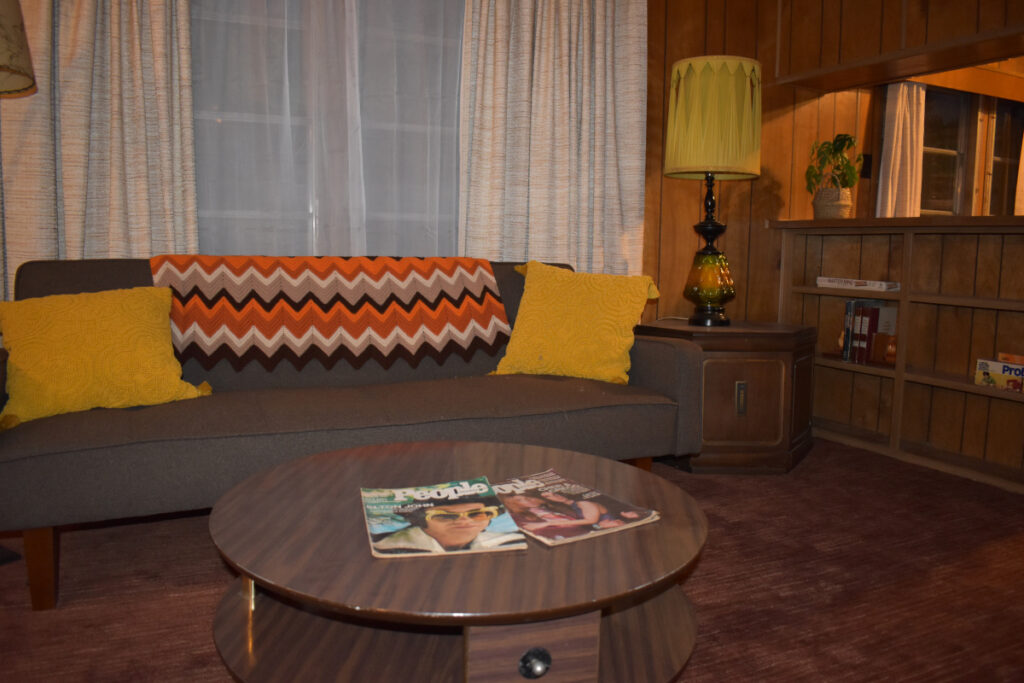
Mid Century Modern Warm woods, restrained lines, and warm, saturated colors quickly replace the stark white farmhouse look that has been popular for so long. This look started and has always been popular in the Midwest, but you now see it from coast to coast. Greens and blues are the stars of this look as well, and it feels good to not only dress up and go out again ourselves but also to let our homes become a little more sophisticated as well. We love how this style feels all grown up, just like we do.
Thoughtful Design A place for everything and everything in its place. The days of clutter and having “stuff” for stuff’s sake are over. Homeowners are now collecting and curating items that mean something to them. Their spaces mirror their tastes and lifestyles, not what they are shown at a local big box store or website. Mixing grandmothers china with a stunning acrylic dining table isn’t only OK, it’s preferred. And if those items have some character and possibly some whimsy to them, they are even more in vogue.
Finishing Touches Metal and wood finishes are warmer than we have seen in the last few years. Black windows, industrial styling, and shiny surfaces are replaced by unlacquered brass and mixed metal finishes. Faucets, hardware, and lighting look like they have been around for a hundred years but have a new, clean, modern style.
Seeing The Light LED lighting has not only become more affordable, it now offers so many exciting design solutions it is hard to know where to start. Flush ceiling lighting has evolved from extensive, protruding eyeballs to tiny square boxes that you hardly notice but can provide hundreds of lumens each. Single pendant lighting has lost its appeal, and we are now seeing oversized shades and lights that are more in scale with our larger open spaces and look more like a work of art than just a source of light.
The Healthy Home Consumers are more concerned than ever about how their home can affect their health and wellbeing. Companies like Beko, a new to the United States appliance company, have realized that healthy living is only possible on a healthy planet and are creating extraordinary new appliances to help us live a healthier lifestyle. Other companies that follow this mindset will be at the forefront soon.
True To You: Being Genuine Now more than ever, earning a new buyer’s trust should be the essential part of your company’s mission statement. With so much social media and untruths out there, customers need to know whom to believe and who will help them through the most significant investment they will probably ever make. When we design and sell a home, it is our reputation and the reputation of the entire industry that is at stake. If you are fair to the customer and lead with honesty, you’ll have a customer for life.
Retro collections are trending in spaces like this great zoom room/dj booth that was once a closet. (Kips Bay Dallas 21 Showhome)
Kinnebrook Manufactured Home Community, Monticello, NY.
Updated Maryland, New Hampshire, New York JLT Market Reports for MHCs Available Now
Manufactured home communities in the northeastern United States show sustained growth in rent and occupancy, according to updated reports published by Datacomp, the industry leader in manufactured home appraisal and market data.
Rent and occupancy trends for manufactured home communities in Maryland, New Hampshire, and New York are available for order, including immediate download.
JLT Market Reports provide detailed research and vital information on communities in 186 major housing markets throughout the United States. Along with the latest rent trends and occupancy statistics, the manufactured home community market reports include information on home types, amenities, community infrastructure, as well as other management insights.
Datacomp is the nation’s top provider of manufactured housing data, and JLT Market Reports are recognized as the industry standard for manufactured housing community market analysis.
March 2021 JLT manufactured housing market data includes information on 229 “All ages” and “55+” manufactured home communities and 40,153 homesites in Maryland, New Hampshire, and New York.
Manufactured Housing Community Data in the Northeast
The Northeast region 55+ communities experienced an adjusted rent increase of 2.9% and an increase in occupancy of 0.5%
The Northeast region all-ages communities experienced an adjusted rent increase of 3.5% and an increase in occupancy of 0.6%
“Manufactured housing community rent and occupancy in the March 2022 publications showed continued steady growth, with only a single set of counties in New York experiencing a slight dip in occupancy rates,” Datacomp Co-President and Chief Business Development Officer Darren Krolewski said.
More About JLT Market Reports
Each JLT manufactured home community rent and occupancy report from Datacomp has detailed information about investment-grade communities in the major markets. The detailed information includes:
Number of homesites
Occupancy rates
Average community rents, and increases
Community amenities
Vacant lots
Repossessed and inventory homes, and much more
JLT Market Reports also include management insights that rank communities by the number of homesites, occupancy rates and highest to lowest rents. Established reports show trends in each market with a comparison of March 2022 rents and occupancy rates to March 2021, as well as a historical recap of rents and occupancy from 1996 to present date in most markets.
The March 2022 Maryland, New Hampshire, and New York JLT Reports for manufactured home communities are available for purchase and immediate download online at the Datacomp JLT Market Report website, or they may be ordered by phone in electronic or printed editions at (800) 588-5426.
Each fully updated report for mobile home communities is a comprehensive look at investment-grade properties within a market, enabling owners and managers, lenders, appraisers, brokers, and other organizations to effectively benchmark those communities and make informed business decisions.
More than 1,500 manufactured housing professionals are expected in Las Vegas April 7-9 as the Manufactured Housing Institute’s Congress and Expo returns to the...
With more homes, more exhibitors, and more buzz than ever before, the 2026 Biloxi Show is expanding, and fast.
The Biloxi Manufactured Housing Show &...