The Legacy Award honors manufactured housing professionals whose overall career contributions are certain to create meaningful and lasting industry improvement and excellence
Dennis Hill of Show Ways Unlimited
June 13, 1943 – July 2, 2023
The 2025 MHInsider Industry Award winners have been announced in five categories.
Dennis Hill was the talent behind Show Ways Unlimited and the hundreds of manufactured housing industry trade shows he and his team organized. Hill started with the Atlanta show, which was outside at the farmers market. Based in Roswell, Ga., Hill was good at motivating people and took great joy in seeing a show come together. The goal, Hill said in a 2017 interview with MHInsider, was to “create something durable.” Subsequent Show Ways were held during the course of more than 50 years in Kansas City, Mo., Charlotte, N.C., Atlanta, Louisville, Ky., Tulsa, Okla., New Orleans, La., Tunica, Miss., Omaha, Neb., Nashville, Tenn., and Atlantic City, N.J. The Louisville Show remains the largest gathering of industry professionals each year. It is sponsored by five state associations and boasts the largest collection of model homes displayed indoors anywhere in the United States. During Hill’s decades of putting on shows, he had many people around him, including a 22-member board, to help organize a trade show from earliest planning through working with partners and vendors, to securing space and getting show homes organized and speakers assembled. He said running shows was an experience that got his blood flowing, something akin to a political campaign with all the months of planning that must coalesce into action.
What do you believe are Legacy Award winner Dennis Hill’s greatest achievements?
Despite facing many challenges throughout his years, Dennis considered his greatest achievement completing 50-plus years of producing trade shows for the manufactured housing industry. He did love the industry. He cherished his friendships and relationships built during those years with those in every aspect of the industry. He handled each show from inception, planning, and organization, both before and on-site, all with a small two-person office that started out in the basement of his home. And, of course, his family, dogs, and cats were his BIGGEST achievement!
— Wife Nancy Hill
What are the award winner’s personal skills or character traits that you feel have contributed most to these successes?
Dennis was good at listening, understanding needs, and being respectful even when disagreeing. He had a flexibility in dealing with a variety of people to make sure a show came off without a hitch. He showed a high degree of persistence and a strong work ethic. He was a force to be reckoned with… with a sense of humor.
— Event Planner and Friend Michelle Middleton
Please click on any of the following award categories to learn more about the award and the 2025 award winner.
Manufactured Housing Resources Group's Roderick Knoll is the recipient of the 2025 MHInsider Leadership Award.
The Leadership Award honors individuals who have earned the highest levels of industry achievement through their corporate or organizational leadership approach
Roderick Knoll of Manufactured Housing Resources Group
The 2025 MHInsider Industry Award winners have been announced in five categories.
Roderick Knoll has provided pre-construction services to developers of manufactured housing land-lease communities since the 1980s. He prepares market studies, arranges construction and permanent financing, brokers land, and completes communities. Among the more notable communities he has helped bring to the market is New Colony Village in Walkersville, Maryland. Knoll is a board-certified appraiser and has been a member of the Urban Land Institute and the National Association of Realtors. Knoll has been instrumental in conducting MHI’s annual Developers Seminar, held each spring in association with the Congress and Expo, an add-on element that is the counterpart to the National Communities Council Spring Forum. He earned a B.A. from Southern Methodist University, where he studied real estate, finance, and economics. For Neighborhood Works of America, he taught courses on underwriting for non-profit developers, the basics of blueprint reading, and an introduction to factory-built housing. He was also a co-author with colleagues Donald Westphal and Craig White for a 2001 book entitled “Renewing Your Manufactured Home Community: A Community Owner’s Guide to Upgrading.”
What do you believe are Leadership Award winner Roderick Knoll’s greatest achievements?
Roderick’s ability to organize seminar items in informative and entertaining ways, both for our MH industry and non-profit housing entities, has been of great value. I have partnered with him on many joint projects over the years, and have always found him adding to the success of those endeavors.
What are the award winner’s personal skills or character traits that you feel have contributed most to these successes?
Roderick’s communication skills, both in person and in written reports, have been essential to his success. His honesty in delivering recommendations that may not always please clients but accurately predict potential outcomes demonstrates his integrity and professionalism. Manufactured housing professionals like Roderick have significantly enhanced the industry’s image and reputation.
— Landscape Architect Donald Westphal
Please click on any of the following award categories to learn more about the award and the 2025 award winner.
The Texas association's Rob Ripperda is the recipient of the 2025 MHInsider Visionary Award. (photo courtesy of MHI/Shawn Spence)
The Visionary Award honors those who have brought to market the coolest concept or product, the idea that makes the job easier, the offering better, the customer experience more meaningful
Rob Ripperda, of the Texas Manufactured Housing Association
The 2025 MHInsider Industry Award winners have been announced in five categories.
Rob Ripperda is the vice president of operations for the Texas Manufactured Housing Association. He has created every data and statistical report, tool, and program in use at TMHA, in a state that many observers view as a leading indicator of market trends. Ripperda has been at TMHA since 2012. He worked at Dell prior to that for several years in systems and programming. He earned a bachelor’s degree from UT Austin and a Master’s from Georgia Tech. By digging through titling and shipment data in Texas, Ripperda created systems and reports that are widely known in the industry. He created the association’s system for tracking pending legislation, reading bills, and conducting research that provides a solid base for detailed analysis that can be applied to policy or proposed policy directed toward specific state congressional districts. The association recently launched a new website, too, which houses the many reports on production, placement, and market data it shares with its 5,000-plus members.
What do you believe are Visionary Award winner Rob Ripperda’s greatest achievements?
Rob is a creative powerhouse whose contributions to the manufactured housing industry come to life through a suite of innovative data products. He built and maintains practical tools, such as the ‘Mobile Homes for Sale’ Google Search Trends tracker and the Manufactured Home Builders Stock Price Index, that turn scattered signals into informative indicators. He also serves as a conduit to academic researchers, amplifying the industry’s visibility through collaboration. For example, he spearheaded the Texas Manufactured Housing Survey, a monthly barometer that gives a real-time read on manufacturing activity, pricing pressure, and backlogs, as well as hard-to-measure factors such as regulatory burden and supply-chain pressure. Rob is a critical player in the manufactured housing industry, creating widespread value through his inge-nuity, relentless energy, and technical expertise.
— University of Southern California Microeconomist Wes Miller
What are the award winner’s personal skills or character traits that you feel have contributed most to these successes?
Rob is entirely self-motivated and is endlessly curious. He has tremendous drive and an unparalleled work ethic. He has a strategic and politically savvy mind and can solve problems from a multitude of different approaches. Knowing him like I do, and working with him now for well over a decade, I can say he is just getting started. The new tools and collaborations in our future will be a sight to see.
— TMHA Executive Director D.J. Pendleton
Please click on any of the following award categories to learn more about the award and the 2025 award winner.
Identify Simple Missteps, Make Them an Action Checklist to Improve Your Visibility Online
A dozen or more years ago, before I joined MHVillage, I was a partner in a consulting firm that was active in the manufactured housing industry. Among our clients, we worked on behalf of several manufacturers to coach their retailers and communities on successful marketing techniques.
In those days, we were doing several hundred consultations a year throughout the country. Many of the companies we visited already were very successful. They just were in need of some optimization in a few key areas. Others had more significant marketing challenges to overcome. But no matter where we traveled, my partners and I began to see a lot of the same mistakes. There was inadequate signage, poor business image, ineffective advertising, lack of prospect follow up… you get the idea.
The process of identifying these marketing missteps became a checklist that we would run through when we consulted with a new client.
Now I’ll be the first to admit that many of these things I’ve mentioned so far may seem pretty obvious. But that’s the point. We learned that even the best marketers often lose sight of the basics, and need a friendly reminder every now and then. Use these tips to improve your organic search results.
As it has been more than a few years since my consulting days, and it got me thinking. What would that list of marketing basics look like today?
We’re in a world dominated by the internet, mobile devices, social media, and now AI. What are the things you should be focusing on in today’s environment of ever-changing technology?
Have you ever noticed how websites look great whether you view them on your laptop, tablet or smartphone? That’s called responsive design, and it’s what enables a website to dynamically resize to provide the best possible user experience regardless of the device on which it is viewed.
In the old days, we would talk about the importance of having a good website. Now, the emphasis is on making sure your website is functional for the way customer will view it. In other words, from a mobile device.
According to the most recent data from Google, mobile searches make up more than 60 percent of internet searches. And that number is continuing to grow.
The concept of responsive design seems simple enough. But the solution is more than just updating your website with the latest WordPress theme. Are the fonts readable on a tiny 4.7-inch smartphone screen as well as on that giant tablet-sized phone? Is the navigation intuitive? Can the consumer easily fill out your contact form or application from a mobile device? According to research cited by web app developer, Mobify, 30 percent of mobile browsers will never return to a website if the experience is not optimized for mobile.
If you’d like to get some insights on how search engines view your website, Google “mobile friendly test” and you’ll find a link to a tool where you can enter your web address and get an analysis of your mobile readiness. It’s a great way to benchmark how search engines like Google are seeing your site.
Can Customers Find You Online?
Pretty much everyone, across every age group, uses the internet during a home search. Indeed, the latest statistics from Google show that internet usage is well over 90 percent among home potential homebuyers, and more than 60 percent of these searches are made from mobile devices.
In the early days of search engine optimization, it was relatively easy to show up in a top position. You’d stuff a web page with the keywords you’d want to target, like “mobile homes in Tuscaloosa”. If you were to repeat the phrase in the header and domain name, like magic you’d own the space. Well, the search engines got wise to that technique a long time ago. Now if you want to have a top position you need relevant content. Or open your wallet to search engine advertising. Most of the time, you have to do a little of both.
You may have noticed that when you search for something from your mobile device, a lot more comes up on your screen than ever. There are paid ads, local business listings, videos and social media pages, just to name a few items. In the past, your company may have been at the top of page one in Google with your organic search results. These were non-paid listings that show up when anyone does an internet search. If you’re fortunate enough to maintain that position, you’re still halfway down the page after everything Google puts in. And if you already were half way down the page, now you’re on page two or three where views drop exponentially.
Don’t worry, though. All is not lost.
Improve Your Visibility Online by Updating Those Important Listings
If you can’t beat them, join them. It may seem like the simple solution to do paid search advertising and buy your way to the top. But that can be an expensive proposition. Online advertising is becoming more competitive and costs are going up. This is especially true when a growing number of companies outside our industry are discovering that manufactured home keywords are great at driving traffic to their industries, too.
A better solution is to start by making sure you have an up-to-date and complete Google My Business listing for all of your locations. It’s a simple process. These local listings regularly appear ahead of organic search listings, most noticeably on mobile. They are particularly valuable when consumers do “near me” searches, which have grown by more than 140 percent on average, year over year.
Search engines place a lot of emphasis on these directory listings, as you can see by the priority Google places Google My Business listings, and other directory sites like Yelp, the Better Business Bureau and MHVillage. In many instances, a community or retailer listing on MHVillage is one of the first things that will show up in the organic search results.
Another reason to maintain your listing is because of the rise of digital assistants like Apple’s Siri, Amazon’s Alexa and Google’s Assistant. These assistants, whether on a mobile phone or a smart home device, use directories and information sources such as Yelp and Wikipedia to provide answers to consumer queries.
How’s Your Online Reputation?
Of course, visibility online is sometimes a double-edged sword. As you may have noticed, search engines like Google also put ratings and reviews next to search engine results. Not paying attention to your reputation online can be very costly.
We know that more than 75 percent of consumers base their purchase decisions on ratings and reviews. And, of course, people are far more likely to share a bad experience than a good one. There are many web-based software tools to help monitor reputation. Though, one of the best solutions is to simply put a program in place to encourage positive reviews.
Ask for Reviews and Testimonials to Improve Your Visibility Online
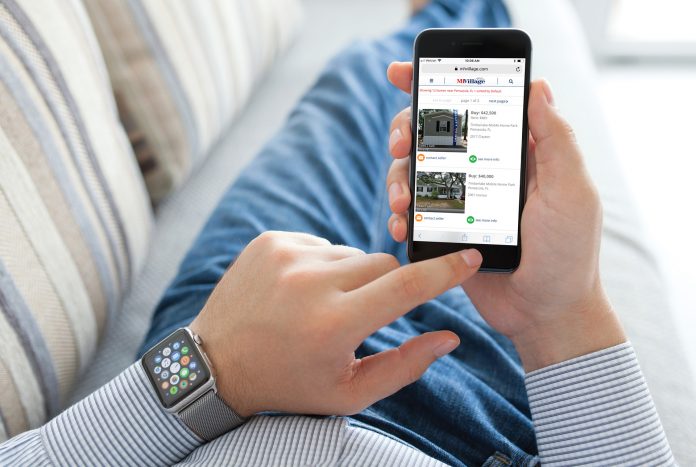
For example, if you look at the MHVillage professional blog landing page, you can see an example of this invitation to leave a review in the right sidebar. This tool guides the website visitor through the process of leaving a review for us on Google, Facebook and a bunch of other sites that are relevant to our business.
Of course another way to build your reputation online is simply to ask your customers.
As an MHVillage advertiser, you notice we ask for testimonials when homes are marked as sold. Responding promptly to the occasional negative review and proactively asking customers for reviews is a great way to stack the deck in your favor. And, this diminishes the impact negative reviews have when they do occur.
Even when it comes to the basics, attempting to keep up with technology can be a daunting task. However, the good news is that the marketing mix will continue to evolve. And our objectives will remain the same. That is, make it easy for your best prospects to find you. Earn their confidence and make them want to do business with you.
Host a resident happy hour at the community, with drinks and snacks for everyone. All photos courtesy of Lisa Stewart/Lisa Stewart Photography.
Times are changing, especially when it comes to manufactured housing. Now more than ever, a new group of potential buyers is discovering our homes, not only for the price, but for the lifestyle they can afford.
Partner with a local provider for a food truck on site. Everyone loves a snack!
This shift in perception presents a promising future for our industry.
When the City of Dallas asked me to join their Development subcommittee and the Inclusive Housing Task Force, I realized it was an incredible opportunity to finally get our city leaders in on what not only factory-built housing can offer, but also the value that land-lease communities could bring to our city. It has now been over a year, and there is so much interest in how Dallas can include more community homes within our city limits. It has also made me realize that many things we take for granted about our homes, and think that everyone else knows about them, are usually not true.
I can’t tell you how many times I’ve had to patiently explain that no, you can’t back a Ford F-150 up to the hitch on the home and drive it away! We often forget that not everyone is aware of the value and incredible design our homes offer.
With that being said, here are “Five for 2025” ways to create value and interest in communities and homes.
Get the kids and grandkids together for a fun Easter egg hunt!
Sharing is Caring
Community owners have often told me that they can’t afford to keep a furnished model, or their homes sell or lease so quickly it isn’t worth the cost. Consumers want to see what they are buying now more than ever. They can go on Amazon 24/7 and buy a house without physically touching it, but have the opportunity to view beautiful photos of a finished home. Consider taking advantage of the professional photography services offered by your home’s manufacturer at no charge. Alternatively, you can negotiate an agreement with a local furniture company to rent furniture for a few weeks, allowing you to stage your home for photos. In return, offer to share the details about local retailers with your new homeowners and potential buyers for their products.
Simple outdoor community cooking is a great way to come together!
Connect with the Surrounding Community
If your community is too small to offer many amenities, find local organizations like the YMCA, or an affordable fitness club that you can offer a discounted membership to, or maybe they would let you have a day of the week where your residents could use their facility at no charge, hoping that they will upgrade to a full membership. If there is a childcare facility nearby, see if you can work out an agreement with them on reduced fees. If you allow pets, consider having someone offer dog training classes at the community. It will help your residents have the best experience with their pets, it will help those pets become great neighbors. This kind of community engagement empowers both the residents and the community itself.
Hire a local band and put on a lawn show in the community.
Host neighborhood Flea Markets or Garage Sales
Have your community host an annual or quarterly community garage sale that all residents are encouraged to participate in. The community can pick up the tab for marketing the event, and then host a celebratory potluck dinner at the end of the day. It’s a great way for neighbors to get to know each other while picking up some great deals! It also helps keep your community fresh and encourages residents to get rid of items in and around the home that are no longer needed.
Create a community garden or vineyard.
Create a Victory Garden
If you have some unused spaces in your community, con- sider creating gardens where residents can plant and grow delicious, home-grown fruits and vegetables. If you are lucky enough to have an abundance of goodies to harvest, donate them as a community to the local food bank. It is a great way to keep your residents busy and happy while creating goodwill in the community.
Celebrate the holidays with your residents. It will provide memories to last a lifetime!
Happy Holidays!
There is nothing that gets people in the holiday spirit like a contest. Host decorating contests for your residents during various holidays, like Halloween, Thanksgiving, Christmas, and the 4th of July. Yard of the Month contests are another way to help your residents take pride in their communities and to keep up the appearance of your community as well. Ensure the community participates, and that the entrance and community buildings match the quality of your residents’ homes.
By creating excitement not only in your community but in the city surrounding your community, you can help change the perception of what today’s ‘trailer parks’ or ‘mobile home parks’ are really about and the excellent, affordable quality of life they can offer. This mission to change perceptions should motivate us all to continue sharing the good news about our industry, so we can all continue to thrive.
Fannie Mae has announced new leadership roles for three of its current executives, includingi Peter Akwaboah, Fannie Mae’s chief operating officer, who has been appointed to the added role of acting CEO, FHFA Director and Fannie Mae Chairman of the Board William J. Pulte said in a statement on Oct. 22, 2025.
“Peter’s deep operating background, as the former Morgan Stanley COO of Global Technology, makes him the perfect fit for the Acting CEO position while the board conducts its search for a permanent CEO,” Pulte said.
John Roscoe, who had been senior vice president of operations and communications, and Brandon Hamara, a former Freddie Mac board member, will work together as co-presidents of Fannie Mae.
“We now have a deep bench of three experienced leaders at the very top of Fannie Mae,” Pulte said. “This means a safer, sounder Fannie Mae, all while growing our great Fortune 25 Company.”
Akwaboah has more than 30 years of financial services leadership in operations, technology, and innovation at Morgan Stanley, Royal Bank of Scotland, Deutsche Bank, KPMG, and IBM. He will continue to oversee Fannie Mae’s COO division.
“At Fannie Mae, we are building a deep, focused, and operationally experienced leadership team, at the top, to lead the company to increased safety and soundness and accelerated profitability,” Fannie Mae Vice Chairman of the Board Michael Stucky said.
Outgoing Fannie Mae President and CEO Priscilla Almodovar said her leadership role at Fannie Mae has been the “privilege of a lifetime.”
“Together, we have made Fannie Mae stronger than ever. I will be eternally grateful to the entire Fannie Mae family, our many partners, and Director Pulte for the opportunity to lead this incredible organization that helps millions of American homeowners and renters access their American Dream,” she said.
The news release stated that all the leadership changes are effective immediately.
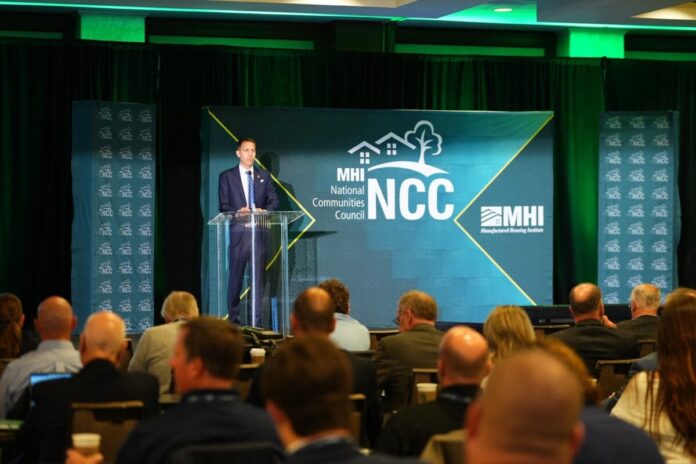
Mark Bowersox, president of MHI, welcomes attendees at the NCC Fall Leadership Forum in 2024.
Manufactured home community owners and operators, as well as other industry professionals, are meeting Nov. 5 — Nov. 7 in downtown Chicago for the annual NCC Fall Leadership Forum.
The event for community owners and operators is hosted annually by the Manufactured Housing Institute, the national advocate for the industry, to discuss the top challenges and opportunities for industry professionals involved in the land-lease business.
The NCC Fall Leadership Forum, being held at the Westin on Michigan Avenue, is the Manufactured Housing Institute’s major annual executive-level meeting for members. Manufactured housing industry professionals in attendance will include:
Community owners Community managers Home manufacturers Industry service providers Brokers Lenders Consultants
The forum offers new ideas, examines new trends, and provides perspective for manufactured housing industry professionals doing business with communities. Organizers have put together two nights and 1.5 days of programming geared toward executives who need a limited time from the office and a high-impact meeting agenda.
The event will begin in the afternoon on Wednesday, with onsite registration at 4:30 and a welcome reception at 6 p.m. The event then kicks off at 8 a.m. Thursday morning with a sponsored breakfast and programs that will include an industry update from MHI and industry experts discussing topics ranging from local and regional trends to expanding and upgrading communities, and the latest regulatory topics. The programming continues Friday morning, with additional discussions about growing the market for manufactured housing and manufactured home communities.
From left, Occupi’s Chief Legal Officer Josh Hornady, Co-founder and CEO Taylor Peake, and Co-Founder and COO Emily Hart.
Pardon… the emerging tech company with local roots may seem like a cute little cartoon character facing a big problem to solve — more on that later — but Occupi comes from an informed place in the man- ufactured housing industry and has applied the latest in tech advances to how homes get filled and monthly payments get made.
Company co-founder Taylor Peake was a community owner long before she started Occupi. She owns parks in Walker County, Alabama, in the area where she grew up, including the community she lived near as a child. She bought that first one from her parents about 10 years ago.
“It’s really difficult to strike a balance between what meets the residents’ needs and what is efficient for the management team,” Peake said. Some of the challenges are obvious on the surface, but difficult in practice — especially around rent payments. “In the communities we serve, we have received a lot of local feedback,” Peake said. “I actually set up myself as a resident in my community and went through the process of submitting an application and walk-in cash payment to experience the process from both sides.”
In many cases, you have to find a local brick-and-mortar store, like Walgreens or another national chain, that has arrangements with payment services, allowing for residents to send money. “In some cases you have to wait in a pharmacy line,” Peake said.
Digital payment sources, particularly app-driven payments, are on the rise. Companies like Block, Inc., which owns Cash App, are making major strides. Today, 60 percent of U.S. mobile phone users take advantage of payment apps, transferring better than $7,000 per year, on average.
“The fees are lower, the service is better, and it is convenient,” Peake said.
Collect Rent Without Knocking on Doors
Peake purchased her second and third communities during the COVID pandemic, compounding the difficulty of communicating with residents, meeting their needs, and completing transactions. Most small to midsize operators in multi-family or manufactured housing community operations faced challenges never seen, never thought of, in the spring of 2020.
“USPS disruptions during Covid made paying and receiving rent via money order even more of a hassle than usual. During the pandemic, the postal service was unreliable and created a major hurdle,” Peake said. “Money orders, cashier’s checks, they were just vanishing.”
The Occupi Technology
Occupi’s software facilitates an easy screening process for applicants and enables multiple payment options in a central hub for renters, including Cash App, Chime, SoFi, Venmo, and PayPal, alongside traditional ACH and card payments.
Many tenants and residents are “underbanked or unbanked”, or simply prefer alternate means to get paid, keep revenue, and pay bills. Many of the Occupi customers have more than one employer, and little free time to run errands, go to the bank, or manage a character code while waiting to complete an in-person transaction. For walk-in or slip payments, the property managers are creating a character code to associate the payment with the resident’s account.
Instead, Occupi is identifying the resident’s account inside of the community’s property management system and (with their permission) associating the resident with their cash wallet or favorite alternative payment method. Using Cash App as an example, the resident can utilize Cash App’s cash deposit locations to quickly deposit cash or employer checks without the cumbersome slip or character code process.
“We see many residents paying rent after hours, when traditional financial solutions or walk-in payment locations are closed,” Occupi co-founder Emily Hart said.
Max Rykov, director of growth for Occupi, comes from the nonprofit housing sector in Alabama and Tennessee. He is was new to the company and new to the industry in 2025, but accustomed to the difficulty of a smooth application and monthly payment process. “It’s such a big issue,” Rykov said. “I assumed that this approach would have already existed. The future of payment will be via app-based solutions.”
Build the Idea, the Brand Emerges
Peake and Hart spent much of 2023 working on the big idea. They booked meetings with TransUnion. They reached out to all of the app-based payment services. They talked with residents, friends, and colleagues in the housing sector and in the tech space.
“It’s a lot of conversation and partnership,” Hart said. “That’s probably why no one else has done this. “We launched the service in 2024 on Taylor’s properties,” she said. “We took a lot of feedback, and, again, looked at what worked and what didn’t… We felt really good about our product.”
Occupi’s fast application process incorporates the use of tax IDs rather than solely Social Security numbers. This innovation opens the application process to legal residents who are not yet citizens. When they made the app available to the wider market, the Occupi team signed up 1,000 doors in two weeks. To date, Occupi has facilitated more than $385,000 in transaction volume. Hart said the application is largely invisible to property owners because it operates in conjunction with owners’ existing software, but also can be used as a standalone product.
“That’s something that fits well for smaller operators using only QuickBooks or Xero,” Hart said
The Origins of the Octopus
Hart has a marketing background and in recent years has been primarily in product development. When it came to naming the company, she wanted an active verb, she said.
“I found myself saying a lot ‘Is this unit vacant or occupied?’ I liked that. ‘Occupied.’ Occupy as a company name was already taken, but Occupi with an ‘i’ was there. And I felt like it worked.”
At bedtime several days later, she was struck by her son’s favorite companion, a plush beanie octopus that he called “Octi”.
“We should do an octopus!” She recalls exclaiming. Not so good for bedtime, but great for marketing.
“We went with an ocean color palette and Octi, the Occupi octopi, and it stuck,” she said.
Take the Product to the Industry
With roots in Alabama, it makes sense Occupi would make its debut at the Biloxi Manufactured Housing Show and Expo. The manufactured housing industry is a complex business. Products designed for other industries, or for other sectors of housing, often feel clunky when applied to the space.
Occupi is one of the very few novel fintech solutions designed for manufactured housing. It takes into account the varying models, from “on land” to scattered site, to community, and full-rentals versus land lease, and the varying utility options and fees associated. There’s no charge to property owners to implement Occupi, and a nominal flat fee is added to each payment, which can either be covered by the property owner or passed to the resident.
Full bonus depreciation is back, which will likely fuel an uptick in demand for manufactured housing communities. Despite high interest rates and a softening of almost every major real estate asset class, communities remain a highly sought-after investment.
With inherently less competition than multifamily, it would seem from the outside that a manufactured housing community would be easy to source and acquire. However, as anyone reading this article understands, this is not always the case. The market seems saturated with smaller communities in secondary and tertiary markets.”
There are operators who have been successful in purchasing small communities, but as a management company with an operation of about 15,000 home sites, we see some recurring trends we would like potential owners and investors to understand.
Challenge #1 — Infrastructure
The core of a land-lease community is land. Sounds obvious, but it is surprising the number of people who purchase a community and pay little to no attention to the infrastructure beneath the ground. Small communities, some of which were built in the 1950s by mom-and-pop operators, were often built with water, sewer, and sometimes electric infrastructure that was not intended to last 75 years. When purchasing a community, it is standard practice to hire a plumber and have them scope the sewer lines to determine their condition. The most common sewer main material at that time was clay tile; if clay tile is properly maintained, it can remain useful for a long time, but once it begins to have root intrusion or sections that collapse, that trend will continue. Do not underestimate how much sewer main repairs will cost.
Water mains are trickier to understand in due diligence, as you cannot scope them with a camera. If there are leaks, they are rarely visible to the naked eye. The first step is to understand the size and material of the main. Some older communities have 1.5 to 2-inch diameter mains, and small mains typically mean low water pressure for residents. Next, look at a master water bill and note the total usage of the community. If usage is over 125 gallons per resident, per day, the community likely has leaks. Do not fall into the trap of thinking that installing submeters will fix your water problem. Submeters are great and will accurately track how much water each resident is using, and allow you to recapture it. If there are leaks before the meter, that water is still lost — unable to be recaptured — leading to consistently higher expenses and lower recapture percentages.
Challenge #2 — Market and Business Model
When did location, location, location stop being the core of a real estate investment? Do not fool yourself into purchasing a community that does not meet the fundamentals of a good investment. We see people purchasing communities in tertiary markets with no tangible value proposition. If a resident can purchase a single-family home for under $150,000 or rent a 2-bedroom apartment for under $800 per month, a large majority will choose that over a new manufactured home in a community. Attainability is the cornerstone of our business; the market requires less expensive housing, and a manufactured home should sell for around a third of the price of the average single-family home.
Let’s look at another scenario, where the community is full and there is no need to infill homes. When looking at a property to buy, take into careful consideration the quality of the houses, even if they are owned by residents. Because… residents move out, no matter what your favorite podcast may say. When a resident moves out, what is the physical quality of that home? Will it need to be demolished, or can it be renovated and resold? In either case, vacancy loss and home attrition costs need to be built into the business model.
Challenge #3 — Staffing and Management
Manufactured housing communities are easy to manage. Pay a resident $500 a month and they will mow the grass and collect the rent! That may have been the business model years ago, but it is not the case anymore. Even if the community does have a sweetheart deal in place with a resident, make sure that when purchasing the community, you adequately buffer expenses in the event they leave. If they do, your operational costs for the community will likely increase significantly. Finding part-time labor for a small community is difficult and landscaping/maintenance costs have increased exponentially in recent years. MHC management is a labor-intensive process. Having a small community doesn’t mean a small workload. Often, a 50-site community will need the same workforce as a 100-site community, with half the revenue to support it.
Purchasing a small community can and should be a successful venture. There are many operators nationwide that do it efficiently and profitably. To be successful, please ensure that the community has viable infrastructure, a clear value proposition to the market, and can operate efficiently over time.
Annual Event Held in Partnership with The Novi Home Show
Manufactured housing professionals in Michigan have the opportunity to see new homes and to talk with exhibitors Oct. 10-12 at the MMHA Manufactured Housing Showcase within the Novi Home Show being held at the Suburban Collection Showplace.
There will be four new manufactured homes on display and open for attendees to tour. Each home is decorated and furnished. Representatives from manufacturers, manufactured home communities, and retailers will be on hand to lead tours through the model homes, according to the MMHA, and answer questions about manufactured home living and community and private property placement options.
Tickets for the event can be purchased online in advance, offering a $3 cost discount and allowing attendees to skip the event line. Tickets the venue are $12, $10 for seniors, and children 12 and younger get free admission.
The Suburban Collection Showplace is located near Detroit, at 46100 Grand River Avenue in Novi. Show hours are Friday from noon to 7 p.m., Saturday from 10 a.m. to 7 p.m., and Sunday from 10 a.m. to 5 p.m.
The home show is a public event, and is expected to draw thousands of attendees.
“Our manufacturing partners are crucial in demonstrating the value of manufactured housing to the general public,” MMHA CEO John Lindley said. “We’re excited for our fellow industry professionals and legislative and government officials to see for themselves the newest in manufactured housing developments.”
About the Michigan Manufactured Housing Association
Michigan Manufactured Housing Association (MMHA) is a nonprofit trade association representing the manufactured and modular housing industry in Michigan. MMHA works to improve the image of manufactured housing by educating consumers, media and government about the quality, affordability, design and beauty of the homes. It also works to protect the interests of the industry and the owners of manufactured homes. For more information, please visit www.michhome.org.
Oct. 6-8 at Avalon Hotel in Alpharetta, Ga.
Manufactured housing community owners have never had more information available to them — or more decisions to...
The Midwest Manufactured Housing Federation has announced that attendee registration is now open for the 2027 Louisville Manufactured Housing Show, returning to the Kentucky...
HUD’s Innovative Housing Showcase, MHI’s Homes on the Hill and Annual Meeting Begin Sept. 22
Two of the country’s largest builders of manufactured homes will...