‘Simplification’ Means Eliminating Duplicative Forms of Oversight, Bringing Down the Cost of Housing
Congresswoman Erin Houchin, R-Indiana, and Congressman Mike Flood R-Nebraska, with a short statement on Sept. 17, introduced the “Affordable Housing Opportunities Made Easier through Simplification (Affordable HOMES) Act”, legislation that eliminates unnecessary federal red tape driving up the cost of manufactured housing and pricing families out of the American dream.
“Families across Indiana and across America are feeling the strain of a housing crisis that continues to drive up costs and limit options,” Houchin said. “Manufactured homes are a vital pathway to affordable housing, yet Washington bureaucracy has only made it harder for families to access them. The Affordable HOMES Act is a commonsense solution to get government out of the way, lower costs, and give more families the opportunity to achieve the American dream of homeownership.”
“America is in the midst of a housing crisis and the federal government needs to cut red tape to help build more homes,” Flood said. “The Department of Energy’s regulation of energy efficiency standards for manufactured housing has created burdensome confusion that drives up the cost of manufactured homes. Removing the Department of Energy’s statutory mandate to regulate manufactured homes is a commonsense step that not only brings much-needed clarity but also enhances regulatory efficiency. Thank you to Rep. Houchin for her leadership in addressing this issue and for helping ensure our government gets out of the way of more people living the American dream.”
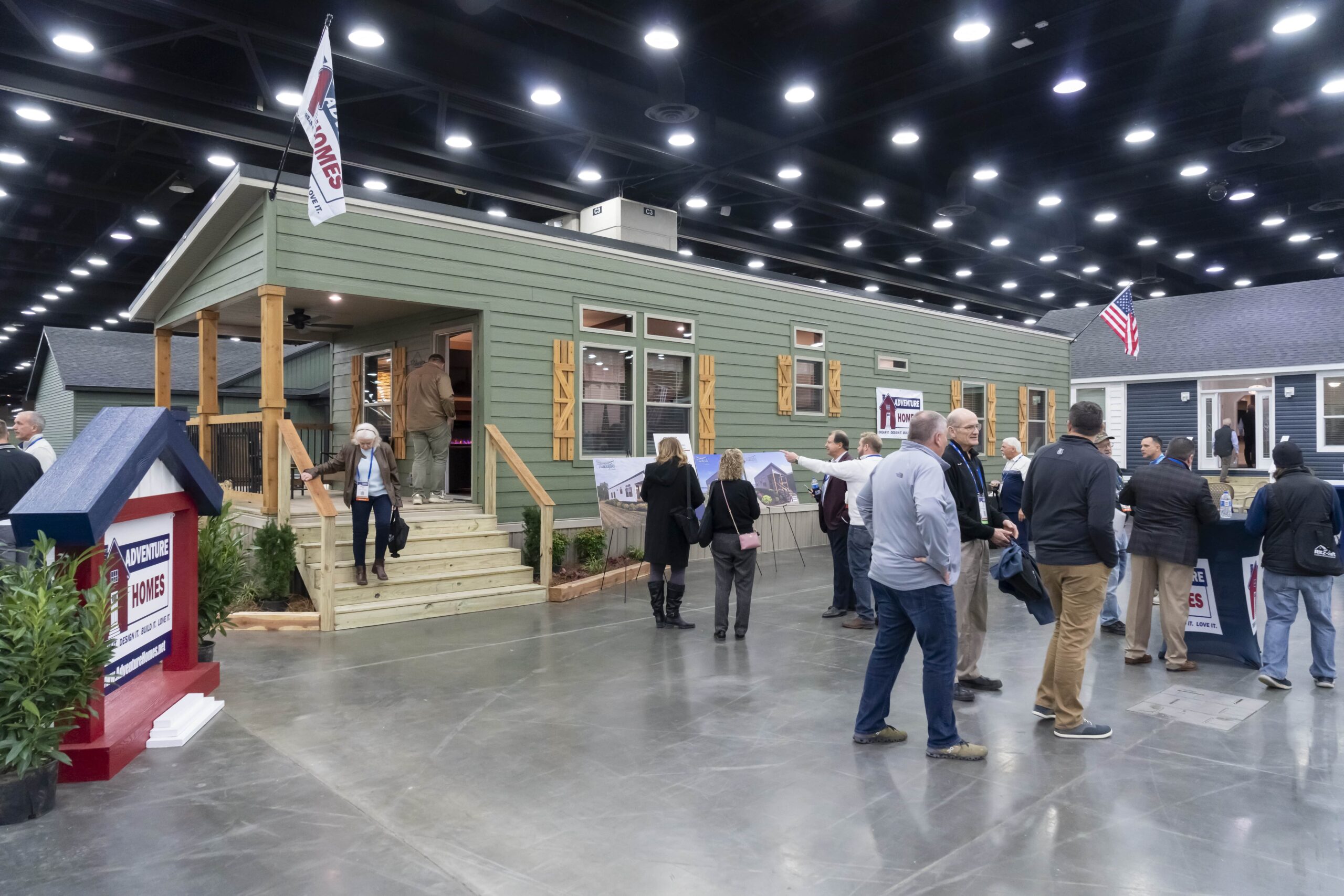
The Midwest Manufactured Housing Federation announced today that attendee registration is now open for the 2026 Louisville Manufactured Housing Show, returning to the Kentucky Exposition Center in Louisville, KY. from Jan. 14-16.
As the precursor to the spring selling season, the Louisville Show provides manufactured housing professionals from across the country the support needed for a strong sales year.
“The Louisville Show is the industry’s chance to tour the latest model homes on display and connect with fellow manufactured housing professionals,” MMHF President Eric Oaks said. “We’ve been proud to help maintain the Show’s 60+ year legacy by making it one of the biggest industry celebrations each and every year.”
The Louisville Show, held at the Kentucky Exposition Center, draws thousands of industry professionals to tour over 40 model homes from the nation’s leading manufacturers—the largest indoor display of factory-built homes in the Midwest.
Attendees can also learn from industry leaders as they share their insights for 2026 and beyond. Topics covered during the educational seminars at the 2025 Show ranged from state of the industry to builder/developer trends to financing to community management.
“Last year was a resounding success for the Louisville Show, and we’re keeping the momentum moving forward for 2026,” Byron Stroud, 2026 Louisville Show Chairman, said. “This year’s Louisville Show will be a can’t-miss event for any manufactured housing professional looking to gain an edge in the industry.”
For information about attendee registration, sponsorship opportunities, hotel block announcements, and other updates regarding the Louisville Show, visit TheLouisvilleShow.com.
Those interested in exhibiting at the event are urged to visit TheLouisvilleShow.com/Exhibitors or call (616) 888-8030 today, as exhibitor booths are quickly selling out.
The Louisville Show is an industry trade event not open to the general public. For more information about the event, go to TheLouisvilleShow.com.
Softening Labor Market Leads to Easing, Reducing Balance Sheet
The Federal Reserve on Sept. 17, 2025 lowered interest rates by a quarter point, the first such move since December 2024.
Mortgage rates have been coming down, down to their lowest rate in about three years, all in anticipation of the cut may be warranted.
The Federal Reserve board is meeting this week. As talks concluded, Chairman Jerome Powell held a press conference with the updated number and the board’s rationale behind the cut.
“You can think of this, in a way, as a risk management cut,” Powell said.
Revised employment numbers in recent months, bringing the monthly average of jobs added to about 71,000, have incentivized the rate cut, which may have happened even if the labor market had remained steady.
Powell said some inflationary pressure could be related to higher tariffs. He questioned whether the impact would show up as a singular event or if the impact will endure and drive more inflation over time.
“Their overall impact on the ecomomy remains to be seen,” he said. “That is a risk to be assessed and managed.”
First Trust Advisors Economists Brian S. Wesbury and Robert Stein stated in a Sept. 15 newsletter to subscribers that the Federal Reserve is “almost certainly going to cut rates on Wednesday – we think by a quarter percentage point – and will be inclined to cut rates further in the fourth quarter, likely by another half a point total.”
Powell added that conversation among the board governors during the week had little momentum toward a half-point cut.
In September of 2024, the Fed cut rates a half point, and followed with two more quarter-point cuts by the end of the year. The Fed’s goal is to get inflation down to 2 percent with continued growth in the labor market. The price of goods and services in August was about 2.9 percent year-over-year, and employment has been unsteady.
Recent numbers show 22,000 jobs added in August, less than a third of what was anticipated, and revised June numbers show a loss of 13,000 jobs. The U.S. economy hadn’t lost jobs in a month in more than four years. Unemployment is up to 4.3 percent, its highest rate since 2021.
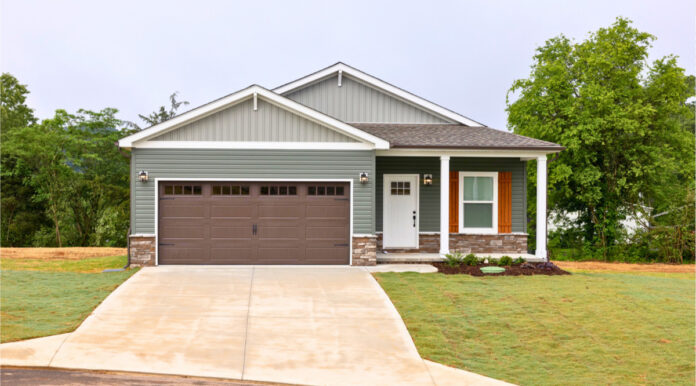
The front exterior profile of a new Clayton CrossMod home, available at Harvest Meadows in Knoxville, Tennessee.
Harvest Meadow Provides Blueprint for Scaling New, Attainable Home Inventory
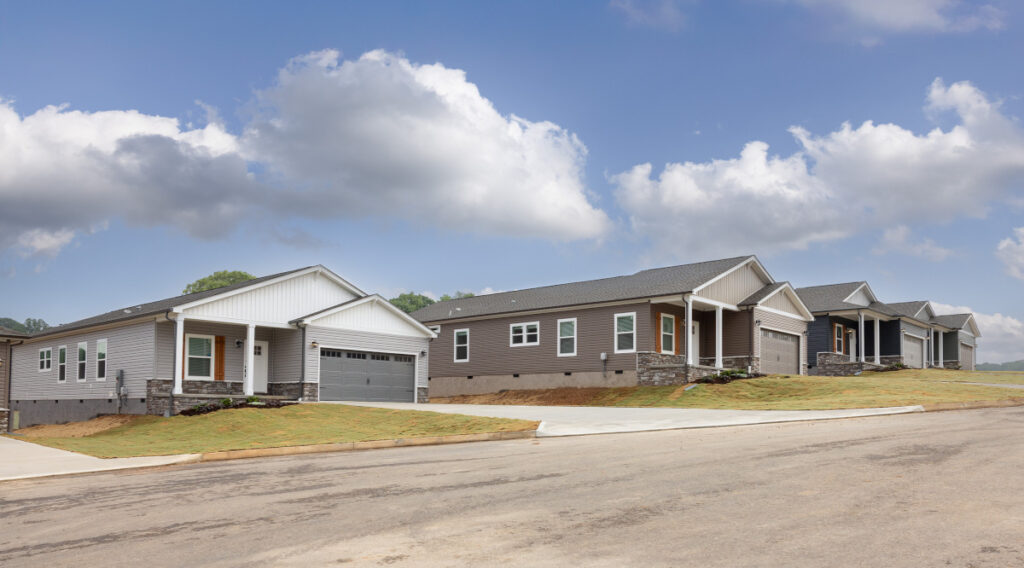
A new 264-home neighborhood in Knoxville is a showcase for the effectiveness of CrossMod® homes in a partnership between Clayton and Cook Bros. Homes, turning it into the largest neighborhood of its type in the nation.
Clayton is a leading national builder based in Knoxville, and Cook Bros. is a local developer. However, both entered the Harvest Meadow partnership with a mind toward expanding the concept.
“It’s an honor to celebrate this important milestone showcasing how off-site construction and developer partnerships can provide attainable, energy-efficient homeownership for more home buyers,” Clayton CEO Kevin Clayton said. “We look forward to scaling this innovative process and embracing local industry partnerships as we develop neighborhoods like Harvest Meadow in more markets across the country.”
CrossMod® is a registered trademark of the Manufactured Housing Institute to denote homes that are built to the HUD code to combine the speed and cost-efficiency of off-site construction with traditional site-built home features.
Home prices in Harvest Meadow, for instance, will start as low as in the $300,000s, offering a more affordable alternative to the national median new home sales price of more than $400,000.
A Unique Approach
Clayton and Cook Bros. have partnered to open a new CrossMod neighborhood in Knoxville, Tennessee. Photos courtesy of Clayton.
The unique approach at Harvest Meadows enables builders to deliver high-quality, energy-efficient homes more effectively and at a lower cost, making homeownership more attainable for families nationwide.
The homes appraise alongside site-built and other CrossMod homes, and can qualify for conventional financing, creating opportunities for homeowners to build equity and longterm wealth through homeownership.
Clayton points to a 2024 FHFA study showing that modern manufactured homes classified as real property, like CrossMod®, are proven to gain in value year over year. Since 2020, they have appreciated at a rate on par with site-built homes.
“The efficient way these homes are built means builders and developers can achieve price points and scale that might not have otherwise been possible,” Andrew Bryant, Clayton’s business development manager for CrossMod® initiatives, said. “With streamlined offsite construction, builders can achieve economies of scale — savings that can be passed directly to the homebuyer. And because the majority of the home construction takes place in a climate-controlled environment, production time » and costs are significantly reduced, allowing homes to be delivered and completed at an efficient pace.”
The interior living and dining space in a new CrossMod home from Clayton.
The homes in Harvest Meadow are all eBuilt®, meaning they are built to meet strict energy efficient performance guidelines set by the U.S. Department of Energy’s Zero Energy Ready Home Manufactured Home requirements. They are estimated to help homeowners save up to 50 percent annually on energy costs, which equates to more than $900 on average per year for the homes at Harvest Meadow.
The homes will incorporate advanced features to maximize energy savings for homeowners, including: *Solar-ready design *Lux® low-E windows with argon gas *All LED lighting *ecobee smart thermostat *Rheem® hybrid heat pump water heater *SmartComfort by Carrier® HVAC system *ENERGY STAR-certified appliances
The interior of a new Redbud CrossMod home from Clayton, at Harvest Meadows in Knoxville, Tennessee, a partnership with Cook Bros.
Local Officials Attend Ribbon Cutting
A recent ribbon-cutting ceremony at Harvest Meadow involved several area officials, including Knox County Mayor Glenn Jacobs.
“It is exciting to witness local builders and developers working together to introduce innovative ways to increase new affordable housing supply, addressing a critical need right here in our community,” Mayor Jacobs said.
There are more than a dozen homes in the neighborhood, and more will be brought in and placed throughout the year.
As demand for new housing continues to grow, developments like Harvest Meadow represent a scalable solution that allows builders and developers to deliver quality homes at a more efficient pace, offering homes that provide long-term value and a lower cost of ownership over the life of the home through annual energy savings.
“We are very fortunate when we can partner with talented developers, like the Cook Bros. of Knoxville, to provide a local solution to efficiently increase new home supply and help develop a beautiful new neighborhood,” Clayton said. “By embracing energy-efficient, attainable homeownership, the 264 homes in this neighborhood will represent a unique solution for families that blends the efficiencies of off-site construction with the aesthetic of site-built features.”
The headquarters for the U.S. Department of Housing and Urban Development in Washington, D.C.
Bi-Partisan Effort Aims to Clarify Regulatory Framework
U.S. Reps. Mike Flood, R-Nebraska, and Emanuel Cleaver, D-Missouri, on Sept. 10, introduced the “Streamlining Manufactured Housing Standards Act.” This legislation clarifies that only the U.S. Department of Housing and Urban Development has the authority to establish energy efficiency and safety standards for manufactured housing.
“America has been grappling with a housing crisis and cutting red tape is one of the key tools to helping home builders create more housing,” Flood said. “Manufactured homes have historically been built to a HUD code, and in order to make manufactured homes a cost-effective option for consumers we must ensure that HUD has primary authority over all manufactured housing standards.
In a statement on the bill, Flood thanked Cleaver for helping to lead the effort.
“I look forward to working together to move this legislation through our committee and the full House,” he said.
Background on DOE Energy Rules in Manufactured Housing
A 2023 suit against the U.S. Department of Energy, brought by the Manufactured Housing Institute and the Texas Manufactured Housing Association, remains in the courts. In May of 2024, a large portion of the complaint was allowed to continue, and a section regarding the consideration of enforcement policies was dropped.
“American families are drowning under a national housing affordability crisis that is limiting economic opportunity and sowing pessimism in the future,” Cleaver said. “By clarifying HUD’s important role in maintaining home energy efficiency standards, we will ensure that federal experts in housing are the ones overseeing quality projects that enable the construction of manufactured housing nationwide. I’m proud to introduce this bipartisan legislation with Chairman Flood as we seek to lower housing costs by streamlining the regulation of quality, affordable homes in communities that need them most.”
The center of the complaint is based on HUD’s role as the sole regulator for manufactured housing. In essence, the department should be able to work with and consider priorities from other bodies without being mandated to comply with rules written outside of HUD.
Advocates and industry professionals have expressed concern that, in this case and far too often, rules are written for other asset classes in the housing sector and then are crudely applied to manufactured housing.
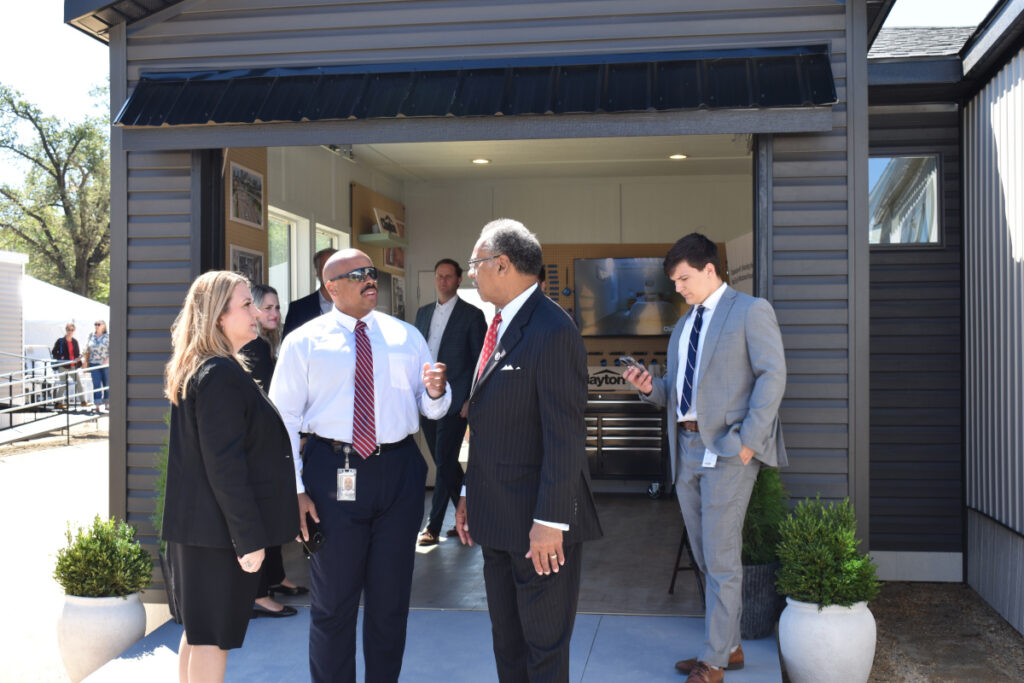
MHI CEO Lesli Gooch has a conversation with Congressman Emanuel Cleaver, center right, and his staff on Monday, Sept. 8, during the 2025 Innovative Housing Showcase.
MHI Applauds Efforts to Streamline Regulatory Framework for Manufactured Housing
“For more than 50 years, our industry has partnered with HUD to help millions of Americans achieve the dream of homeownership,” MHI CEO Lesli Gooch said. “The Streamlining Manufactured Housing Standards Act reaffirms HUD’s sole authority over our construction standards, preserving the integrity of this long-standing partnership. Manufactured housing is the only form of housing built to a federal construction code, and we do it at scale — delivering quality homes across the country at attainable prices.
“We commend Chairman Flood and Ranking Member Cleaver for their bipartisan leadership in protecting the regulatory efficiency that is central to this partnership. Regulatory efficiency, combined with factory-built efficiency, is the formula that makes manufactured housing the most affordable quality homeownership option available,” Gooch said. “This bill preserves the regulatory side of that equation and strengthens a vital housing solution for families nationwide.”
Flood is a member of the Housing Financial Services Committee and the chair of the Housing and Insurance Subcommittee. He serves as the Chair of the Republican Main Street Caucus, and has introduced numerous pieces of legislation shaping housing policy, including the recent “Unlocking Housing Supply Through Streamlined and Modernized Reviews Act.”
Fannie Mae Indicates Similar Plan for MH Advantage®
Freddie Mac, a government-sponsored entity that provides a secondary market for home loans, announced recently that its CHOICEHome® program will include financing for single-section homes with features that meet a pre-determined criteria.
“Under President Trump, U.S. Federal Housing is committed to delivering affordable homeownership and finding ways to grow our nation’s housing supply,” Freddie Mac Chairman William J. Pulte said. “Modern single-section factory-built homes can offer high-quality alternatives at a lower price point. Freddie Mac’s expansion of the CHOICEHome program helps make more homes accessible to more Americans through the conventional mortgage market.”
Freddie Mac ensures that CHOICEHome financed manufactured homes meet specific construction standards, which include features such as permanent foundations, energy-efficient designs, pitched roofs, attached garages, and enhanced durability and comfort of the home. These features also make for easier integration with existing neighborhoods that include site-built homes, including urban infill.
CHOICEHome mortgage brings conventional loan financing to modern factory-built homes that are built to exceed federal standards called for by the U.S. Department of Housing and Urban Development. This financing typically offers a more affordable option than traditional site-built homes. The mean price of the newly accepted single-section home is around $200,000, including land in most markets, while a standard single-family site-built home can, on average, exceed $500,000.
MHI Applauds Freddie Mac’s Program Extension
The Manufactured Housing Institute applauded Freddie Mac for expanding its CHOICEHome program to include single-section CrossMod homes as a “pivotal step” toward unlocking greater access to attainable housing nationwide.
CrossMod homes combine the best of on-site and factory construction and have gained popularity in recent years due to the many advantages they offer over conventional manufactured homes. High-end, energy-efficient, and affordable, CrossMod factory-built housing appeals to underserved homebuyers who value homes built to rigorous federal standards for quality, safety, and durability, as well as curb appeal features like pitched roofs and garages. With manufactured homes costing up to 50 percent less per square foot than site-built homes, CrossMods present a compelling path to quality homeownership and are attainable for buyers of nearly every budget.
“Freddie Mac’s inclusion of single-section CrossMod homes in the CHOICEHome program is a meaningful advancement for increasing the supply of attainable housing in the country,” MHI CEO Lesli Gooch said. “These homes are ideally suited for infill development and smaller lots, helping communities meet growing demand with innovative, efficient housing solutions. MHI has consistently advocated for this change, recognizing that expanding financing options for single-section CrossMods will unlock new opportunities for homeownership and support the evolving needs of today’s housing market.”
Freddie Mac’s existing financing options include financing for multi-section factory-built homes with a 3 percent down payment option. As of today, Freddie Mac will include the same financing option for single-section, or single-wide, modern factory-built homes for the first time. Freddie Mac’s counterpart, Fannie Mae, posted to its MH Advantage landing page that plans are underway to include single-section homes in its program as well.
“We join the entire industry in celebrating Freddie Mac’s significant effort to add the single-section home design to their CrossMod mortgage program,” Clayton CEO Kevin Clayton said. “This important update will now provide attainable, energy-efficient homeownership to many more deserving families, helping to make these homes available in established neighborhoods and narrow urban lots.”
Freddie Mac Executive Vice President and Head of Single-Family Acquisition Sonu Mittal said support for modern single-section factory-built homes will play an important role in creating and promoting affordable housing in markets that need additional supply to help first-time homebuyers.
“Lenders can leverage our existing CHOICEHome mortgage offerings to finance these homes, and we are ready to purchase these loans now,” Mittal said.
Engineered Helical Pile System Gets Industry Attention
Over the last 15 years, GoliathTech Corporation, a manufacturer of helical piles for the commercial and residential construction industry, has quietly introduced a foundation system for manufactured homes that is beginning to have a significant impact on the industry.
Unlike its counterpart, the concrete pier and cinder block, helical piles are engineered and installed with measurable torque to provide the compression, tension, and lateral load support needed for every size manufactured home.
It is an emerging technology in the industry and ensures homes are anchored securely to the ground.
Helical piles, also known as screw piles, have a long history dating back to the 19th century — first being used for the footings of lighthouses in difficult soil conditions where traditional footings were not feasible — and they continue to expand into new areas of business, including manufactured housing.
Although somewhat disruptive to the industry, the intention and practical use of a highly engineered solution like helical piles is not to displace all other solutions but to provide a much-needed improvement to how manufactured homes are secured. There have been some improvements to anchorage and lateral support systems over the years, of course. The difference with GoliathTech is a completely new foundation system, backed by measurable installation data.
An illustration of a manufactured home installed using helical piles. Image provided by GoliathTech.
“GoliathTech is a highly innovative company always in search of markets where helical piles can provide a solution, and the manufactured home industry was a perfect fit,” GoliathTech Vice President of OEM Relations Michael Coyle said. “We work well in frost climates where depths of 40 feet and deeper are common… Going south, we can provide an improved solution in areas that have expansive soil conditions where concrete runners are the norm.
Basically, anytime a concrete footing or runner is required, the GoliathTech system competes well cost-wise and is superior in every other way, Coyle said.
A typical system is installed to a depth of five to 10 feet with the use of a mini excavator or skid steer outfitted with a designated hydraulic motor, ensuring the pile is properly inserted into the ground.
“With our piles, there is no concrete involved,” Coyle said. “As we achieve acceptance in the marketplace we’re seeing that we compete well in areas of the country like the Midwest and Northeast where frost is present and in states like Texas, Nevada, and Colorado where expansive soils are a problem.”
The process follows a specified foundation plan where torque and depth are determined for each footing. The operator monitors these factors in unison during installation, Coyle said. Once the installer hits the numbers, the team moves onto the next footing. The speed of installation also is a benefit. A foundation and a home are installed in a single day.
“There is no waiting for concrete to cure,” Coyle said. “And it can be installed in any weather condition.”
Coyle said he believes GoliathTech is the first company to provide this type of industrial-strength anchorage with the engineered foundation system for homes.
Seven years ago, Clayton took notice and realized the system provided an improved foundation and improved ease of installation.
A close-up look illustrates the anchoring system above the piles. Image provided by GoliathTech.
Working Piles Into the Code
GoliathTech is already working with some of the largest builders in the manufactured housing industry to identify areas where its technology can be most beneficial. Companies like Clayton, Cavco, and Champion have added the GoliathTech Foundation system to their DAPIA certifications and installation manuals. The company also has had meetings with the Department of Housing and Urban Development, discussing how the system is improving the foundation of a manufactured home.
“While our customers realize that this system provides a massive improvement over existing systems, it continues to be implemented through CFR-3280 as an alternate foundation,” Coyle said.
Coyle said GoliathTech would like to see a helical pile foundation system approved within HUD’s Permanent Foundation Guide for Manufactured Housing.
“The hold down capability is why the system is approved for use in all wind zones and flood zones under FEMA’s P-85 definition,” Coyle said. “We’re going to do it in pieces. The first step is anchorage. The second step would be for them to approve the entire system.
“It will perform as well or better than a permanent foundation wall,” he said. “Once the specified depth and torque are reached, screw piles do not move. In many soil conditions, the same cannot be said for concrete footings. They are reliant on the solidity of the underlying soil and those foundation walls are relying on that soil.”
One of the key benefits of the helical pile system is its versatility. For use in flood plains, for example, the system is designed to work at any height above grade. One of GoliathTech’s clients, a community owner in Montana with several lots in flood plains, were faced with very costly soil removal, engineered fill, and re-compaction costs. Using helical piles, those excavation costs were no longer required.
Helical piles are driven deep into the ground, getting through the layers of problematic soil.
Once the piles reach the good soil and the specified depth and torque are reached, the foundation is secure.
Illinois-based HUD inspector Dan Mailin is a big proponent for the use of the system in flood plains because it removes a lot of the complexities synonymous with setting homes in these types of environments.
Coyle said installers and community owners appreciate how solid the system is and the speed at which it can be installed. At the highest level of efficiency three crews can install 100 homes in a month.
“This is huge for community owners where time to occupancy and revenue is greatly reduced,” he said. “They are getting used to the idea of change once they see the benefits.”
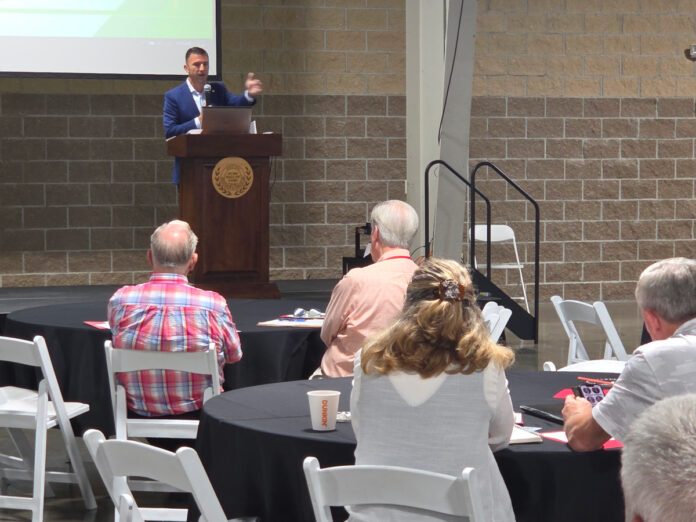
Congressman Yakym address manufactured housing professionals at the MH FacTOURy Summit on Aug. 19.
Elkhart, Northern Indiana Event Center Host Annual Education Program
U.S. Rep. Rudy Yakym took to the lectern as the keynote speaker Aug. 19 at the 2025 MH FacTOURy Summit at the Northern Indiana Event Center in Elkhart, Ind.
“This museum highlights what is so important and impressive about Elkhart County,” Yakym said of the event center, and associated RV/MH Hall of Fame attractions. “Elkhart is the most manufacturing-packed county in the entire U.S., not just manufactured housing, RV, marina, but in health care, furniture, and more.
“It’s with such incredible pride that we make these products,” he said.
In its fourth year, the event brings two days of educational seminars and factory tours to Elkhart, Ind. Industry professionals have the chance to learn from industry leaders, tour the region’s leading manufactured home building facilities, meet with factory representatives, see the latest manufacturing innovations, and foster new and ongoing business relationships.
“The MH FacTOURy Summit is a must-attend event for factory tours and educational seminars,” Indiana Manufactured Housing Association – Recreation Vehicle Indiana Council Executive Director Ron Breymier said. “Elkhart, Indiana has proven time and time again to be the center of manufactured home building and innovation in the Midwest, and we’re proud to host this event at the center of it all.”
At the Factories in Northern Indiana
Among the facilities toured by attendees this year included Adventure Homes, Cavco Nappanee, Champion Topeka, Clayton Middlebury, and Clayton Wakarusa. Attendees could choose from any of these five tours to attend throughout the day on Wednesday, August 21.
One key theme present during the factory tours was the variety of product available and the efficiency at which it was made.
“We build park models, HUD units, and Canadian units all out of one line here,” Jeff Tanner, a sales manager for Cavco Nappanee, said. “Nobody else builds more variety than we do here in the Midwest.”
Yakym said he will visit each of the counties in his district — Elkhart, South Bend, and Warsaw — at least three times each during the next month. Much of what he will be talking about to constituents, he said, is how to get people back to work, earning more and paying less.
“I am in Washington 35 weeks this year working on legislation,” Yakym told the nearly 100 attendees. “Costs have gone up up up… Absolutely through the roof. One of the ways we need to fix this (in housing) is by increasing supply.
“Everyone saw this coming, and very little has been done to address the need,” he said.
The One Big Beautiful Bill Act will reduce some regulations that add to housing cost, and under a CRA, Congressional Review Act, a range of rollback will be made permanent.
“Once we pass a CRA and it’s signed by President Trump, that item forever becomes ineligible to be reintroduced. It’s permanent,” Yakym said.
Changes are to include a Made in America provision and full acceleration on capital expenditures to help in the recovery of investment dollars. The congressman provided an example based on their efforts to continue to build the presence of manufacturing companies in Northern Indiana.
“You can depreciate 100 percent of the shell of that building in one year rather than having to wait on depreciation during the course of 30 years,” Yakym said. “You don’t need tax increases, you need tax relief and spending cuts from your government.
A big part of the American Dream, Yakym said, for many generations has been owning a home of your own.
“For most Americans, the wealth they have is tied up in their home. That’s what you all provide every day,” he told his audience. “We want to make home ownership more affordable.”
— MHInsider Writer and Editor Sean Vichinsky contributed to this story
For the second year, longtime community owner and insurance provider Barry Cole has hosted an event in Costa Mesa, California, to honor the stellar work of women in the manufactured housing industry.
Cole, who owns and operates Manufactured Housing Insurance Services, said a pair of colleagues who are women, several years ago, mentioned how often there are luncheons and awards that focus on the work of men in the industry.
“They were right,” Cole said. “And it made me think ‘What could I do to establish a yearly program for women who might not have had the recognition they absolutely, surely deserve?’ Some have made their own success, and some have made others successful.
“This group is the genesis of those conversations,” Cole said.
The 2025 Manufactured Housing Women of Distinction gathering took place on June 13 at the Park Club in Costa Mesa, California. There was a pre-dining mixer, a welcome from the host, a menu that included an option for a rack of lamb or salmon, and the awards ceremony during which each person honored receives a personalized, engraved silver serving plate that can be mounted or displayed.
2025 Manufactured Housing Women of Distinction
Rheannon Arciniega – Bessir-Casenhiser Victoria Brennan – Horizon Homes Eileen Cirillo – Star Management Susy Forbath – Cozen O’Connor Deneen Gansert – Skyline Homes Betsy Gibson – Boudreau Pipeline Deena Gomez – Starcrest Escrow Candy Holcombe – Watt Capital Developers Patricia Jones – Universal Homes L. Sue Lofton – Loftin Bedell PC Nicole Luu – Galaxy Homes Jean McGrath – Blue Carpet Homes Julie Paule – Paule Consulting Maria Solache – Manufactured Housing Insurance Services Christie Warkin – Blue Carpet Homes
Cole said part of the inspiration for organizing an annual event to recognize industry women and the great work they’ve done is the experiences he has had working with and for women.
“I have had many minimum wage employees who have become successful like two of the recipients last year, Belin Ramirez, who is now president of Express Escrow, and Natalie Costaglio, who is president of MCM,” Cole said.
“I have worked easily, effectively, and efficiently with and for many women,” he added. “I have collaborated with Vicky Derieg for over a half century and I worked for Chelu Travieso, an MH legend who was a mentor and friend. Those are just some examples. Oh yeah, and my wife Donna. We have our 40th anniversary in September.”
Many of the women honored in 2024 attended the event to support the new honorees.
“Onward, hopefully, we will have all MH associations and non-profits join in publicizing the efforts behind this event, bringing awareness of great manufactured housing women achievers,” Cole said. “But you are among the first to get the plate, so spread the word to your friends and associations.”
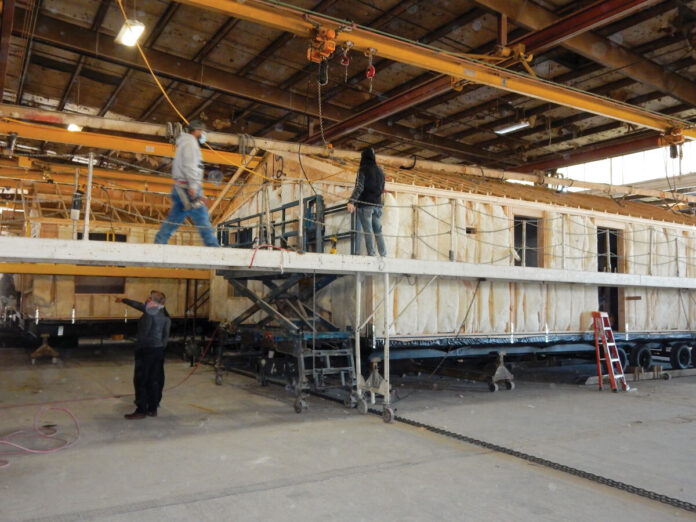
A new HUD-Code home under construction in the factory.
This year’s MH FacTOURy Summit is a two-day event hosted at the RV/MH Hall of Fame from Aug. 19-20, 2025.
The event brings two days of factory tours and educational seminars to Elkhart, Ind. Hundreds of industry professionals will have the chance to tour the region’s leading manufactured home building facilities, meet with factory representatives, see the latest manufacturing innovations, and foster new and ongoing business relationships.
“The MH FacTOURy Summit is a must-attend event for factory tours and educational seminars,” Indiana Manufactured Housing Association – Recreation Vehicle Indiana Council Executive Director Ron Breymier said. “Elkhart, Indiana has proven time and time again to be the center of manufactured home building and innovation in the Midwest, and we’re proud to host this event at the center of it all.”
Now in its fourth year at the RV/MH Hall of Fame, the MHFacTOURy Summit is geared towards manufactured housing professionals, particularly retailers and community owners, property managers, sales personnel, marketing team members, and new employees in the industry. Those who attend can find new ways to stay ahead of the competition, grow a high-performing sales team, and learn about the newest trends and preferences in manufactured housing.
The RV/MH Hall of Fame Induction Ceremony will precede the 2025 Summit, on the evening of Monday, Aug. 18. The ceremony will honor 10 manufactured housing and RV veterans for their industry service and enshrined in the Hall of Fame.
Exhibit and Sponsorship Opportunities Available For This Year’s MH FacTOURy Summit
Exhibit and sponsorship opportunities have also opened for the 2025 MH FacTOURy Summit. These are ideal ways to increase company exposure and show everything it has to offer.
Sponsors can sign up for exclusive opportunities throughout the event to boost their brand visibility among manufactured housing professionals across the country.
For more information regarding exhibit and sponsorship opportunities, please contact Sue Bartee at (317) 247-6258 ext. 14 or email info@imharvic.org.
Visit www.mhfactourysummit.com today to register for the MH FacTOURy Summit or to learn more about the event. The MH FacTOURy Summit is an industry conference for manufactured housing professionals and is not open to the general public.
Oct. 6-8 at Avalon Hotel in Alpharetta, Ga.
Manufactured housing community owners have never had more information available to them — or more decisions to...
The Midwest Manufactured Housing Federation has announced that attendee registration is now open for the 2027 Louisville Manufactured Housing Show, returning to the Kentucky...
HUD’s Innovative Housing Showcase, MHI’s Homes on the Hill and Annual Meeting Begin Sept. 22
Two of the country’s largest builders of manufactured homes will...