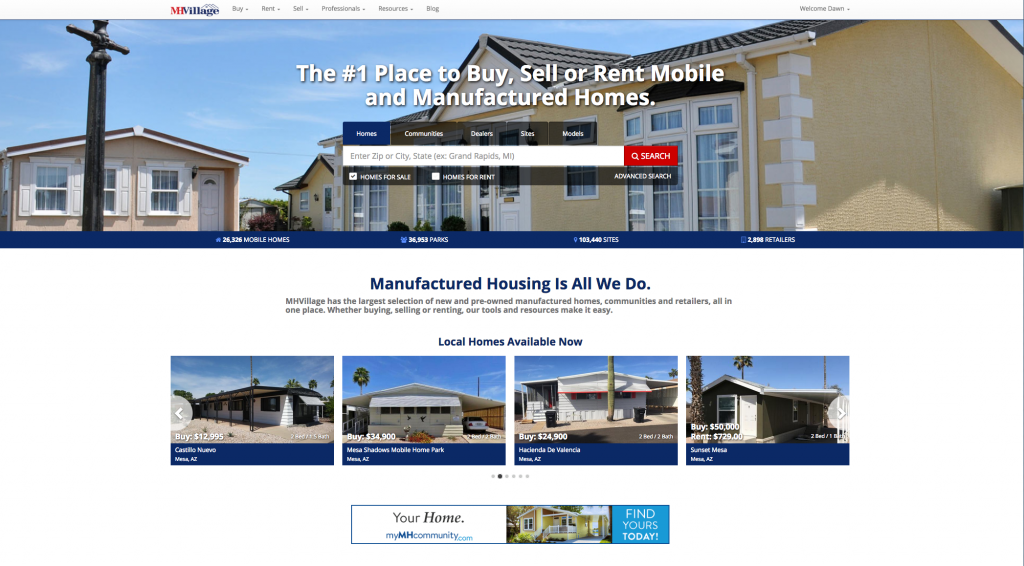
If you access your Professional Account on MHVillage through your phone, you might have noticed something new. We have a whole new account look for MHVillage users on mobile!
Right now, it is still in “Beta”, which means we are still testing it and making sure it’s running smoothly. But we would love for you to give it a test drive and tell us what you think!
How to Access the New Account Look
First, go to mhvillage.com on your smartphone. You will see a new way to access your account.
Click the Account (Beta) link and then sign in with your normal username and password.
That will take you to the new, redesigned account look.
We’re really proud of how this came out, and we plan on taking it to the desktop very soon. However, it was a big change, with a lot of programming, so we definitely wanted to make sure it is as perfect as we can make it before we released it everywhere.
You’ll notice that we added quick links to help you get to the things you use all the time, like your listings, communities, leads and your billing information. We’ve also added links to our social media and this newsletter, so you can keep track of what is going on, right from your new account page.
Here’s another screenshot so you can see what is in store:
But, Wait – There’s More!
As you go through our new account design, you might notice that not everything has been given the new look. It’s all in process, but we wanted to get this into your hands as soon as possible. In fact, we have lots of new and exciting thing in the works for 2018, keep an eye on this newsletter to see what’s coming up next!
According to Facebook, as of Sept. 30, 2017, the platform has 2.07 billion monthly active users with average daily users numbering 1.37 billion. These large numbers make it hard to ignore Facebook in your marketing strategy.
Facebook has changed during the years, and with the recent update on Jan. 12, it’s becoming more and more likely that, to reach your target audience, you will have to invest in Facebook Advertising.
Advertising on Facebook offers multiple layers of audience targeting and campaign types to help you reach the preferred audience as well as maximize your return on investment (ROI).
Here are five steps to help you get started with Facebook Advertising.
Step #1: Define Your Goals
Before starting a campaign Advertising on Facebook make sure you have defined your campaign goals, budget and key performance indicators (KPIs). This will help with measuring your success against some pre-defined metrics.
Some example goals for advertising on Facebook are:
Increase traffic to your website from Facebook
Increase attendance to an open house
Generate mobile home listing leads
Boost engagement for your Facebook page
Increase the reach of your content on Facebook
Install Facebook Pixel
Before setting up your campaign make sure that you have the Facebook pixel installed along with event tracking. The Facebook pixel allows you to track events and create audiences for ad targeting and dynamic ads.
Locate the Facebook pixel code in the Business Manager in section the under “Events Manager”. Facebook offers documentation to help you get the pixel and events installed.
Step #2: Create Your Campaign
Begin creating a campaign by opening Facebook’s Power Editor and clicking the “create campaign” button. Click “Use Guided Creation”. Facebook has campaign objectives broken into three categories:
Awareness
Consideration
Conversion
For example, if we wanted to promote a mobile home listing, we would define the campaign objective as a conversion because we would want to generate leads for that listing.
Step #3: Choose Your Target Audience
Once you have saved a draft of your campaign, you will need to go to the ad set section of your campaign.
In this section you define the following:
Audience
Daily Budget
Campaign Schedule
Ad Placement
There five different custom audience types to choose in advertising on Facebook:
Audience from email addresses: In the audience tab in the Facebook Business Manager console you can create an audience by uploading your email addresses. The minimum amount needed is 200. However, if you are just targeting email addresses, 1,000 is recommended for better reach. Sometimes Facebook will not serve your ads if the audience is too low.
Website Traffic: Create an audience that has visited specific pages of your website. This will need the Facebook pixel installed and will need some time to populate. You can find this in audience tab.
Engagement: Create an audience based on people who engage with your posts on Facebook or Instagram.
App Activity: If you have an app and want to target people who have used or took specific actions.
Offline Activity (Just Added):Create an audience that interacted with your business through in-store, by phone or through offline channels. You will need to define your offline events, such as phone calls in the offline event sets tab.
Advertising on Facebook offers not only the custom audiences, but you also can choose your audience by location, age, gender, language, Facebook interests and connections.
For example, if wewere promoting a mobile home listing, the audience could be customized from website traffic that visited the listing, similar listings or similar communities.
If your audience is more at the top of the funnel, meaning they are researching the area or researching your business, you could offer some free content after they fill out a lead form. These freebies may include a mobile home buyers guide, neighborhood market report or new listing updates.
Ad Placement
Facebook gives you the option to select where your ads are shown. You can choose “Automatic Placement”. But, to begin, go with “Edit Placements” and simply choose Facebook feed ads and Facebook right column ads.
If later you want to add Instagram ads, you will need to connect your Instagram account to Facebook.
Step #4: Create Your Ads
Once you have set a daily budget, defined your audience and selected ad placements, you now go to the Ad tab of your campaign and edit your ad.
Choose a Facebook page, if you manage more than one, as well as the type of advertising on Facebook you want to create. Then ad content, such as written descriptions, photos and links.
Startwith the multiple image carousel ad or the collection ad type, fill in the text, headline text and destination url.
The destination url needs to have UTM codes codes on the end of the link to track your campaign results. UTM code is a simple code that goes on the end of your URL so you can track source, medium and campaign name.
Google offers a great tool called Campaign URL Builder that helps you add UTM codes to any URL.
If images, language and the link look good, you can click the “Review Draft Items”. When this button is clicked the campaign will be uploaded to Facebook Ads Manager. If no start date was selected the campaign will start once Facebook approves your ad.
Step #5: Analyze Your Campaign Results
Make sure you give the campaign seven to 14 days to allow for Facebook to optimize the campaign. This window of time also will ensure there is a big enough sample of data for you to analyze.
Once the campaign has had significant time to run, you want to look at the following:
Relevance Score of Your Ads: Relevance score lets you know how relevant your ads are to the target audience. It is on a scale of 1-10 and the ideal relevance score is 8 to 10; by having a higher relevance score the cost per click will be lower.
Conversions: Is the campaign generating leads?
Cost per Conversion: Is the campaign within your budget?
Adjust the campaign according to your pre-defined metrics to improve the results.
Facebook has many different advertising options that will help you reach your target audiences. If you want to reach more people, be sure to experiment with the different custom audiences and ad options to see what gets your business the best results!
Our industry continues to grow, and as it does there is a similar growing need for more professionals to take part in managing manufactured home communities.
With every new community that is built, expanded or re-modeled, owners and current managers face an increasing shortage of qualified talent.
If you are new to the industry, this article will help you with some basic tips on managing manufactured home communities.
Often times managers will come from other industries like real estate, residential rent management, or even commercial property management. While the work force in our industry benefits from these new perspectives, it also can mean a bit of a learning curve when it comes to manufactured housing terms, specs and regulations.
To be honest simply learning the language can be a feat all of its own!
Here we have a great article that breaks down some of the Manufactured Housing Terms that might be foreign to a professional who is new to this industry.
While we don’t manage communities, we do work with quite a few companies that do. These folks have been in the business for a long time. Over the years we have picked up some great info on the benefits and the challenges that might come from managing a community.
Managing A Community – More than just the homes
Unlike traditional residential management, manufactured home communities often do not own the homes within the community. Most often, the resident owns and maintains the home they live in. The community provides amenities like lawn care, pool services, an activity center and other lifestyle offerings.
However, similar to managing a traditional rental property, there is going to be the detail of maintenance. So, depending on whether your community owns or rents homes and land will dictate the extent of your responsibility.
DIY?
Hired help can be your saving grace
Too often we hear of stories of managers who are entirely worn out by the end of the first year managing manufactured home communities. It’s almost always due to the manager stretching themselves too thin.
We all know the saying “good help is hard to find”. However, it’s possible. If you are new to the industry there is going to be a great deal of knowledge you need right away. Hiring selling agents, maintenance crew and even an assistant can make a world of difference when managing manufactured home communities.
Marketing a Community – Know Your Audience.
Marketing available homes or spaces within your community can be one of the more challenging aspects of the job.
The first step is going to be to establish the home owners/renters you are hoping to have within your community. Then comes gearing your advertising to that crowd.
We have a super helpful article on “The Benefits of Knowing Your Audience” that goes further into the details of different types of manufactured home buyers and renters.
Once you have established your audience, the next step is getting the community out there! MHVillage offers a FREE advertisement option for communities. The “Basic Community” advertisement includes two community photos, all of the community details, and you get free sales leads via email too!
Here is a video on how you can use our website to advertise your community:
The Manufactured Housing Institute’s Lobby Efforts Win Extension of Energy Tax Credit
Congress passed and the President signed into law an extension of the Energy-Efficient New Home Tax Credit last week.
The measure also is known as the 45L credit. It was part of a two-year budget agreement and stopgap spending bill in Congress.
Included in the agreement is extension of:
Adventure Homes
Federal flood insurance program
Deductibility of mortgage insurance premiums
The tax credit for residential energy improvements
For example, the energy improvement measure offers considerations for high-efficiency water heaters, air conditioning units and furnaces.
The 45L credit expired in December 2016. However, the recent action on manufactured housing in Congress makes the credit retroactive for 2017.
Extension of the Energy-Efficient New Home Tax Credit fulfills one of MHI’s top legislative priorities for 2017. As a result, MHI has been a consistent voice on Capitol Hill advocating strongly for the extension of the tax credit, established by the Energy Policy Act of 2005.
45L History with Manufactured Housing in Congress
Interior of a new Fleetwood home
MHI has worked with House and Senate tax committees to advocate for the annual extension of this tax credit. In July 2017, MHI submitted a letter to the Senate Finance Committee as a part of its public call for proposals to improve the tax system and provide relief to middle class individuals and families.
MHI argued that the 45L credit is an important, market-driven incentive that has promoted and improved energy efficiency for manufactured homes. It also provides significant monthly energy savings for millions of Americans residing in them.
Under the 45L credit, manufactured homes qualify for a $2,000 credit. Homeowners are eligible if the home conforms to Federal Manufactured Home Construction and Safety Standards (FMHCSS) and meet the energy savings requirements of site-built homes.
In lieu of the above, manufactured homes can qualify for a $1,000 credit if they conform to FMHCSS and reduce energy consumption by 30 percent relative to International Energy Conservation Code 2006.
Alternatively, manufactured homes can also qualify for a $1,000 credit if they meet ENERGY STAR Labeled Home requirements.
In December 2015, MHI secured a retroactive extension of the credit, which previously expired in December 2014. Furthermore, MHI continues to advocate before the tax committees in Congress each year to ensure the credit remains.
The 45L credit provides a crucial investment in energy-efficient manufactured housing and substantially eases the financial burden of energy costs on hard working American families.
MHInsider reports manufactured housing industry news collaboration with the Manufactured Housing Institute. Read more news from MHI and become a member.
Also, for questions or more news on manufactured housing in Congress, contact MHI’s office of Government Affairs Department at (703) 229-6208 or MHIgov@mfghome.org.
In December 2017, new manufactured home shipments increased 3.6% to 7,269 homes as compared to the 7,019 homes shipped in December 2016. Total shipments for December 2017 are lower by 1,319 when compared to November 2017.
The trend is mixed compared with shipments of December 2016. Single-section homes were down by 0.4% and multi-section homes up by 9.1%. Total floors shipped in December 2017 increased 5.1% to 10,500 compared to December 2016.
15.5% homes shipped in December were FEMA units
MHI reports that 1,129 homes of the 7,269 shipped in December were for FEMA units. Three states received FEMA units in December: Alabama with 372, Maryland with 88 and Texas with 769.
Annual New Manufactured Home Shipments
For all twelve months of 2017, monthly shipments are higher when compared to the previous year.
Shipments from January through December this year total 92,891 homes compared with 81,169 homes in 2016, a 14.4% net increase.
In addition, the seasonally adjusted annual rate (SAAR) of shipments was 102,117 in December 2017, down 5.0% from the adjusted rate of 107,476 in November 2017. The SAAR corrects for normal seasonal variations and projects annual shipments based on the current monthly total.
In December 2017, 131 plants representing 36 corporations reported production data, which is one more of each than November 2017.
MHInsider reports monthly and annual home shipment reports in collaboration with the Manufactured Housing Institute. Read more news from MHI, become a member, or enter member log-in information for the institute’s full Manufactured Housing Activity Industry Production Shipments and Trends report.
HUD Secretary Ben Carson will speak at MHI's annual Congress & Expo in April.
MHI Announces U.S. Department of Housing and Urban Development Secretary Ben Carson for Keynote Speaker April 25 in Las Vegas
Secretary Ben Carson of the U.S. Department of Housing and Urban Development has been confirmed as the keynote speaker for the upcoming 2018 MHI Congress & Expo.
Secretary Carson will speak at the Opening General Session of the MHI Congress & Expo at the Paris Hotel in Las Vegas on Wednesday, April 25 at 9 a.m.
The Congress & Expo for Manufactured and Modular Housing is the national trade show for industry professionals to obtain the knowledge and resources necessary to excel in today’s housing marketplace.
In addition to being on hand for Carson’s comments, attendees can choose from top quality educational programs with other powerful speakers, network with the industry’s most successful professionals, develop new ideas for business and visit the exhibit floor to see the latest and greatest products and technologies.
Congress & Expo runs April 24-26, 2018 at the Paris Hotel in Las Vegas. Visit the MHI website to register.
Secretary Carson Bio
Dr. Benjamin S. Carson, Sr., M.D., was sworn in as the 17th Secretary of the U.S. Department of Housing and Urban Development on March 2, 2017.
For nearly 30 years, Secretary Carson served as Director of Pediatric Neurosurgery at the Johns Hopkins Children’s Center, a position he assumed when he was 33 years old, becoming the youngest major division director in the hospital’s history.
Carson received dozens of honors and awards in recognition of his achievements including the Presidential Medal of Freedom, the nation’s highest civilian honor. He also is a recipient of the Spingarn Medal, the highest honor bestowed by the National Association for the Advancement of Colored People (NAACP).
The author of nine books, Carson wrote four of the publications with his wife Candy. The U.S. News Media Group and Harvard’s Center for Public Leadership named him among “America’s Best Leaders” in 2008.
The couple co-founded the Carson Scholars Fund, which recognizes young people of all backgrounds for exceptional academic and humanitarian accomplishments. The Fund operates in 50 states and the District of Columbia. It has recognized more than 7,300 scholars, awarded more than $7.3 million in scholarships and installed more than 150 reading rooms nationwide.
Born in Detroit to a single mother with a third grade education who worked multiple jobs to support their family, Secretary Carson was raised to love reading and education. He graduated from Yale University and earned his M.D. from the University of Michigan Medical School. He and his wife are the proud parents of three adult sons and three grandchildren.
How well your home is sited depends a lot on soil density.
What is the Pocket Penetrometer, and how is it used?
In 1989, George Porter came across the pocket penetrometer.
He had been in the manufactured housing business for about two decades already, and like many people, he spent much more time considering the actual home than the space on which it might sit.
“Might” is the operative word here.
“The executive director of Pennsylvania association at the time said ‘Why don’t you write a course on how to set up a manufactured home?’
“I thought this would take most of the afternoon,” Porter recently confessed. “About a year later I had most of it figured out.”
There is a lot that goes into siting a home, not the least of which is soil density. In other words, how consistently firm is the soil on which the home’s piers will rest? And will it hold the home over time, or “might” it not?
It’s All About the Soil
“What I knew about soil at the time was that it was ‘dirt’ and there were two kinds, wet and dry. Wet is called mud,” said Porter, who operates Manufactured Housing Resources, Inc., and trains scores of manufactured housing professionals on proper home installation.
The Manufactured Housing Institute education division offers a 12-hour training program developed and delivered by Porter. The content offered in the program is the latest and most relevant information for home installation on a state-by-state basis.
Suffice to say, George Porter has learned quite a bit about soil density and all else involved with placing a manufactured home.
But back to the item at hand, the pocket penetrometer.
Are your homes on sturdy ground? A pocket penetrometer can help you find out.
What Is A Pocket Penetrometer?
When Porter came to learn everything from Andisol to Vertisol in the world of soils, he was told by industry folks and manual writers that a very important step in the home siting process is figuring out load-bearing capacity; but how?
Most presentations looked beyond this practical bit of fieldwork. And no one he knew was testing soil density, with or without a device that could help.
Asking around, he was directed toward a large, unwieldy machine that sat on a tripod and utilized a heavy blow-cap to would drive a spike in the ground. Counting the number of blows required to reach a certain depth offered a density reading.
Porter said he recalls the demonstration, thinking, with hand on chin, “This isn’t going well.”
Where the Manufactured Housing Industry Turned
Shortly after, Porter was turned on to the device most people in the industry use today – the pocket penetrometer.
Of all the ways to test soil – including hiring an expert or sending a sample to a lab – use of this diminutive device is by far the most time and economically efficient. And, today, most install manuals for new homes call for the use of a pocket penetrometer.
Pocket Penetrometer from AMS
If you buy one, it should cost less than $150, and come in a small carrying case that includes instructions for use. Depending on brand, new devices can be found for $50.
To take the middle ground, AMS makes a pocket penetrometer that’s sold here and other places for about $90.
A pocket penetrometer measures soil for the number of tons it will support by square foot. Many times the references in home installation manuals hinge on pounds per square foot. So, a conversion or two may be necessary, but knowing that 2,000 pounds is equal to one ton is the essential element, and will put you on sturdy ground for finding the needed answers.
How Is the Pocket Penetrometer Used?
“You press the pocket penetrometer into undisturbed soil and you try to pick a patch that’s unaffected by the sun and most similar to the area where you’ll place footings,” Porter said. “This means you may need to remove some baked topsoil before you get to the moist soil that’s common to the area.
“In a state like Michigan, because of the frost line, you can’t just place a home on top of the ground. It’s not a good idea and you won’t pass inspection either,” he reminded.
The user presses the penetrometer into the soil. When this is done, the spring-loaded pin in the ground also presses up into the handle of the device. When the pin reaches the grooved part of the handle ¼” up, a load bearing reading between one ton and four tons is made evident by the red ring on the barrel. That reading correlates to a specific type of setup system for installation of the home.
Be mindful that a penetrometer only works on soil. An attempt to measure density on top of gravel, for instance, will render a false reading.
Where to Purchase a Pocket Penetrometer
Today, a plastic pocket penetrometer is available. Porter uses the same metal device he purchased when he began studying soil.
“That was a long time ago,” he said. “The plastic one is not that much cheaper, but the paint comes off, and if you step on it, you’ll crack it. I don’t know what you could do to break the metal one without trying real hard.”
A pocket penetrometer can be purchased at the local supply store, the same place you buy anchors and skirting. They also can be picked up through the industry catalogs, like Oliver and Westland Distributing.
Just like the age old saying “know thy self”, knowing your audience is the first step in marketing and advertising. This information can set the course for your entire marketing venture. So, lets break it down!
When advertising homes or communities for sale there are a few general categories to choose from:
Home Buyer OR Home Renter
Those seem pretty obvious, however they each have their own sub-audience to play with as well:
Home Buyers
First you want to look at the individuals looking to purchase:
A Home in a community (All ages and/or 55+)
A pre-owned home and have it on private land or into a community.
A new or home to move to either private land or a community
A custom home to build and place on either private land or within a community
In addition to the above groups you also have professionals who purchase homes as well. Those you can typically breakdown to the following groups:
Professional assisting individuals on their home search
A community manager or owner looking to purchase pre-owned or new homes for their community
Professionals home sellers looking to purchase homes (both new/pre-owned) for resale.
Home Renters:
With individuals looking to rent a home there can be a number of categories. The most common tend to be:
Individuals looking to rent a home for short term due to a job re-location, to temporary location change.
Someone seeking a second home or a retirement property to rent seasonally
Individuals looking to rent due to budget restrictions or preferred flexibility with a lease agreement.
Once you have invested time in knowing your audience you can move on to the following marketing and advertising steps!
Exposure/Market
Understanding the market you are looking to work within and navigating the available exposure is the next logical step after knowing your audience. Knowing your audience will dictate the types of marketing and advertising that will be most effective.
Statistically, online advertising is still at the top of the list in general, since it’s easily manageable, typically reasonable in cost and lets face it everyone starts their search online these days.
In addition to online advertising, there are still some benefits to advertising in print.
So for this step in your process you will want to evaluate the most effective avenue to reach your buyer/renter, then be sure you are dominating that market as best you can.
Content
Content is so important. Not only do you want to be sure any and all details of a home are included in your advertisements, but your contact options too!
Someone looking to purchase or rent a home will need all information about the home upfront. In addition you also want to give any necessary details in reference to monthly fees if in a community, any sales commission a professional might require etc.
You also need to be sure that all of the content is accurate and updated regularly. For example, if you have photos of the home that were taken with snow on the ground and the ad is being posted in July, then you will want to have current photos taken and the advertisement updated.
Follow-through
These days there is little to no excuse for not following up with a customer. However, not only is it important to follow-up, it’s also important to provide all of the information they need within that response.
Source: www.digitalairstrike.com
This still goes back to content in a way since you want to be sure your buyer or renter has all of the information they need to take the step in closing the deal.
So, while there are several areas to manage when advertising homes, starting by establishing your audience can dramatically increase the efficiency and eventual quality of your marketing campaigns.
If you have any additional questions on how you can improve your MHVillage advertisements please contact us!
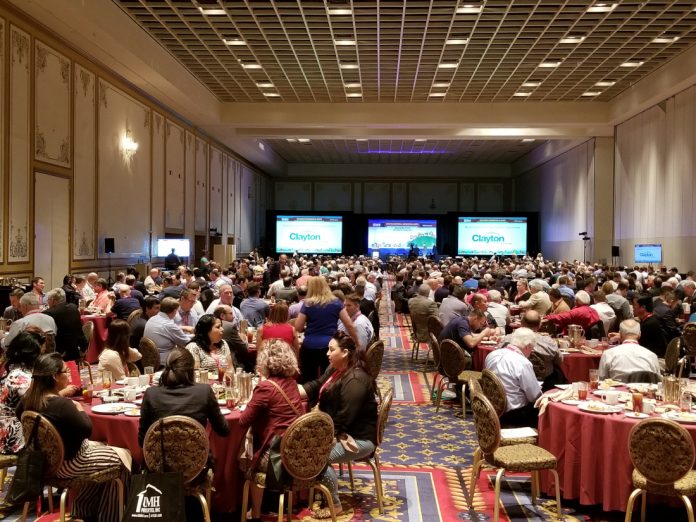
MHVillage/Datacomp Appraisal had a team of six represent the company and put a wrap on Louisville 2018. We are among 3,000 MH Pros who will say it was a great year to be at the Kentucky Expo Center.
Attendance was up, according to Show Producer and Manager Dennis Hill, of Show Ways Unlimited. 2018 attendance surpassed the previous year at 10 a.m. on day 2, less than halfway through the event.
This alone shows the enthusiasm and upward trajectory of the industry!
Louisville 2018 gathered 3,188 manufactured housing professionals from 1,061 organizations.
“I think everybody would agree that this year’s show was a success. The degree of enthusiasm was most rewarding,” Hill said.
Video fireplace and LED lighting in a Commodore Home.
Homes, Homes, Homes
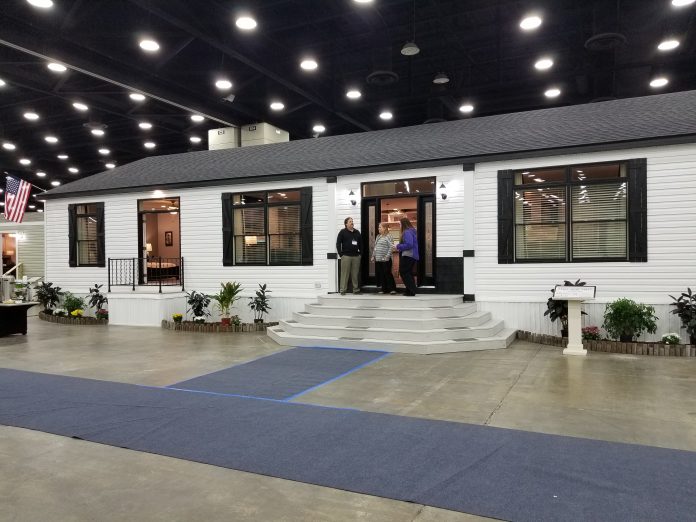
We walked the floor, talked to supplier exhibitors, and toured each of the nearly 60 new model homes on display. And boy did those exhibitors bring out the goods!
The show had single-section, multi-section and tiny homes galore. All the homes had compelling new materials, very livable floor plans, and awe inspiring features. Just to note a few of the trends:
Wrap on Louisville 2018 Trends
The study in a new Redman Home.
Large tubs and open shower/tub combinations
Mudrooms and lockers
Hanging barn doors for interior transitions
Distressed wood laminate flooring
Distressed wood cabinetry and trim
Enhanced/increased outdoor deck spaces
Added square footage/emphasis on shared spaces
Small office spaces
Tray ceilings
Chalkboard walls or chalkboard panels over utility access
Video fireplaces
Multi-color LED accent and backlighting
Probably the most fun and interesting new feature pays tribute to our furry friends. One new home now uses a pet-wash station installed in the rear laundry bay. This is evidence that makers really do put themselves in the shoes of the homeowners when they’re drawing out designs.
A freestanding shower in a new Champion home, the Northwestern.
Seminars and Speakers Capture Attention in Louisville
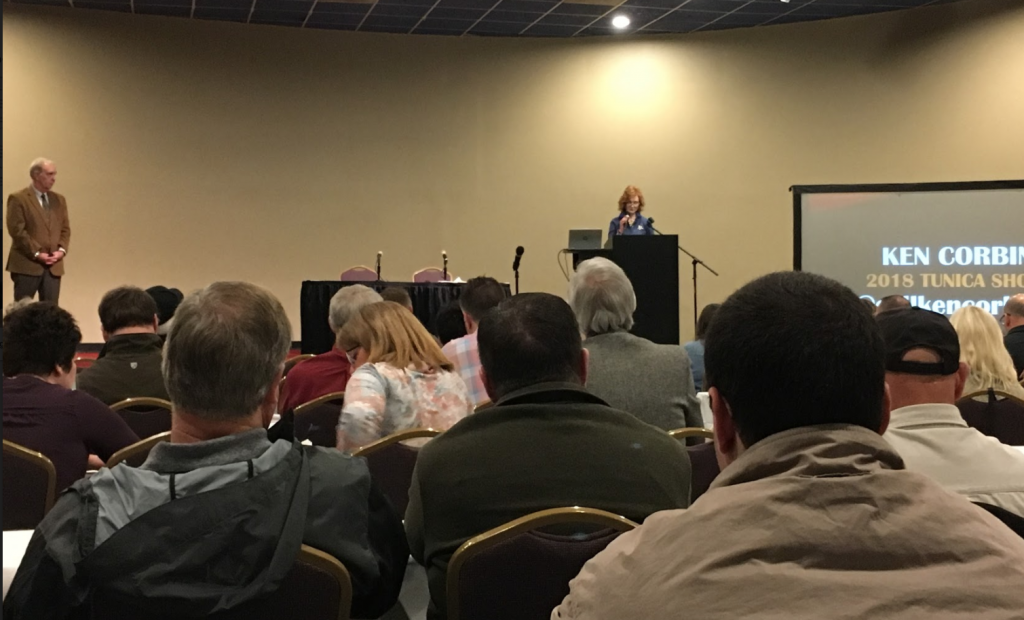
Hundreds of attendees sat in the main hall for presentations on home buying, finance, marketing and a Friday finale that detailed home foundation types and related soil-type and ground density issues. We will detail this surprisingly interesting session in a future blog.
MHInsider Introduced in Louisville
The big development of the show for MHVillage was the introduction of the new MHInsider magazine, received in a rather celebratory fashion. The need for a new manufactured housing industry magazine became all the more apparent in Louisville. Especially relevant was the positive reaction from industry professionals who were profiled in the first edition, and others who want to be involved in upcoming issues.
Founder of Show Ways Unlimited Planned and Organized Hundreds of Shows in His 50 Years in Manufactured Housing
Dennis Hill, with 50 years in manufactured housing, is the talent behind Show Ways Unlimited and the hundreds of manufactured housing industry trade shows he and his team have put on.
Though many in the industry may believe Hill gained his start in the events business forming shows in Atlanta or Nashville, there is a deeper story yet to be told.
Prior to the start of his 50 years in manufactured housing, Hill was in graduate school at the University of Georgia. In 1966 he was swept up in the U.S. call for 50,000 troops to Vietnam. He trained and prepared but never was shipped out.
“I was placed in special services and put in charge of conducting entertainment for troops at Fort Rucker,” Hill said.
He said it took a while to convince his superiors that they guys didn’t really want to spend their time playing checkers in the USO Club, and that there had to be some alternative yet safe ways to “blow off steam”.
Clayton “town center” at Louisville in 2018.
Rockin’ Fort Rucker
“We put on Rock shows. And that’s what I think got me started on the idea of doing events,” Hill said. “The commanding officers were only convinced we’d made some good decisions when they saw 4,000 to 5,000 people out in the parade field being entertained.”
He programmed all phases for the entertainment section, and prior to the event had to recruit, evaluate and assemble the performers into bands that could hold the stage for an hour, if not more.
Yes, Dennis Hill organized “boy bands” for the troops, in a time some 20 years prior that was better known for the “British invasion”.
“The performers were local rock groups we assembled,” Hill said. “It was amazing to see something like that come together.”
In 2018, Dennis Hill of Show Ways Unlimited Celebrates 50 years in Manufactured Housing
When Hill was discharged, his father, who had been a manufacturer’s rep in the industry, was in poor health. His father asked that Dennis and his brother follow him in the manufactured housing business, but the brothers were ill-suited to work together.
Dennis Hill allowed his brother to take his father’s path, and Hill signed on with what was referred to as “the old Southeastern Manufactured Housing Institute”.
“The regional group was there for 10 years, and my original role was around member services and the service and supplier division,” Hill recalled. “Maybe it was a catch all for anything and everything.”
The trade show thing literally just popped up.
“My boss walked in and said ‘You’re going to do a trade show’ and I said ‘What is a trade show?’” Hill confessed. “I guess I figured it out.”
The Formative Years
Overlooking homes and vendors at The Louisville Show in 2018
Hill said there were many people around him – a 22-member board included – to help organize the management of a trade show – from earliest planning, through working with partners and vendors, to securing space and getting show homes organized and speakers assembled.
And it was an experience that got his blood flowing, he said. Doing shows was something akin to running a political campaign; many months of planning that must coalesce into action, an effective day or two that provide a collective experience for the whole.
He could run a weekend “how to” retreat on the topic these days, but in the early ’70s it was a rather undefined landscape. That’s the type of perspective that 50 years in manufactured housing offers.
“It was the wild and wooly days. The business almost allowed you to show up set up your display and leave it for the weekend. This happened one time and I called a guy to ask him how his show was and he responded ‘It was the best show ever’.”
“It changed, and I like to think I had a positive influence,” Hill said. “The shows were going to move forward, and they needed to be about more than partying and being out at night.
John Manley, a veteran in the industry and member of the RV/MH Hall of Fame, was there to help Hill in those formative years.
“His influence as a West Point graduate appealed to me, having just come out of the military,” Hill said. “In the morning, when I got chewed out for whatever, it didn’t really bother me because that’s just the way it worked.”
‘Industry Competition and Collaboration’
Hill started with the Atlanta show, which was outside at the farmers market. He said the industry was very competitive at the time, and lacked the undercurrent of cooperation seen today. The goal, Hill said, was to create something durable that allowed for industry competition and collaboration.
When Show Ways was organized in 1978, the trend went toward bringing shows inside, and creating professional presentations and talks. The trade shows could still be about selling products and having fun, but programs that advance the industry found a place as well.
“That was a big decision to make,” Hill said of starting Show Ways Unlimited. “Any time you start a business, it is a big deal. The number of shows I was doing at the time made me wonder if I could make it. But when I got underway, I realized I was reasonably good at it.”
All Those Shows
Shows for manufactured housing professionals were held in Kansas City, Mo., Charlotte, N.C., Atlanta, GA, Louisville, Ken., Tulsa, Okla., New Orleans, LA, Tunica, Miss., Omaha, Neb., Nashville, Tenn., and Atlantic City, N.J.
Tim DeWitt, former director of the MMHRVC, worked in collaboration with Dennis for a good portion of his 39 years in the business.
“He found a niche, and honed in on it. I think what’s made him as successful as he has been, is because when you’re in a state association it’s very helpful to be able to work with a private promoter who has more room to move and can make decisions to get something implemented a lot faster than you’d be able to working in public sphere.”
DeWitt recalls Hill as a true football nut, always wearing his Bulldogs ball cap during move-in days prior to a show.
“He was always a calming influence, and that’s important. He supported us in good times and bad, and we could rally around that,” DeWitt said.
Eventually, the Atlanta show grew up and moved to Nashville. It turned from an outdoor / indoor show, to a regional affair. The Nashville show was held at the Opryland hotel complex and outgrew that space, too. This resulted in the move to Tunica, Miss., which was where the show continued to be held each March until it traveled south to Biloxi in 2022.
Still ‘Crazy for That’ After 50 Years in Manufactured Housing
Today, The Louisville Show is the largest gathering of MH professionals in the Midwest, is sponsored by five state association, and boasts the largest collection of model homes displayed indoor anywhere in the United States. A record number of nearly 3,000 attendees are expected at this year’s show.
Dennis Hill’s own plaque at the RV/MH Hall of Fame, bestowed when he was inducted in 2004, reads: “He has brought hundreds of manufacturers together with thousands of retail centers for the betterment of the housing industry and has returned over $3.5 million to the state associations that sponsor the shows.”
In 1998, Hill also was named “Industry Person of the Year” by the industry publication The Journal.
Running shows and managing relationships within the manufactured housing industry has been a dynamic experience in recent decades. He continues to view his role as one of providing increased professionalism at each event.
“This is where we are today,” Hill said. “It’s important to recognize and understand how to trust, and how to get the job done just as you say you are going to get it done.
“I’ve hung in there with it, and I’m proud of that.”
Dennis has had a great “show site” office manager in Michele Middleton. She has played an integral part in assisting him at the show since the Nashville Show. To add to his Roswell office, Hill has had Trisha Ragoopath join on as his office manager about a year ago.
Still Work To Be Done
Though 2018 marks his 50 years in manufactured housing, Hill said he has plenty to contribute and makes no mention of retirement.
“Looking back, the trade show was definitely what I enjoyed the most,” he said. “I guess I’m crazy for that, but there’s something about it I really liked, and I still do.”
Hill continues to run his business from Roswell, Ga., and lives nearby in Alpharetta, Ga., with his wife Nancy. Married for 53 years, the couple has a daughter, Allison Sims, two grandchildren, Bri and Max Sims, and their wonderful family dog Beau.
More than 1,500 manufactured housing professionals are expected in Las Vegas April 7-9 as the Manufactured Housing Institute’s Congress and Expo returns to the...
With more homes, more exhibitors, and more buzz than ever before, the 2026 Biloxi Show is expanding, and fast.
The Biloxi Manufactured Housing Show &...