General Manager Darren Felder Joins MHInsider on Home Sales
MHInsider asked a Clayton retailer to participate in a question and answer session on how homes are selling, how higher interest rates are being managed, and what customer are asking for in a new home. Here are the responses…
How long have you been operating?
I’ve been in the industry for 26 years. Originally, I worked for an independent retailer that was bought by Fleetwood Homes in 2005.
Is the average home you sell increasing in size, getting smaller, or staying about the same?
The average home size has remained about the same for many years. For the past 20 years or so, the average multi-section home we sell has been around 1,500 square feet and 1,200 square feet for single-section homes.
How many homes do you sell annually?
We sell 90 homes per year on average, and this has remained the same over the past several years.
What is your average time from the order of the home to set up?
We keep our best selling home models in stock. We currently have around 30 homes ready to order, and a lot of those are available at our store. For homes that we do not have available, the delivery of the home to the site varies depending on if the home building facility has received other orders ahead of the homebuyer’s order. Other factors like where the building facility is located and time of year can also affect the delivery time.
What is the most common add-on feature in your market?
One add-on feature that we tend to see is switching floor vents to ceiling vents. However, customers typically do not request any add-ons beyond site improvements.
How have you seen your business evolve over the last few years?
We’ve seen a lot more interest from customers in our affordable home options thanks to improvements in the home building process. The least expensive home is built using the same construction process as the most expensive home we offer. We also offer much more energy-efficient homes than we did years before.
Energy-efficient home packages have always been an attractive option to our customers and with eBuilt homes now being built in all Clayton home building facilities, we can help homeowners save up to 50 percent on utility costs annually.
What do you think is the greatest challenge facing the industry right now?
One challenge that hinders access to off-site built homes is zoning. Our industry is working closely with municipalities across the country to educate community leaders, zoning officials, and the public to allow off-site built homes in more locations.
Are there specific strategies you’ve identified to keep homes moving?
We monitor the housing market very closely. In the past, our more basic home packages have moved best. Within the last few months, though, we’ve seen more customers looking for higher-end home options. Staying ahead of the curve by understanding what our customers are looking for helps us anticipate what products we need to have available.
What customer trends do you see in terms of use-of-space and/or lifestyle amenities/materials choices?
For the past three years, many customers have been adamant that they do not want carpet in their homes.
Why do you feel it’s important to attend events like Louisville, Biloxi, Congress and Expo and others?
I attend the Biloxi Home Show every year. I believe it’s important to attend events like this to stay up-to-date on new product offerings in the market (like the uptick in energy-efficient features and packages), to make connections with others in the industry and to keep a pulse on where the industry is heading.
What do you think the next year is going to be like for the industry?
Community managers at the recent summit held by Roots Management.
How Roots Management Attains a More Personal Experience for Managers and Residents
Roots Management Group holds itself up as an example of a “best-in-class” offering, but it is not a reputation earned without a significant amount of introspection and institutional change.
“Community managers are the cornerstone of our vision,” Roots Management Group President Tom Stapley said. “We believe that a people-first ethos is a proven path that can help pave the way for a revitalized industry.”
In 2006, the predecessor to Roots, Treehouse Group, was established by Tom Stapley, Marcus Ridgway, and Dallas Tanner.
The business plan was to acquire older manufactured home communities in key locations, initially settling in on 20 properties in the Phoenix area. It was a time of enormous change, transformation, and opportunity across the industry and throughout housing.
By 2008, Stapley, Tanner, and Ridgway had expanded into the single-family rental business, founding Invitation Homes. But Stapley maintained his passion for manufactured housing at Treehouse, and the business continued to grow. In 2020, as the company continued to expand, Stapley recognized that community managers, many of whom were responsible for nearly every aspect of the business in the field, were becoming overwhelmed.
“We really wanted to see what it was like in the field from a fresh perspective. I started managing punch list items from when the company had just started, from when we had just a handful of properties. Still, we wanted to know what the landscape currently looked like from a community manager’s point of view,” Roots Management Group Chief Operating Officer Tauvaga Iii said.
Tom Stapley, president of Roots Management, addresses community managers during a recent company-wide summit.
Boots on the Ground
Treehouse sent a new operations intern, McKay Lyman, a grad school student just dipping his toe in the industry, to Brookhaven Estates in Apache Junction, Ariz., where there had been a significant amount of staff turnover.
McKay Lyman
“I had a lot of work to do, I knew I had to gain the resident’s trust,” Lyman said.
Stapley asked that he go out several times a day on a golf cart to clean up some litter and to “break the ice” with community residents.
“The idea resonated with me, and before long, I felt like I had gained a great deal of trust and appreciation from the residents, and it also allowed me to meet several of them much quicker,” Lyman said. “I encouraged residents to speak freely with me and let me know what was on their minds. Soon I started receiving a lot of baked goods as gifts, and the residents invited me to their community potlucks.”
Most importantly, Lyman said, the experience helped him and senior management understand what needed to be done in the community, and it ultimately provided great leadership insight that could translate across the company’s portfolio.
Tua Iii
“When we looked at McKay’s time logs and noticed that he was being bombarded by corporate requests and getting the same routine questions asked by the residents about where to pay rent and how much they owed, we knew something needed to be done,” Iii said.
Introspective Change, Staff Enablement
The company implemented electronic communications for residents and taught residents how to check balances and make payments. All corporate staff members were asked to prioritize a community manager’s time, to first seek answers from other sources, for instance, to keep time in the field free for managers to work with residents, contractors, and other staff members.
In 2021, the company decided to enhance its portfolio by bringing in additional properties owned and operated by Vineyards Management Group. Two years later, Treehouse Communities and Vineyards Management Group rebranded to Roots Management Group. With the additional staff and merging the two companies, Roots launched a learning and development department that created what is now called Roots University. The team provides educational content for the community managers, and develops the curriculum for Roots University, which is a 30-hour manager certification course covering Roots procedures, financial handling, reporting, and community-focused materials.
Parkhaven, a manufactured home community owned by Roots Management. All photos provided by Roots.
Stapley said the company also revamped its shared services department to further help relieve managers of non-resident-centric work. Shared services now has more than 30 people handling the home ordering, logistics and installation, marketing, and listing of homes for sale or rent.
He said the department has a full-time community success manager.
“Our shared services teams and every employee at Roots Management Group is here to support our front lines, our community managers,” Iii said.
The commitment translates into satisfaction for the community managers. Brooke McAlister is the community manager at Countryside Estates in Hays, Kansas.
“I really value the education and the trust put in us to run the communities as if we are the owners,” McAlister said.
McAlister also participated in a company-wide manager summit, a three-day immersive experience for managers and support staff.
“The Community Manager Summit really helped me learn to take the ownership role, feel secure taking the reins, learn how to maximize the impact of the online tools available to me and participate in peer-to-peer mentor groups,” McAlister said.
The company not only took tasks away from community managers to give them more time to focus on the residents, but they provided the opportunity to rate the staff members who are tasked with supporting community managers.
“We have each manager fill out a Net Promoter Score (NPS) survey each month that rates our company using a score based on how well we are responding to their needs and supporting them as a central services team,” Iii said. “We’ve come a long way since the first round of scoring, which had the corporate team rated by community managers at a negative-14. Today, they are reporting at 66, which is considered ‘Great’, according to the NPS rating system.”
Lyman says although he is no longer working at Brookhaven, he enjoys supporting all the Roots Management Group properties and the community managers.
“My time spent as a community manager was certainly a favorite for me in this company and is foundational to my appreciation for manufactured housing,” he said. “The industry is still growing and evolving, while Roots continues to push forward and transform the industry as a people-first company.”
The year was 1996 when I was able to purchase my very own cellular phone. I remember how excited I was to start using it, and, in my humble opinion, the feeling of having the latest technology. I remember rushing through incoming calls because I didn’t want to be charged after the first free minute. I was just getting started as a home designer and the money was minimal. Fast forward to 2024, and now I can watch TV on my smartphone, surf the internet, and have things shipped to my home the same day.
It’s amazing to see the progress in cell phone technology in almost 30 years since I purchased my first one. The ancient Greek philosopher, Heraclitus, said it best when he said “the only constant in life is change.”
I look at this type of progress as growth. These newer products have brought us so many benefits and made life very interesting, to say the least.
Now think of the growth and progress in our industry over just the last 10 years. The evolution of our product, the power of our finance offerings, the methods used to install homes, each have vastly improved in the last decade alone.
One of the major successes in the manufactured housing industry is the fact that more and more people have considered purchasing a home, buyers who would not have previously considered our product.
We have so much opportunity to increase sales by tapping into the segment of the site-built market that can no longer purchase a site-built home because of pricing and financing.
For all the growth we have seen in our product, financing, construction practices, and potential homebuyers coming into our segment, there is one aspect of our business that could benefit from some focus, and that would be the buying experience we provide our potential clients.
Having spent 14 years in retail sales of manufactured homes as a housing consultant, sales manager, or general manager, I can honestly say that I have yet to see a comprehensive and intentional initiative to improve the home buying experience provided by a sales staff.
OK, before anyone takes my words to the dartboard, let’s make one thing clear. I am a huge proponent of our industry, our product, and what we can do for homebuyers across the country. However, things seem to have been so good over the years that there hasn’t been quite the level of attention focused on sales process improvement and sales training to bring our representatives and consultants up to a new level. We have been good with the “status quo” because that’s how we’ve done it, and it has worked.
When I say sales training, I am not referring to simply getting people to make more calls, or answer the phones, or place more ads. Making certain our sales consultants are driving traffic to the location is where everything starts. What I am referring to is introducing the same level of respect, pride, and desire to be more that we would see from a sales consultant at an exotic car dealership or high-end retail store. I know there are plenty of sales consultants, managers, and retailers who have shopped at these places for themselves, and know exactly what I am referring to when I say “enhanced” buying experience.
What does that buying experience look like? How would your sales consultants represent themselves, your company, and your product?
Ultimately, how would your clients respond to that type of experience? In today’s world of higher prices and higher rates, our ability to provide that type of buying experience would help offset some of the pushback we get from potential even though they know our product and appreciate that it is more affordable than other housing options..
What we are talking about here is improving our perspective on the business so that we can effect change in the perspective of the homebuyer. We talked earlier about a new segment of the market coming into our industry and our desire to fill this need for housing. Many customers decide to rent because they were left wanting more from the experience they had on the sales lot.
In 2024, homebuyers want more out of the buying experience. And we want even more out of our sales consultants. It’s time we made clear that we are the premier choice for high-quality homes at an affordable price.
Here are a few focus areas I’ve identified that could provide a great positive gain. These also are areas we will be discussing in future editions of MHInsider magazine.
Selling in today’s market to today’s buyer is less transactional
Steps toward creating working relationships with clients that built on trust and empathy
How to establish yourself as a professional sales consultant and NOT the salesperson
Consider the leadership skills to embody no matter your title
A successful career that revolves around solving the needs of others
Two things must happen for us to make a change. First, we must want to improve. Second, we have to care to make it happen.
The manufactured home sales is the disruptive innovation that the housing market needs.
Champion Home Builders’ Doug Tollin in a LinkedIn post asserted that we have held that place for some time, and that many people simply haven’t taken notice. I’m here to tell you that they are watching now. IT’S OUR TIME TO SHINE!
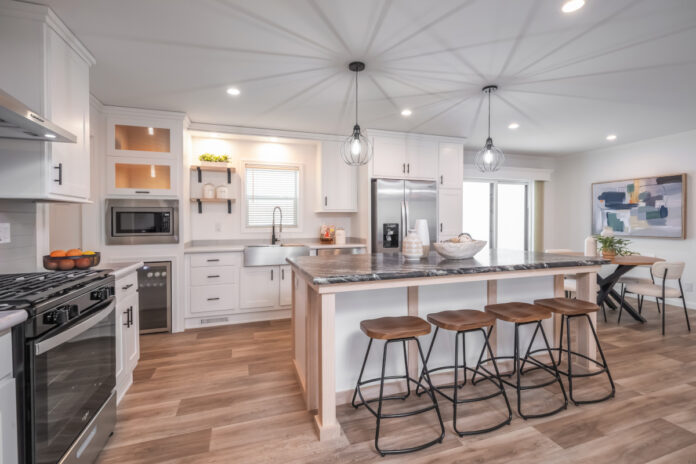
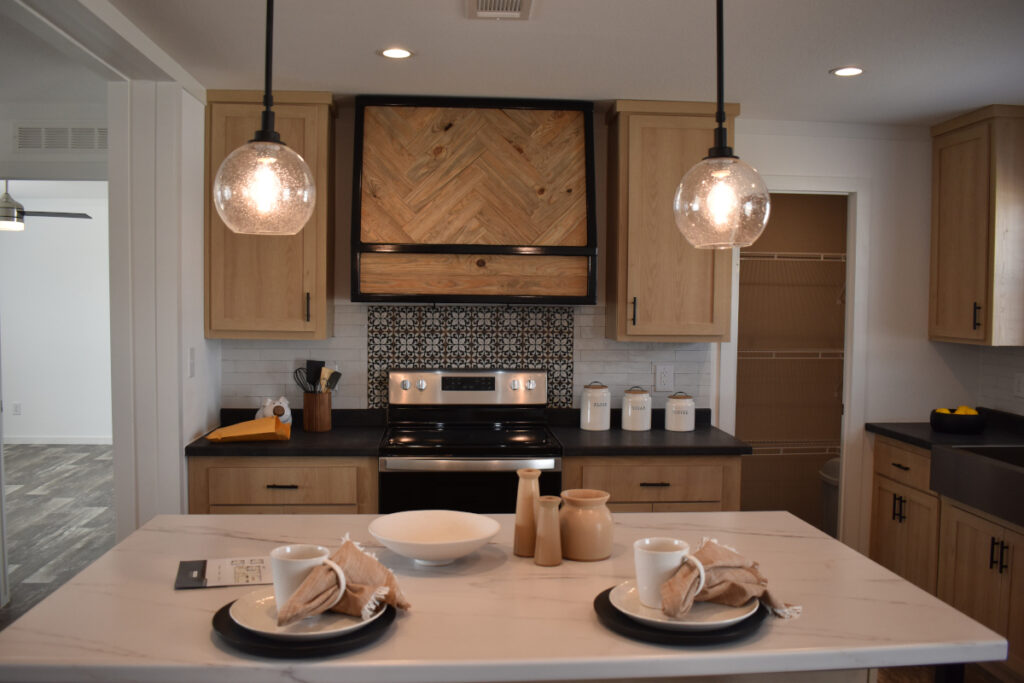
The kitchen and dining space in the new Skyliner II.
Nine percent. That is the magic mark that manufactured housing has contributed to housing starts each year for at least the last decade. Still, the manufactured housing industry may finally be poised to break through that ceiling.
Suzanne Felber, Lifestylist
How? By working together.
There are some new opportunities opening up in our markets that manufacturers and retailers are starting to discover. Identifying these niche markets and learning those that are right for you can be your key to success for 2024 and beyond.
Who is Your Customer?
Doug Tollin, director of customer experience at Skyline Champion, shared some excellent points on identifying your customer.
“Understand that customers have multiple options other than manufactured housing for their housing needs,” he said. “The main competitor to a retail sales center is not the manufactured housing retail sales center down the road but the site-built alternative, apartment living, existing home sales, and living with relatives, for example.
“Each market is different. Understanding who the largest competitor of the home shoppers is will allow the retail centers to know how to develop their unique marketing strategy,” he said.
Knowing that some buyers might not visit a street retailer location, but would be interested in the same house if it was in a community is changing how some retailers sell.
A new Genesis home from Skyline Champion Corporation.
Selling a Total Package
There are several channels by which manufactured homes make it to the customer. For so many years, street retailers sold homes despite the difficulty of having to help customers find land or a community, as well. Likewise, when a customer visits a community they want to know where they can buy a home to go in that vacant homesite. Many retailers sell land-home packages, especially on acreage, and we feel more will come. With site-built sales slowing down, more developers have land that needs to be developed and are having to get creative about how they bring in homes.. They are now starting to discover the factory-built advantage.
Competing with the Build-to-Rent Market
With the rise in interest rates making it harder to get financing, site builders have been turning to building new home communities that are all rentals. Single-family site built rental homes built in 2022 reached over 69,000, with many more townhome and condo communities also being built to take advantage of this demand. Tollin said he feels renters, for the most part, do not care about the method of construction used to complete their living space. This becomes a value-added to the developer or owner of a project. Suppose a “build-to-rent community” can complete its project in 30 percent less time and with 13 percent less cost and keep the community looking as attractive as they had ever imagined. In that case, the developer can generate rent revenue more quickly, reduce costs, and mitigate many risk factors. Many BTR clients are investors, not builders. Offsite construction simplifies the process for those not interested in becoming a builder.
Cavco has also become focused on this market and has started Cavco In-Neighborhood. This new division is dedicated to providing turn-key homes established in select communities and developments. Bryan Rogers is a regional vice president for the effort, and already is causing a stir in the manufactured housing community. The “diffusions of innovation,” Rogers said, is a concept his team is following to help explain how new ideas, products, and technologies are adopted and applied in different ways. By working with developers to create new community type where homes are sited and ready to be occupied in a goal of two weeks, Rogers shared that “We can offer an alternative to site-built housing. If we can capture the interest of those early adopters and gain 16 perenct of the housing market, our world will change.”
People like Bryan and Doug will change the housing world, and being a part of that is exciting.
Is this a possible dream? Of course, it is! Our industry has the resources to build, finance, insure, and sell our homes so we can genuinely offer that turn-key solution.
More on the Turn-key Process
Many consumers are concerned that we are only selling a home, and that they will have to arrange all of the partnerships needed to get the home completed. Most of us in the industry know this isn’t the case, but again, in many cases, we haven’t done a great job telling our story.
In some ways, buying a manufactured home is more straightforward than purchasing a site-built home. If a site builder were to build in the same community that these manufacturers will now be building in, it would take a minimum of 90 days to construct the home and probably 30 days to get the financing secured after the home is purchased, Cavco In-Neighborhood is using a two week sales time to buy and move in for land and homes that are set and move-in ready. This could indeed be the answer to the scarcity of attainable housing, particularly in the middle market. Some of the communities will be a land-lease purchase, and others will be where the land and home are sold together.
Another unique opportunity with these developments is that they are welcoming sales from retailers and Realtors®, which will give our homes renewed visibility they haven’t enjoyed in a long time, maybe ever. Our homes also present Realtors® a path to increased commissions. With the Cavco division, each development will have an onsite sales office, and retailers can bring clients to that sales office. The Cavco representative will handle the rest of that transaction, but the retailer still gets their commission.
If They Won’t Come to Us, We Need To Go To Them
I think manufactured housing is one of the most misunderstood industries in the country. When I talk to site builders and consumers, most guess what we still build are tin roof single wides, which you only find in older parks. Fortunately, that perception is changing, and companies like Cavco and Skyline Champion are doing a great job helping to show how far we have come. Both companies had a pair of homes at the International Builder’s Show and the Kitchen and Bath Industry Show in Las Vegas in February. More than 100,000 builders, developers, manufacturers, and designers attend the show every year, and it is exciting that our industry will have four complete homes for people to tour in the village setting right outside the convention center.
Cavco had a 540 square-foot small footprint home (great name!) And a 400 square-foot ADU model. The Genesis division of Skyline Champion brought a 1,493 square-foot, three-bedroom, two-bath home with a primary bedroom oasis as well as a 1,587 square-foot home with three bedrooms and two baths with a split bedroom design. These homes will feature the latest technology and finishes available in the industry and give our industry a way to show off what we can do. All of these homes are consistently decorated in a way that would compete with any site-built home, yet when a consumer visits some retail centers, they don’t get the same experience.
Do Your Homes Offer a WOW Feature?
Even big box retailers like Walmart and Target realize that consumers now expect to be wowed, no matter what the price point of the item they are selling. If you have gone into a Walmart lately, you will see that they no longer have just racks and shelves with vast amounts of clothing; they now have beautifully designed displays that offer one of each size with back stock hidden away. Likewise, consumers no longer want to buy a home with bare walls and floors in a monochromatic color scheme where they can’t visualize their grandmother’s china cabinet or other belongings; they expect model homes full of ideas like what they see every day on Pinterest or HGTV. Jennifer Jones, a general manager with Clayton Homes of Alexandria., in Louisiana., discovered that when she offered her many homes for sale, the fully furnished and decorated ones sold faster. She didn’t have to worry about moving and storing furniture and accessories when they did sell. It eliminated the nicked walls and scratched floors when furniture is moved out of a sold home. The houses started selling so quickly that she got contracts before we could finish hanging the artwork!
By knowing who your buyer is and what your retail center’s strengths and weaknesses are, it is possible to tap into one of these niche markets or find one of your own. We are excited about what the future holds for all of us!
MHI at the 2024 Congress and Expo will give attendees a more immersive and productive experience with a two-day event that has extended exhibit hours and enhanced educational sessions.
2024 Congress and Expo takes place April 3-4, 2024, at the MGM Grand in Las Vegas. Attendees will get to see the latest product innovations in the exhibit hall, open Wednesday, April 3, from 1 p.m. to 6:30 p.m., and Thursday, April 4, from 8 a.m. to 6 p.m.
In addition to longer exhibit hours, Congress and Expo will inform and inspire with a pair of general session speakers who have presentations designed to help manufactured housing professionals better understand the market. In all, Congress and Expo will provide a dozen educational sessions on a variety of topics.
The popular Developers’ Seminar at the Congress and Expo expands to one and a half days to dive deeper into the development process. Open to Congress and Expo attendees with an add-on registration, the Developers’ Seminar will take place Tuesday, April 2, from 1 p.m. to 5 p.m. and Wednesday, April 3, from 9 a.m. to 3:30 p.m. Seminar attendees will learn more about building with manufactured housing, on topics that include site development, zoning, and financing from people who have been there, done that and come out on top.
The National Communities Council Spring Forum returns to the 2024 Congress and Expo as an add-on event on Wednesday, April 3, from 10:30 a.m. to 3:30 p.m. The forum covers content specific to land-lease communities and allows community professionals to maximize their learning time.
MHI’S Congress and Expo will showcase products and services from about 150 exhibitors in the 45,000 square foot expo hall at MGM Grand in Las Vegas. Congress and Expo is a trade event and only industry professionals will be admitted.
Congress and Expo 2024 Sponsoring and Exhibiting Companies
21st Mortgage Corporation ABT Water Management AccessParks Ace Tire & Axle Advantage Homes Adventure Homes Albano Dale Dunn & Lewis Insurance AmRent Atwell, LLC B.A.C.H. Land Development, LLC Backyard Products Berkadia Big Rig Media LLC Blevins, Inc. Boom Brine Development Brown & Brown California Southwestern Insurance Agency Capital One Cascade Financial Services Cavco Industries, Inc. CBRE Manufactured Housing Group – West Clayton Home Building Group Colliers Communications Consulting Group Conservice, LLC Cooper Cardinal CoverTree Credit Human Eastdil Secured LLC Efidol Equity Lifestyle Properties, Inc. Family Homes Gama Sonic Solar Lighting Home Depot Pro Renovation & Remodel ILT innovation Legacy Housing Corporation Lument Lyons Industries, Inc. ManageAmerica ManufacturedHomes.com Marcus & Millichap Metron Sustainable Services MFI Commercial MHC Funding MHP Brokerage MHVillage / Datacomp MHWC Minute Man Anchors Mobile Insurance NextCentury NMHC Group Northpoint Commercial Finance Oliver Technologies, Inc. Onyx Capital Other Street Advisors Partner Valuation Advisors Phase3 Photovoltaics, Inc. Philips International Princeton Capital Group QMC Metering Solutions Quality Home Transport Rent Manager RHP Properties, Inc. ROC USA Rose Paving Sands Investment Group Skyline Champion Homes Speedread Technologies, LLC Style Crest Inc Sun Communities, Inc. Sunstone Real Estate Advisors Tammac Tie Down Engineering Inc. Timberline Construction Group Triad Financial Services, Inc. UMH Properties, Inc. Universal Utilities Vanderbilt Mortgage & Finance, Inc. Wells Fargo Wild Energy Witten Vent Company Yale Realty & Capital Advisors Yardi YES Communities Zego (Powered by PayLease) Zippy, Inc. *Exhibitor list as of February 19, 2024. Companies listed in bold are event sponsors.
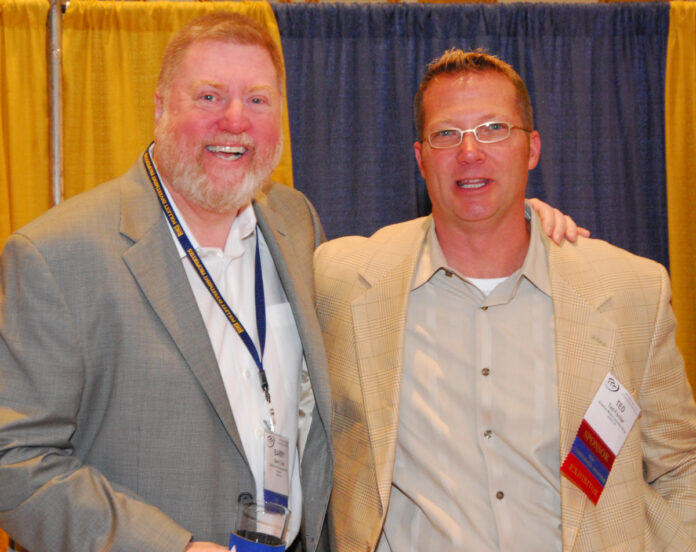
Barry Cole, left, with friend and colleague Ted Fischer.
Life Stories from a Manufactured Housing Professional (with Varied Interests)
Anyone who’s taken the time to sit and chat with manufactured housing industry veteran Barry Cole knows… well, anything is possible. And you should prepare to be surprised.
Perhaps he’s lived two lifetimes or more. But when Cole starts his professional story, and begins to tell of his childhood, it seems fantastical — like something from a feature film.
In fact it is, but from the mind of someone who didn’t really experience the story. The story is fiction. Cole lived it.
One word of note, from the source; typically the kid who lives at hotels and gets dropped at school by the bell hop gets beat up for a bit, has a 15 year old body guard and has to make some plans to normalize his relationships.
“It’s an odd life, and you have to get creative,” Cole said.
Charles W. “Curly” Cole, Cole’s father, was a protege of the legendary hotelier Conrad Hilton. Cole said his father, during the time he ran The New Yorker Hotel, an art deco masterpiece that remains in business today where he was the president of the hotel association and seemed to know everybody and was best pals with Yankees slugger Mickey Mantle, was close to many celebrities and had been “honorary mayor” of Hell’s Kitchen, alongside theater and screen icon Sydney Poitier.
The hotel was famous worldwide. It had an indoor ice rink, direct access to the subway, and was the first hotel to have a TV in each room.
His mother, Lola (Cogan) Cole, was a dancer, and worked with Carmen Miranda, Esther Williams, and Betty Davis. She is in the Three Stooges Hall of Fame Museum and was crowned “Queen of the Stardust Ballroom” in Hollywood and is in the California Swing Dance Hall of Fame. She met Curly Cole while singing in big bands and they married in 1945.
He lived in The Senator Hotel in Sacramento before the move to the New Yorker, and the family returned to California by the time he was out of grade school. During that time the family had interests far and wide, including in Albuquerque where the Cole Hilton was and remains the only co-branded hotel in Hilton history. They owned The Deshler in Columbus, Ohio, included in the best-selling book “Harry Truman’s Excellent Adventure: The True Story of a Great American Road Trip.” Flamboyant Curly had ladies on swings in the lobby and horses in elevators going to the top floor.
It was with all that he saw in front of him and from those early “hotel offices” that Cole began to have thoughts about his own future, business ideas, and how to capture the imagination of customers.
High School Ideals
By the time he was back in Southern California in his high school years, Cole was the first President of West Coast Surfers.
“I was a terrible surfer and they felt sorry for me but I had a garage in Hermosa Beach storing boards,” he said.
He also started Cole Racing Enterprises, because he and many young people of that day thought Corvettes were beyond cool.
“I went to the drag strip and sold T-shirts with the logo,” Cole said. “We sewed in first and last names, too, or whatever they wanted. They were really great and people loved them.
“Then I got the cease and desist letter. Corvette got mad at me,” he said.
Live and learn.
He was a member of the Screen Extras Guild appearing in shows Hogans Heros, Time Tunnel, please don’t eat the daisies, the Man from uncle, Bob Hope Chrysler Theater, Felony Squad and many others.
Six Years of Service
During the Vietnam War, Cole enlisted in the Navy. He was active for two years at Port Hueneme, during which he worked in a records office and as a yeoman at builders school, then had two years of meetings, and two years of inactive service, he said.
“At some point I was asked how it was I hadn’t been assigned to a Sea Bee Construction battalion, which is how you ended up seeing combat,” Cole said. “I said ‘I don’t know, probably coincidental bad records.’”
Cole admitted that returning from the military he expected to be a famous actor. Instead, he got married to his first wife in St. Louis, moved back to California, and got a job selling beer.
“All I did was drink beer, play darts, and shoot pool all day while buying patrons drinks,” he said. “I got up to a 40-inch waist.
“Then I started selling mobile homes in 1972,” Cole said.
Cole gained his footing in retail sales in Compton, and also spent much time with the builders, in operations with Lancer Homes, Levitt Homes, and Westway Homes.
“In mid-1976 I was speaking with the paper easel and stick pointing to all the stuff HUD is doing and that we wanted everyone to start calling them manufactured homes… and 50 years later people are still calling asking about mobile home insurance and mobile homes.”
It was in those years that Cole’s desire to start his own operation re-emerged. In 1986, he started Red Label Housing, a retailer in Orange, Calif., which evolved into Community Mobile Home Sales in 1992 which was a top dealer for eight years.
In 1999 he launched Manufactured Housing Insurance Services, the entity under which he continues to do business in 38 states. He and his team provide only manufactured home insurance, an anomaly in today’s market.
Insurance In California
Manufactured housing insurance premium rates are regulated by the state. Fire risk, regulations, and fraud have caused much of the pain and carriers could not raise their rates to maintain profitability, Cole said.
It also has caused many providers to discontinue writing new policies, he said, in a state where they are losing billions as the state makes it unreasonable to raise rates.
“Aegis, Century National, Foremost, Cabrillo Coastal, Pacific Specialty, they and others have all left. American Modern and American Bankers are still here but will only do newer homes, homes built within the last 30 years and will only do business in designated areas. That leaves out most of the homes in the state,” Cole said. “When there is a catastrophe the unfortunate homeowner loses everything – memorabilia, cherished possessions, valued property, and lives.
“It’s a tough deal, it’s tough to get insurance. We get 300 calls a week and unfortunately many times respond and say ‘Sorry, wish you the best’ to most of them,” Cole added. All of this will be supported soon, because within a year all the renewals come, most of those customers will go with the California FAIR Plan.”
The plan is an initiative to help state residents get fire insurance, though it only covers the home. A second plan is required to cover contents.
“It’s a lot more cumbersome than our regular manufactured home insurance,” Cole said.
Cole has felt the pain himself, having his commercial coverage pulled after being with the same group for 24 years.
Manufactured Housing Insurance Services had 300 sub-producers at one point. He’s paring that back. Several years ago he sold off part of his insurance interest of 10 offices in Southern California to concentrate solely on manufactured housing clients.
It is a business he loves.
In addition to providing insurance for the industry’s customers, he also is a partner in 32 communities in California, Colorado, Idaho, Illinois, North Carolina, Utah, Virginia, and Washington.
Cole is a founding member of the California Manufactured Housing Institute, has served multiple terms as chairman, and continues as a CMHI officer to give resources toward state and regional efforts within the industry. Nationally, he has served on the Board of Governors for the Manufactured Housing Institute, has been the recipient of numerous awards and honors, and in 2014 was elected into the RV/MH Hall of Fame and is Chairman Emeritus in Elkhart, Ind., an organization he has supported steadfastly throughout his career. Cole has been on the board of non-profit Affordable Community Living Corporations for 22 years and ACLC has placed over 300 veterans in Manufactured Homes.
Dipping Back Into Hospitality
After decades of work, Cole’s tireless energy and optimism for all things good brought him back into hospitality, but not hotels. Cole, along with being a manufactured housing professional, is a noted restaurateur.
“We have two restaurants in the desert, RD RNNR (‘roadrunner’) and the DSRT CLUB,” Cole said. “They get really great ratings, most days and nights there are lines to get in. RD RNNR is top rated in the area as a bar and restaurant, and the beautiful DSRT CLUB is new, it’s only been open a few months.
“It was fun when so many of my friends and colleagues, about 140 people, were in town last fall for an MHI meeting and dined at the RD RNNR. It was a great night, I felt like the maitre d in a classic old place, going to each table and saying hi, asking how things are.”
Cole said RD RNNR is a lively place frequented by the younger crowd, including many celebrities and the famous golfers who come to the Palm Springs area for the famous golf courses.
“DSRT CLUB opened for fine dining, a place that some of the older crowd likes to duck into because it’s a little quieter,” Cole said.
Unsurprisingly, Cole says he has no plans to retire. He continues to live and work primarily from Orange, Calif.
“My old friend, boxer Jerry Quarry, who fought Muhammad Ali, was living with me and convinced for me to a young lady named Donna working at American Mobile Homes to go out with me,” Cole said. “We did go out, and she never left, so Jerry had to move out.”
He and Donna have been happily married for 38 years.
“I have two girls, two grandsons, and four great-grandchildren,” he said.
When he’s not running his businesses or doting on his dog Sammi, he’s engaged in his favorite hobby, restaurant and bar hopping.
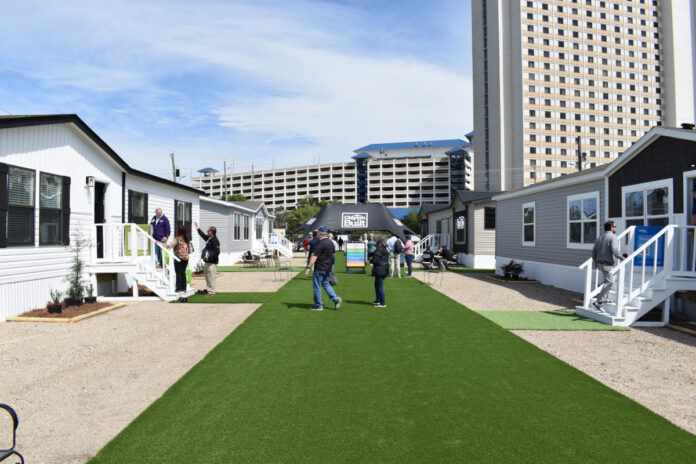
Manufactured housing industry professionals tour homes in Biloxi during the 2023 show.
The Biloxi Manufactured Housing Show and Expo returns to the Gulf Coast for the third year with about 90 exhibitors and dozens of homes on display from 11 builders.
“We have 49 homes, up from 35 homes the previous year,” Mississippi Manufactured Housing Association Executive Director Jennifer Hall said. “We are maxed out with that number. We do have some new manufacturers, too, and we’re excited about that.”
Hall said Dr. Lesli Gooch and Mark Bowersox from the Manufactured Housing Institute will provide an industry update from a national perspective, including an update on pending U.S. Department of Energy mandates for manufactured housing.
There also will be a lenders panel, and a presentation on tech and marketing trends from MHVillage Co-President and Chief Business Development Officer Darren Krolewski.
MMHA works with the Alabama Manufactured Housing Association each year to host the event at the IP Casino Resort in Biloxi, a carry-over from the former Tunica Show.
“A month ahead of schedule we were setting records for registration, vendors, and sponsors participating in the Biloxi Show,” AMHA Executice Director Lance Latham said. “We couldn’t be more excited for what’s in store this year in Biloxi! Trust me when I say this is one industry event you do not want to miss!”
“Everyone is excited about coming back to Biloxi for the show. They love coming down for show, for the casino, and for the area’s amazing restaurants,” Hall said.
In addition to the many attendees and exhibitors at the show, the two associations will host myriad public officials from surrounding counties.
“We will have public officials come tour the homes on Wednesday,” Hall said. “We have everything set up and looking so nice, it’s a great time to get people through these homes to see what they’re missing and help them gain perspective on the opportunity to provide more affordable housing in their cities.
Biloxi Show Schedule 2024
Monday, March 18 8 – 11 a.m. Exhibitors and manufacturers only pick up registration packets/name badges 11 a.m. – 6 p.m. Registration open for attendees, foyer Studio B 8 a.m. – 5 p.m. Exhibitors set up in the Exhibit Hall, Studio B second level 1 – 5 p.m. Home in the outdoor village open to attendees 4 – 5 p.m. Education session – Lending panel in Studio A 6 – 7:30 p.m. Welcome Reception
Tuesday, March 19 8 a.m. – 5 p.m. Registration, foyer Studio B 8 – 9 a.m. Breakfast in Exhibit Hall Studio B 8 – 5 p.m. Exhibit Hall open in Studio B 9 a.m. – 5 p.m. Display homes open in outdoor village 9:15 – 10:15 a.m. Education Session – State of the Industry/National issues from Lesli Gooch and Mark Bowersox, MHI Executives, in Studio A 10:30 – 11:30 a.m. Education Session – Fannie Mae and Freddie Mac discuss manufactured housing programs in Studio A 11:30 a.m. – 1 p.m. Lunch in Ballroom on the third level 2:30 – 3:30 p.m. Education Session – Darren Krolewski from MHVillage covers emerging tech and marketing trends in Studio A
Wednesday, March 20 8 – 9:00 a.m. Breakfast in Exhibit Hall Studio B 8 a.m. – Noon Exhibit Hall open in Studio B 9 a.m. – Noon Display homes open in the outdoor village 9 a.m. – Noon. Local officials to tour the display homes
HUD Secretary Marcia Fudge, pictured preparing for testimony in Congress Jan. 11, has announced she will resign her post March 22.
Final Day March 22, Deputy Secretary Adrianne Todman Named Interim
Secretary of the U.S. Department of Housing and Urban Development Marcia Fudge has announced she will leave her post March 22, and will be replaced on an interim basis by Deputy Secretary Adrianne Todman.
Fudge said in interviews that she has “mixed emotions” about retiring after decades in public service and that HUD “was the ideal opportunity to culminate a career focused on doing the most good for the most people, including those who have often been left behind or left out.”
While Fudge’s departure is somewhat of a surprise, it’s not uncommon for cabinet positions to open in the face of a presidential election. Fudge is the second member of the Biden-Harris White House cabinet to step away, preceded by Labor Secretary Marty Walsh exiting that post in 2023.
“It has always been my belief that government can and should work for the people,” Fudge wrote. “For the last three years, I have fully embraced HUD’s mission to create strong, sustainable, inclusive communities and quality affordable homes for all. The people HUD serves are those who are often left out and left behind. These are my people. They serve as my motivation for everything we have been able to accomplish.”
Fudge served in the lead role at HUD for more than three years, navigating the department through the COVID-19 pandemic. She said she will return to Ohio and private life.
“It’s time to go home,’’ Fudge told USA TODAY in an exclusive interview on her resignation. “I do believe strongly that I have done just about everything I could do at HUD for this administration as we go into this crazy, silly season of an election.”
With that, Fudge told the outlet that housing should be a top issue for both Republicans and Democrats.
‘‘It is not a red or blue issue,’’ the secretary was quoted as saying. “Everybody knows that it is an issue so it’s not a one-sided issue. It’s an American issue.’’
“Under Marcia’s transformational leadership, we have worked hard to lower housing costs and increase supply. We’ve proposed the largest investment in affordable housing in U.S. history. We’ve taken steps to aggressively combat racial discrimination in housing by ensuring home appraisals are more fair and by strengthening programs to redress the negative impacts of redlining,” the statement read. “Thanks to Secretary Fudge, we’ve helped first-time homebuyers, and we are working to cut the cost of renting. And there are more housing units under construction right now than at any time in the last 50 years.”
Prior to her tenure at HUD, Fudge served as U.S. Representative for the 11th Congressional District of Ohio and was a member of several Congressional Caucuses and was past chair of the Congressional Black Caucus. As a Member of Congress, she earned a reputation of tackling the unique challenges of her district by working with her delegation and across political ideologies. Fudge’s career in public service began in the Cuyahoga County Prosecutor’s Office, rising to the rank of director of Budget and Finance.
Interim Secretary Todman previously worked as a legislative director for Congressman Ron de Lugo, a delegate of the U.S. Virgin Islands. She also served as a policy aide in HUD’s Office of Public and Indian Housing, spent time with District of Columbia Housing Authority, and was selected in 2017 as the CEO of the National Association of Housing and Redevelopment Officials before returning to HUD.
$225 Million Made Available to Support Manufactured Housing Communities
The White House has released a plan to increase the supply and lower the cost of housing, including a multi-pronged approach to protect manufactured housing and to provide support for home-only loan programs.
“Manufactured housing provides an essential path to increasing overall housing supply and offers significant savings over site-built housing. Today, the Biden-Harris Administration is announcing steps to preserve and rehabilitate existing manufactured home communities and to make it easier to finance the purchase of manufactured homes,” the White House release stated.
Part of the plan to protect manufactured housing communities includes access to Preservation and Reinvestment Initiative for Community Enhancement (PRICE) grants, a fund of $225 million that now is available for the purchase of new homes in a community, as well as for infrastructure improvements, and for resident services.
This is the first time the federal government has made grant funding available specifically for investments in manufactured housing communities.
“Manufactured housing offers a proven solution to America’s affordable housing supply crisis,” HUD Secretary Marcia L. Fudge said. “Today’s actions bring us one step closer to a future where everyone has access to housing that meets their needs.”
The FHA, in its Title I Final Rule published with the National Register, has increased loan limits to 115 percent of value for manufactured homes, tying to industry average, would increase a loan limit for a single-section and multi-section manufactured home from $69,678 to $106,405 and $195,322, respectively.
“HUD’s Title I program has been an important source of financing for manufactured homes, but low loan limits have made the program dormant in recent years,” the White House stated in its release. “The rule will increase loan limits to be in line with current market prices and enable HUD to regularly update the limits in the future. To support this action, Ginnie Mae revised eligibility requirements for Issuers of its Manufactured Housing Mortgage-Backed Securities program. These actions are intended to reduce barriers to entry for Issuers and increase participation in its securitization program for Title I loans.”
An expansion of Title I lending, for purchase and refinancing, has been a top priority for the Manufactured Housing Institute and its work on Capitol Hill in recent years.
Additionally, a clarification grants the use of CBDG Funds in acquisition of manufactured housing units, in the service of manufactured housing units, and for providing resilience to manufactured housing communities.
The White House plan, in non-manufactured housing-specific language, is looking to HUD to ensure the elimination of non-rent fees — for application and screening, for instance — in public housing and subsidized programs. Language in the plan also provides a set of tenant rights for military services members, adds resources to prevent unfair evictions, and provides renters’ rights during tenant screening.
MHInsider is the leader in manufactured housing news and is a product of MHVillage, the top place to buy, rent, or sell a manufactured home or mobile home.
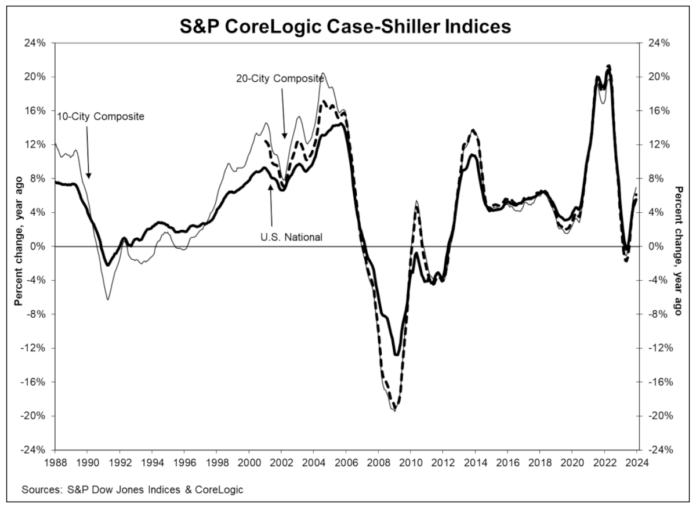
The S&P Corelogic Case-Shiller Index shows national home prices remain up 5.5 percent year over year, but have declined slightly each of the most recent two months for which reporting data is available.
Seventeen of 20 major metro markets reported month-over-month price decreases, the report released Feb. 27 stated.
The U.S. National Index showed a continued decrease of 0.4 percent, while the 20-City Composite and 10-City Composite posted 0.3 percent and 0.2 percent month-over-month decreases respectively in December.
“U.S. home prices faced significant headwinds in the fourth quarter of 2023,” S&P Dow Jones Indices Head of Commodities, Real & Digital Assets Brian D. Luke said. “However, on a seasonally adjusted basis, the S&P Case-Shiller Home Price Indices continued its streak of seven consecutive record highs in 2023. Ten of 20 markets beat prior records, with San Diego registering an 8.9 percent gain and Las Vegas the fastest rising market in December, after accounting for seasonal impacts.
“2023 U.S. housing gains haven’t followed such a synchronous pattern since the COVID housing boom. The term ‘a rising tide lifts all boats’ seems appropriate given broad-based performance in the U.S. housing sector,” he said. “All 20 markets reported yearly gains for the first time this year, with four markets rising over 8 percent. Portland eked out a positive annual gain after 11 months of declines. Regionally, the Midwest and Northeast both experienced the greatest annual appreciation with 6.7 percent.”
Looking Back at 2023
The year “appears to have exceeded average annual home price gains” over the past 35 years, Luke said.
“With trend growth at the national level of 4.7 percent, a 5.5 percent return demonstrates solid, steady growth. While we are not experiencing the double-digit gains seen in the previous two years, above trend growth should be well received considering the rising costs of financing home mortgages,” he said. “We previously suggested that the surge in home prices during the COVID pandemic could have accelerated home ownership temporarily. The past two years reflect consistent growth slightly above trend, suggesting a more secular shift in home ownership post pandemic. In the short term, meanwhile, we should be able to measure the impact of higher mortgage rates on home prices. Increased financing costs appeared to precipitate home price declines in the fourth quarter, as 15 markets saw lower values compared to September.”
Oct. 6-8 at Avalon Hotel in Alpharetta, Ga.
Manufactured housing community owners have never had more information available to them — or more decisions to...
The Midwest Manufactured Housing Federation has announced that attendee registration is now open for the 2027 Louisville Manufactured Housing Show, returning to the Kentucky...
HUD’s Innovative Housing Showcase, MHI’s Homes on the Hill and Annual Meeting Begin Sept. 22
Two of the country’s largest builders of manufactured homes will...