There are concerns in many parts of the industry about the changes, particularly in regard to implementation costs for manufactured homes — from the cost of materials to financing — and how it may affect availability for consumers who already rely on new energy-efficient manufactured homes as the best option for affordable home ownership.
Manufactured Housing Institute CEO Lesli Gooch said the new energy rules for manufactured homes shows a lack of understanding about the industry’s unique building and delivery process, and undermines the White House plan to “Ease the Burden of Housing Costs” that was announced days prior to DOE’s publishing.
“Manufactured housing is by far the most affordable homeownership option in America – and the industry is currently building quality affordable homes that are already energy efficient and resilient,” Gooch said. “Instead, the significant cost increases to actual manufactured homebuyers far exceed the speculative energy savings the rule claims will take place.”
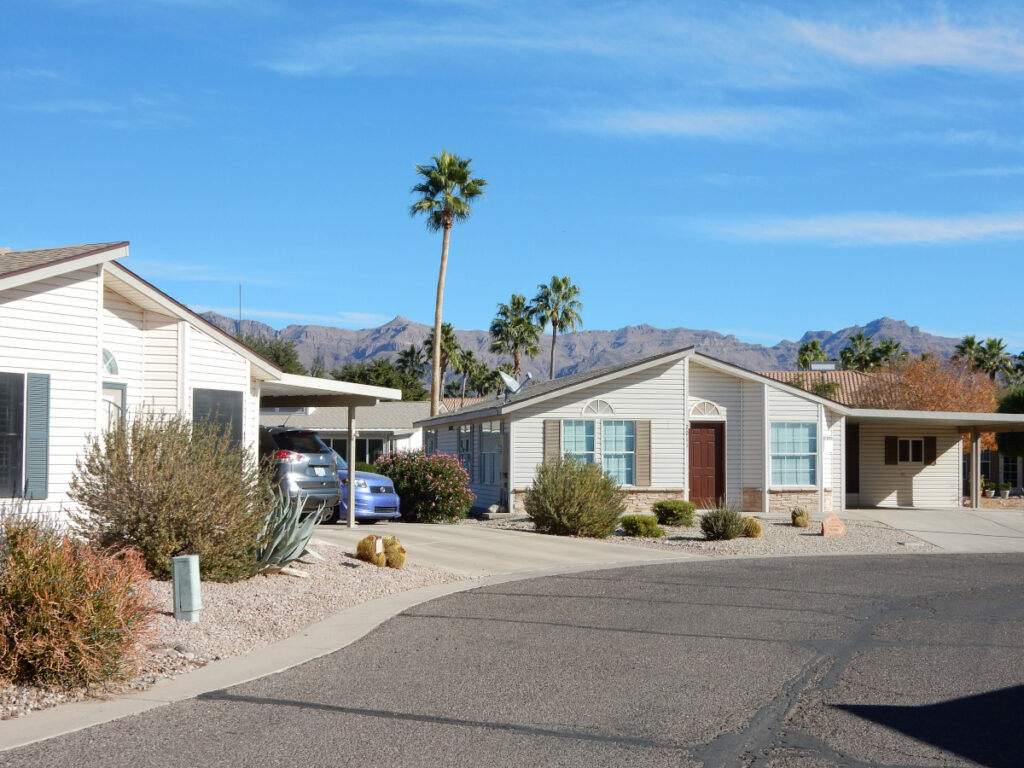
Manufactured homes in Dolce Vita, a community in Apache Junction, Ariz.
Manufactured homes have been regulated by the U.S. Department of Housing and Urban Development for more than 40 years. Industry leaders believe energy standards for manufactured homes should derive from the industry’s longtime primary regulatory body. A contingent of manufactured housing industry professionals convening with lawmakers will carry that message with them during the Innovative Housing Showcase and Homes on the Hill events June 7-12.
Energy efficiency is a strong point for manufactured homes, particularly homes built during the last dozen years. Nearly every builder of HUD-code homes has improved its standard energy efficiency and rolled out myriad options for products that help with sustainability in energy transfer and cost reduction.
Builders today pack every bit of R-value they can into a home, knowing it will be a prime tool in marketing the homes because it will help reduce monthly costs for the buyer. The industry hits the mark on efficient housing, including when it comes to energy, from the way materials are shipped and stored at a manufacturing facility, to efficiencies on the line, and the quality of products used within well-designed floorplans.
Wells Fargo Multifamily Capital in partnership offers insight in a two-part series on current market dynamics and how multiple factors are likely to impact commercial lending for manufactured housing communities. Part I follows, and part II will be posted here in the coming months following print publication in MHInsider Magazine.
We live in turbulent times with many cross-currents impacting the economy and commercial real estate. Unlike other recent economic cycles, white-hot inflation has moved into the headlines as the Federal Reserve Bank balances its dual mandates of price stability, moderate long-term interest rates, and full employment. The Consumer Price Index (CPI) is running at its highest level in four decades leading many to conclude inflation is no longer transitory.
Treasury rates have been on a steady rise in 2022 with the 10-year Treasury yield eclipsing 2%, marking a two-year high and an approximate 150 basis point increase from the Treasury’s all-time low of 0.51% in August 2020. In order to help borrowers prepare to face a higher interest rate environment, this article will be the first of a two-part series in which we take a look back at past economic cycles for insights, and then highlight alternatives borrowers should consider when assessing financing options and structures.
The Influence of the Fed
The Fed influences short-term interest rates through its open market committee (FOMC), which sets the federal funds rate — the interest rate applied on overnight loans from one financial institution to another. While they do not set market rates such as Treasury yields, changes in the federal funds rate along with the Fed’s policies and pronouncements are followed closely by market participants, and market rates along the yield curve respond accordingly. Besides setting the much-followed fed funds rate, the FOMC also establishes Fed monetary policy which, in order to provide market stability, authorizes the Fed to purchase securities (bonds). This is commonly known as quantitative easing. Through QE the Fed buys securities on the open market, providing a liquidity backstop and lowering the yield on bonds during times of capital markets upheaval like that which resulted from the COVID-19 outbreak in 2020. Many also will recall when the Fed utilized QE in 2009 as financial markets muddled through the Great Recession. QE aims to stimulate more lending and investment that keeps rates lower during times of market disruption than what market participants would normally demand. Using a similar strategy in March 2020, the Fed injected more than $700 billion in bond purchases, and in June 2020, it added monthly purchases of $120 billion of bonds – $80 billion in U.S. Treasury securities and $40 billion in mortgage-backed securities.
That program continued until December 2021 when QE began being phased out.
Inflation in the U.S.
The economy has rebounded following the sudden and severe recession experienced during the first half of 2020. The economy in 2021, as measured by Gross Domestic Product, grew at an annualized rate of 5.7%, marking the fastest rate of growth in a calendar year since 1984. However, inflation picked up throughout the year and the CPI grew by 7%, the largest calendar-year change in the cost of living since 1981.
At the end of January 2022, the 12-month inflation rate jumped to 7.5%. This resurgence of inflation appeared to force the Fed to reconsider its monetary policy and use of the term “transitory”. The Fed reduced its monthly $120 billion in bond purchases by half in December, and plans to curtail the entire strategy.
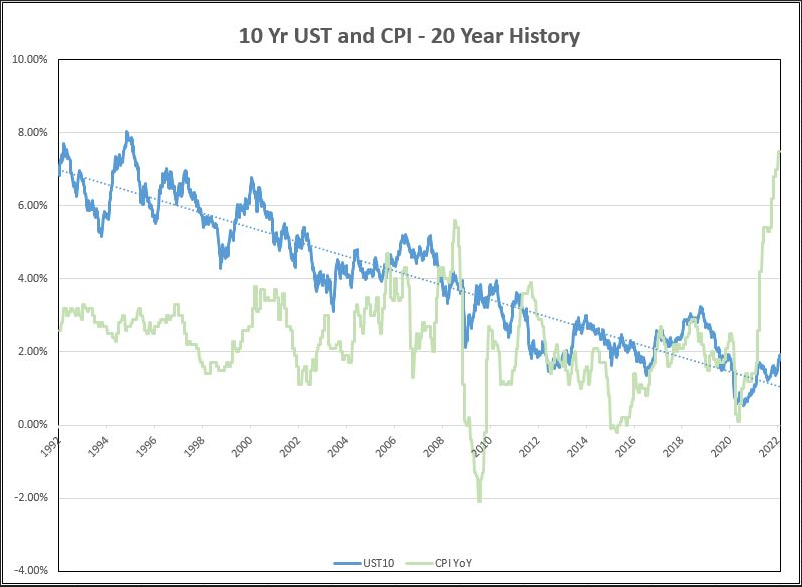
Given all of this, it is worth re-visiting historic averages for perspective and insight into the years ahead. In statistics, regression toward the mean is the concept that extreme measurements or outliers in a defined group will be closer to the average over time. Outliers in economic statistics occur during times of upheaval and then typically move closer to the average as more measurements are made. Because the 10-year Treasury is a common index used for fixed-rate loans, we should consider the following: Over the last 20-year and 30-year periods, the 10-year treasury yield has averaged 2.97% and 4.01%, respectively. These periods include a low rate (outlier) environment during the Great Recession and another during the COVID-19 pandemic. Inflation for decades had remained tame as the Fed prioritized maintaining a low inflation environment, and year-over-year CPI increases averaged approximately 2.5% over the past 30 years. By managing inflation, the Fed was also able to maintain price stability as shown below in the 20-year history of the 10-year treasury yield.
However, during the six months ending January 2022, monthly CPI increases averaged 6.4% and they are increasing at an escalating rate. While many have been predicting materially higher interest rates for years, we now appear to be facing the possibility of rates above historical averages for the next several years. Barring unforeseen capital market disruption in the coming years, we expect a further increase in long-term fixed rates and related Treasury indices. Of the Fed’s mandates, price stability has been its top priority in recent years. One reason for this may be that the Fed is comprised of members who remember the years of high inflation and economic instability experienced in the 1970s and early 1980s. Inflation is a political liability that impacts fixed and lower-income households particularly hard, and we believe the Fed will be willing to slow the economy to rein in inflation in a tight labor market. On top of increases in the fed funds rate, the market also has to absorb the impact of the removal of QE. With supply chain issues persisting and oil prices spiking due to geopolitical threats, there appears to be no immediate relief in sight for inflation.
Although we expect that over time there will be a tightening in interest rate spreads that will offset some of the increase in Treasury rates, we believe borrowers should assess their current loans and borrowing alternatives under the assumption that rates are going to be higher in the coming years. In part two of this series we will identify some key considerations to be weighed when reviewing your current and future financing strategies.
Tony Petosa, Nick Bertino, Erik Edwards, and Matt Herskowitz are loan originators at Wells Fargo Multifamily Capital, specializing in providing financing for manufactured home communities through their direct Fannie Mae and Freddie Mac lending programs and correspondent lending relationships.
The Biden Administration this week announced plans to close the housing gap in five years through a multi-pronged approach that includes creating improved financing for manufactured homes.
“The plan’s policies to boost supply are an important element of bringing homeownership within reach for Americans who, today, cannot find an affordable home because there are too few homes for sale in their communities,” the White House communication stated. “And it will help reduce price pressures in the economy, as housing costs make up about one-third of the market basket for inflation, as measured by the Consumer Price Index.”
Among the new financing mechanisms the White House intends to deploy with the goal to build and preserve more housing is for “manufactured housing (including with chattel loans that the majority of manufactured housing purchasers rely on), accessory dwelling units (ADUs), 2-4 unit properties, and smaller multifamily buildings.”
In addition, the administration is looking to expand programs for construction to perm loans, often used in the industry to begin construction and convert to a conventional mortgage upon completion and home placement.
The Manufactured Housing Institute issued a statement indicating the White House plans toward other industry priorities as well, including “keeping the HUD Code up to date, addressing zoning barriers, easing supply chain constraints, and addressing the shortage of construction workers.”
Land-Use Reforms
The White House plan intends to tie federal funding to local land-use practices, including planning and zoning efforts.
“One of the most significant issues constraining housing supply and production is the lack of available and affordable land, which is in large part driven by state and local zoning and land use laws and regulations that limit housing density,” the statement said.“Exclusionary land use and zoning policies constrain land use, artificially inflate prices, perpetuate historical patterns of segregation, keep workers in lower productivity regions, and limit economic growth.”
Materials and Labor
In the months ahead, the Biden Administration said it is “committed to working with the private sector to address near-term constraints to supply and production – with the goal of achieving the most completed housing units in a single year in 15 years.
The plan calls for U.S. Housing and Urban Development Secretary Marcia Fudge and U.S. Department of Commerce Secretary Gina Raimondo to meet with private sector organizations that face supply chain disruptions, as well as promote alternative building methods, and recruit more qualified labor to the construction and craft trades.
Champion Home Builders has agreed to acquire Manis Custom Builders for an estimated $10 million.
Skyline Champion Corporation, the parent company, and the largest publicly traded factory home builder in the country, said it expected to close the deal for the Laurinburg, N.C., company by month’s end.
Champion President and CEO Mark Yost said Manis will be a welcomed addition to the team.
“While working with founder Joe Manis and his team during this transaction, we learned that their core operating principles mirror our own,” Yost said.
Manis has led the organization that bears his name since 1983 and has set a standard for high quality. Manis builds 800-square foot to 2,000-square foot custom modular homes.
“With the addition of this 250,000 square foot campus in Laurinburg and Manis’ retail location in eastern North Carolina to our existing North Carolina campuses, we are now better able to serve customers throughout the region with cost-effective, streamlined product offerings that are greatly needed in the current economic environment,” Yost said. “We anticipate continuing to build out the approximately $15 million of backlog as we upgrade and re-tool portions of the plant.”
Champion operates from Troy, Mich., while the corporate entity, Skyline Champion, is headquartered in Elkhart, Ind.
The Federal Reserve in May made good on its promise last month to keep a keen eye on inflation by raising rates just enough to avoid a recession. The half-point boost doubles what the Fed did last meeting, and indicated continued hikes through the year equaling at least another point.
The half-point boost in the Fed’s benchmark rate is the largest single push in more than 20 years.
“In support of these goals, the committee decided to raise the target range for the federal funds rate to 3/4 to 1 percent and anticipates that ongoing increases in the target range will be appropriate,” The Fed said in a released statement.
Additionally, the Fed said it will begin reducing its holdings of Treasury securities and agency debt, and agency mortgage-backed securities, on June 1 as described in the “Plans for Reducing the Size of the Federal Reserve’s Balance Sheet” released in conjunction with this statement.
Further rate hikes will be managed with a wide range of information in mind, the statement said, including readings on public health, labor market conditions, inflation pressures and expectations, as well as other financial and international developments. The invasion of Ukraine by Russia is causing tremendous human and economic hardship. The implications for the U.S. economy are highly uncertain. The invasion and related events are creating additional upward pressure on inflation and are likely to weigh on economic activity. In addition, COVID-related lockdowns in China are likely to exacerbate supply chain disruptions.
“Inflation is much too high and we understand the hardship it is causing and we are moving expeditiously to bring it back down,” Federal Reserver Chairman Jerome Powell said.
Policymakers in Washington are keenly focused on ways to address the nation’s affordable housing supply shortage. The need for immediate solutions is only increasing — in 2021, home prices increased by more than 18% while “real” average weekly earnings for U.S. workers fell by more than 3%. With housing inventory at near historic lows and economists estimating more than five million homes are needed, finding ways the federal government can help spur additional affordable housing supply is at the top of the agenda. The Manufactured Housing Institute is working to ensure manufactured housing is well-positioned to be at the forefront of these deliberations.
Talk of Manufactured Housing at the Capitol
Last September, the Biden-Harris administration directed federal agencies to use “every tool available in government to produce more affordable housing supply as quickly as possible.” Manufactured housing supply was a leading component of this effort, with White House Press Secretary Jen Psaki highlighting the administration’s commitment to boosting the supply of manufactured housing. Beyond Washington, the plan included calling on state and local governments to reduce zoning and financing barriers to manufactured housing which “allows families to achieve homeownership and build wealth.”
This is a historic time for our industry when our efforts in Washington continue to yield attention at the highest levels of government to help more Americans achieve homeownership through manufactured housing. As a result of the White House directive, an inter-agency task force has been convened to look at federal homeownership financing programs and how they can better support the purchase of manufactured homes.
With current HUD Secretary Marcia Fudge pledging her support of manufactured housing at numerous congressional hearings, saying it is an “outstanding option,” MHI’s efforts to educate policymakers has positioned us to ensure federal efforts to increase the affordable housing supply in America will include changes in policy that support manufactured housing. In addition, to support by administration officials, MHI has worked to ensure that the benefits of manufactured housing are a topic at every affordable housing hearing that has taken place in the 117th Congress.
We are not just cultivating relationships with those congressional representatives that already know us.. We are taking our message about the quality and affordability of manufactured homes to congressional leaders, including many who have never seen a manufactured home but want more quality affordable homeownership options in their districts. Our efforts have yielded results and through our advocacy, we have support from congressional members on both sides of the aisle and from all parts of the country – saying at hearings that manufactured housing is “the most affordable homeownership option available nationwide” and “manufactured housing offers a safe and affordable, wonderful, place for a family to call home.”
Seize the Opportunity
Now is our time, and MHI is seizing the opportunity to advance key priorities to grow the market, including ensuring federal housing finance programs (FHA, Fannie Mae, Freddie Mac, USDA, VA) support manufactured housing; updating the HUD Code on a regular cadence; making sure efforts to increase energy efficiency standards for manufactured housing are feasible and cost-effective; moving the federal government to address local exclusionary zoning policies and enforce the preemption of the HUD Code; and supporting the preservation of land-lease communities.
In addition to our direct work with federal policymakers, MHI’s membership has served as a key grassroots connection to elected representatives and regulators. Since the beginning of the 117th Congress and the Biden Administration, we have generated more than 1,500 contacts to the administration and Congress. Our advocacy has resulted in the first update to the FHA Title I program in 40 years; the first comprehensive updates to the HUD Code in decades; the Senate telling HUD to expedite further updates to the HUD Code and further FHA financing reforms; House members telling the Department of Energy they do not support the proposed efficiency rule; and administration efforts to address lumber prices and supply chain shortages. MHI is also developing partnerships with key national housing and business coalitions to ensure industry priorities are embraced by the advocacy community so that our voice to policymakers is even stronger. Through these relationships, MHI has participated in numerous housing industry events, including the National Association of Realtors® December “Real Estate Forecast Summit: The Year Ahead.”
Build for the Future
MHI is continuing to build upon our momentum from 2021 so that we can continue to elevate housing innovation and expand attainable homeownership. We will continue to build relationships with federal policymakers and ensure the manufactured housing industry continues to be a part of the federal dialogue about addressing our nation’s housing challenges. Our access to Washington policymakers is as strong as ever and it is bolstered by the direct engagement from MHI members to their elected representatives to keep our issues at the forefront.
In addition to advocacy, we are committed to supporting our members with quality events, education, and information. Our upcoming in-person conferences will be packed with exceptional programming and networking opportunities. In addition, we are growing our resources for members, ranging from useful economic reports to interactive maps on topics like zoning and manufactured housing communities, to timely news and updates. MHI continues to gain momentum in Washington, not only due to our effective advocacy strategy but because of what is happening in the industry – the quality of our houses and our people. Together, with a strong voice and unified message, we will ensure federal policymakers support our industry’s growth so that the American Dream of homeownership can be a reality for more Americans.
Datacomp has published the May 2022 JLT Market Reports for the state of Florida, the largest market area for manufactured homes in the United States. JLT Market Reports provide detailed research and information on communities in 186 major housing markets nationwide. The reports include the latest rent trends and statistics, marketing programs, and a variety of other useful management insights.
Datacomp publishes the JLT Market Reports and is the nation’s #1 provider of market data for the manufactured housing industry. JLT Market Reports are recognized as the industry standard for manufactured home community market analysis.
May 2022 manufactured housing market data published in JLT Market Reports for Florida includes information on 802 “All ages” and “55+” manufactured home communities.
Altogether, the reports on Florida manufactured home communities include data representations for 212,857 homesites.
Florida Statewide Trends in Manufactured Housing Community Rent and Occupancy
Florida all-ages communities experienced a 0.5% increase in occupancy and a 5.5% increase in rent.
Florida 55+ communities experienced a 0.8% increase in occupancy and a 6.2% increase in rent.
“Manufactured home community occupancy increased in all but five of the Florida markets detailed in Datacomp’s May publication,” Datacomp Co-President and Chief Business Development Officer Darren Krolewski said. “This, along with healthy rent appreciation across the state reflects the growing demand for quality affordable housing.”
More About JLT Market Reports
Each JLT manufactured home community rent and occupancy report from Datacomp has detailed information about investment-grade communities in the major markets. The detailed information includes:
Number of homesites
Occupancy rates
Average community rents, and increases
Community amenities
Vacant lots
Repossessed and inventoried homes, and much more
JLT Market Reports also include management insights that rank communities by number of homesites, occupancy rates, and highest to lowest rents. Established reports show trends in each market with a comparison of May 2022 rents and occupancy rates to May 2021, as well as a historical recap of rents and occupancy from 1996 to the present date in most markets.
The May 2022 JLT Market Reports for Florida manufactured home communities are available for purchase and immediate download online at the Datacomp JLT Market Report website, or they may be ordered by phone in electronic or printed editions at (800) 588-5426.
Each fully updated report for mobile home communities is a comprehensive look at investment grade properties within a market, enabling owners and managers, lenders, appraisers, brokers, and other organizations to effectively benchmark those communities and make informed business decisions.
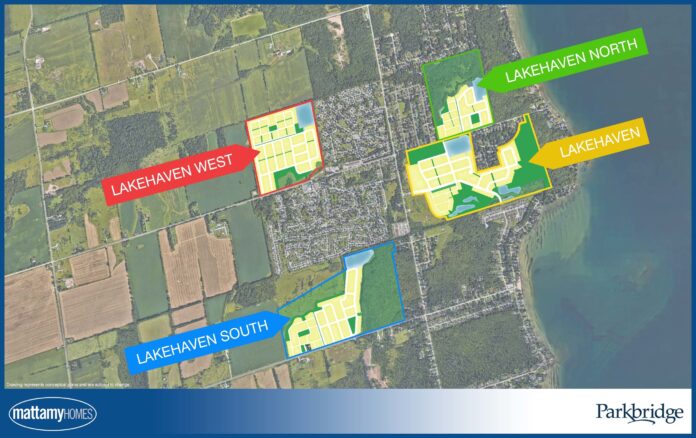
The future community of Lakehaven in Innisfil, Ont., is expected to total approximately 2,000 homes and be built out in four stages over 10 years. Approximately two-thirds of the homes will be single-family in the traditional ownership model and one-third will be bungalow townhomes in the land-lease ownership model. The community is a partnership between Mattamy Homes and Parkbridge. (CNW Group/Mattamy Homes Limited)
Leading Developers Collaborate for Housing Choice, Flexibility
Mattamy Homes, North America’s largest privately-owned homebuilder, and Parkbridge Lifestyle Communities, Canada’s leading developer of residential land-lease communities, have announced a partnership to bring the first mixed-ownership community to Ontario.
Lakehaven will sit on Lake Simcoe in Innisfil, Ont., and include about 2,000 homes, and be built out in four stages over 10 years. Approximately two-thirds of the homes will be single-family in the traditional ownership model and a third will be bungalow townhomes in the land-lease ownership model.
“At Mattamy we are deeply invested in doing our part to address housing choice and affordability and foster a sustainable housing market for buyers in Ontario,” Mattamy Homes Canada CEO Brad Carr said. “We believe in providing a variety of choice and homes that appeal to every type of homeowner who wants to have a home, some green space, live in a community and build equity in their home. In Lakehaven they will have that exciting opportunity of choice in a community with different options for ownership. We are so excited to be entering a new market for Mattamy and to be doing so with an amazing partner like Parkbridge.”
Carr said land lease as a model for homeownership is growing quickly in Canada, and is well established in the U.S. and Europe.
“In a land-lease arrangement, the buyer owns the home outright and leases the land,” Parkbridge CEO Mark Gow said. “By removing the expensive land portion from the ownership equation – a particular concern in central and southern Ontario – this model can increase affordability and offer an ideal housing option for people looking to downsize, or for first-time buyers.”
The start of sales for the community is expected in late 2022.
The Federal Housing Finance Agency published the 2022-2024 Underserved Markets Plans for Fannie Mae and Freddie Mac under the Duty to Serve Program.
The DTS Plans demonstrate a strengthened commitment to serving manufactured housing, affordable housing preservation, and rural housing. The targets and strategies in the Plans build on lessons learned and progress made during the first four years of the DTS program.
“Providing sustainable liquidity for affordable housing preservation, rural housing, and manufactured housing in a safe and sound manner is an integral part of the Enterprises’ responsibility to serve underserved markets,” FHFA Acting Director Sandra L. Thompson said. “The additional activities and objectives to be implemented under these Plans are important steps toward the Enterprises fulfilling their Duty to Serve mandate over the coming years.”
In May 2021, the Enterprises submitted proposed Duty to Serve Plans that FHFA evaluated against agency priorities and the DTS regulation. FHFA determined that none of the Enterprises’ initial Plans met the DTS Non-Objection standard. After further revisions and evaluation, FHFA has determined that the Enterprises’ latest proposed Plans now meet the Non-Objection standard.
The activities outlined by the Enterprises to achieve their DTS plan objectives remain subject to FHFA review and approval to ensure compliance with the Enterprises’ Charter Acts, safety and soundness measures, and other conservatorship and regulatory requirements.
Under the DTS Program, the Enterprises prepare and submit to FHFA proposed three-year underserved markets plans that outline their objectives and activities to serve the manufactured housing, rural housing, and affordable housing preservation markets. FHFA reviews and issues Non-Objections to those proposed plans based on the intended impact on each market.
Freddie Mac Plans to Meet DTS Requirements
In its published report, Freddie Mac outlined several initiatives underway.
Over the next three years, Freddie Mac intends to expand support for the manufactured housing market in the following ways:
1. Support manufactured housing titled as real property: a. Increase purchases of loans secured by manufactured homes titled as real property. b. Provide new product flexibilities to facilitate the origination of mortgages secured by manufactured homes. c. Support growth in the market for manufactured homes through research and outreach.
2. Support manufactured housing titled as personal property: a. Complete a feasibility assessment for the requirements and processes necessary to support loan purchase, including but not limited to credit, servicing, consumer protections, pricing, and risk structures. b. If FHFA approval is obtained, purchase loans to assist with product design to support future loan purchase capabilities.
3. Support the Resident Owned Community (ROC), non-profit, and government instrumentality market: a. Purchase loans on ROCs and non-profit and government instrumentality-owned communities.
4. Support opportunities for Duty to Serve-qualifying tenant pad lease protections: a. Purchase loans on properties that commit to implement Duty to Serve tenant pad lease protections.
“In the manufactured housing market, we will expand financing solutions for consumers, improve tenant protections in the manufactured housing communities (MHCs) that we finance, and increase secondary market liquidity,” the report stated.
Fannie Mae Plans to Meet DTS
Fannie Mae Regulatory Activities for Manufactured Housing A. Support manufactured homes titled as real property 1. Acquire purchase money mortgage (PMM) loans secured by MHRP. 2. Explore opportunities to facilitate financing of loans secured by MHRP located in certain manufactured housing communities. 3. Expand on prior efforts to facilitate financing of loans on homes secured by MHRP located in fee simple developments.
B. Manufactured housing communities (MHCs) owned by a governmental entity, nonprofit organization, or residents 1. Increase loan purchases of MHCs owned by government entities, nonprofit organizations, or residents.
C. Manufactured housing communities (MHCs) with certain pad lease protections 1. Increase the number of loan purchases of MHCs with tenant site lease protections.
D. Additional Manufactured Housing Communities Activities 1. Increase the purchase of MHC loans benefiting from Manufactured Housing Rental flexibilities. 2. Supporting renters in manufactured housing communities through credit-building activities.
Fannie Mae Loan Purchase Targets for Manufactured Housing A. Support manufactured homes titled as real property 1. Acquire purchase money mortgage (PMM) loans secured by MHRP. B. Manufactured housing communities (MHCs) owned by a governmental entity, nonprofit organization, or residents
B. Manufactured housing communities (MHCs) owned by a governmental entity, nonprofit organization, or residents. 1. Increase loan purchases of MHCs owned by government entities, nonprofit organizations, or residents.
C. Manufactured housing communities (MHCs) with certain pad lease protections 1. Increase the number of loan purchases of MHCs with tenant site lease protections.
D. Additional Manufactured Housing Communities Activities 1. Increase the purchase of MHC loans benefiting from Manufactured Housing Rental flexibilities.
“Fannie Mae will continue to be a reliable source of financing for manufactured homes and communities, providing affordable and stable homeownership and rental opportunities for households around the country,” Enterprise published in its report. “We are committed to sustainably increasing our share of the Manufactured Homes Titled as Real Property (MHRP) market, increasing our role in financing non-traditionally owned MHCs, and working with our partners to increase market adoption of FHFA’s tenant site lease protections, as well as advancing innovative solutions to benefit more families and help the industry grow.”
‘May Soon Begin to See the Impact of Increasing Mortgage Rates on Home Prices’
Craig Lazzara, Dow Jones Indices.
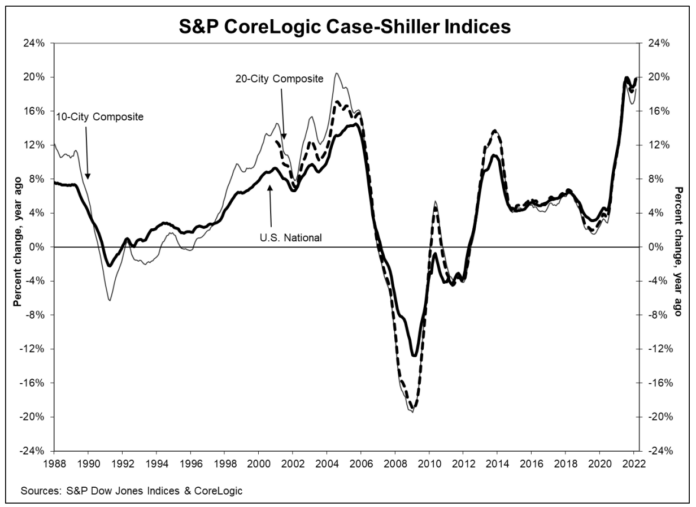
S&P Dow Jones on April 26 released the latest results for its monthly home price indices, showing February data that point to an acceleration again in pricing with a measure of 19.8%.
More than 27 years of S&P CoreLogic pricing history can be found at the indices website.
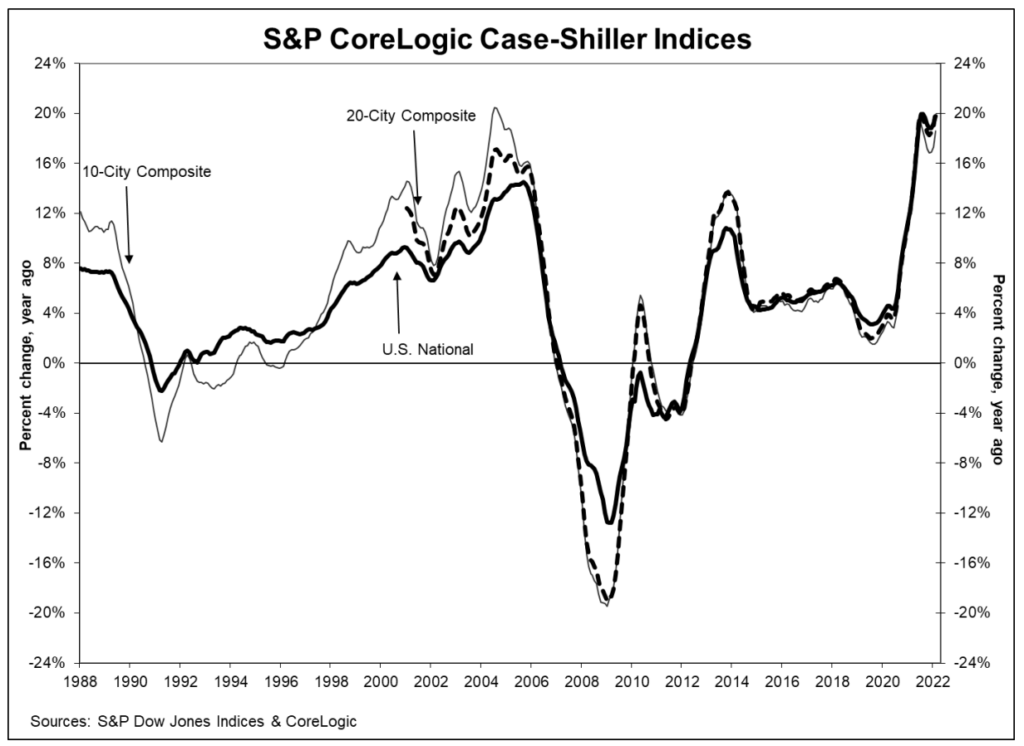
The S&P CoreLogic Case-Shiller U.S. National Home Price NSA Index, covering all nine U.S. census divisions, reported the 19.8% annual gain in February, up from 19.1% the previous month.
The 10-City Composite annual increase came in at 18.6%, up from 17.3% in the previous month. The 20-City Composite posted a 20.2% year-over-year gain, up from 18.9% in the previous month.
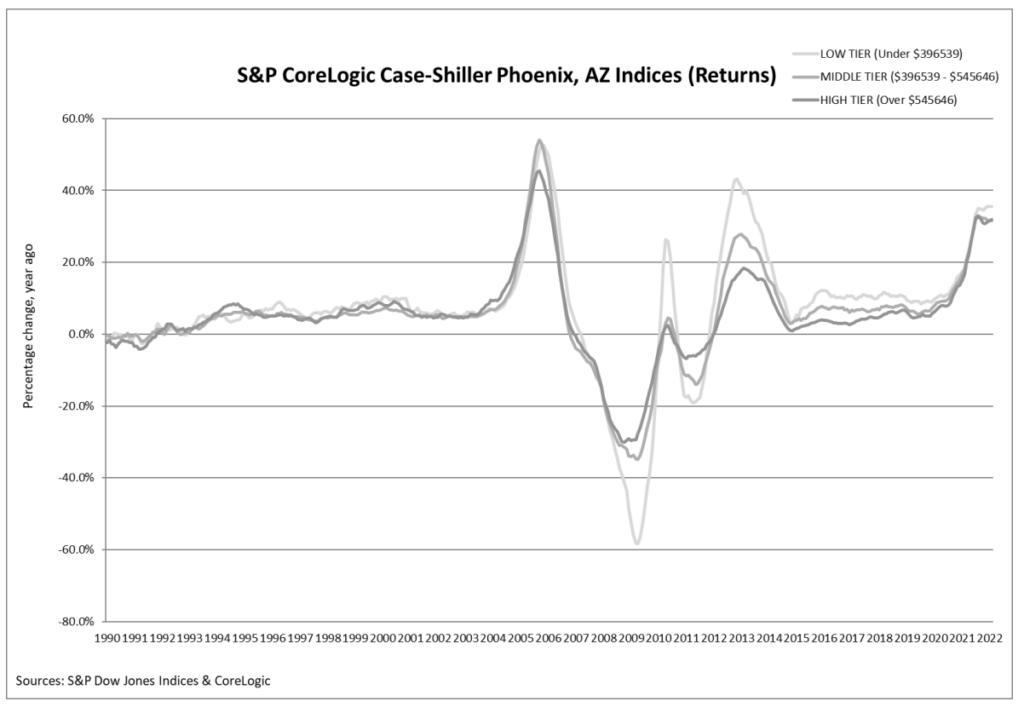
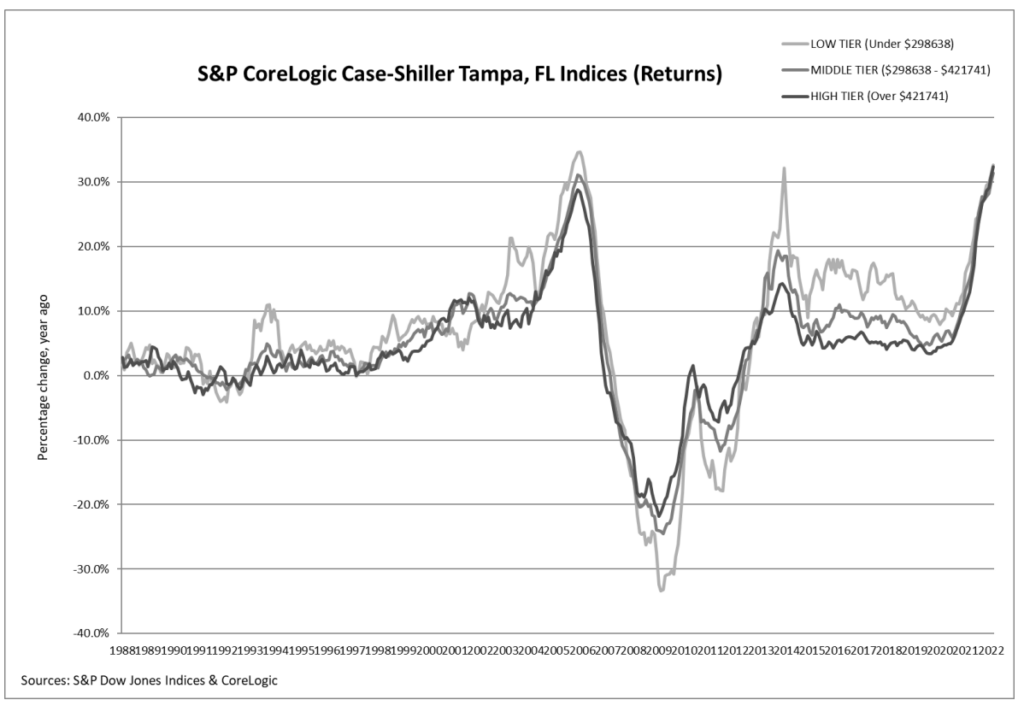
Phoenix, Tampa, and Miami reported the highest year-over-year gains among the 20 cities in February. Phoenix led the way with a 32.9% year-over-year price increase, followed by Tampa with a 32.6% increase and Miami with a 29.7% increase.
All 20 cities reported higher price increases in the year ending February 2022 versus the year ending January 2022.
“U.S. home prices continued to advance at a very rapid pace in February,” S&P DJI Managing Director Craig J. Lazzara said. “All three composites reflect an acceleration of price growth relative to January’s level.
“The National Composite’s 19.8% year-over-year change for February was the third-highest reading in 35 years of history,” he said. “That level of price growth suggests broad strength in the housing market, which is exactly what we continue to observe.”
Phoenix’s 32.9% price increase led all cities for the 33rd consecutive month, with Tampa and Miami close behind. Prices were strongest in the South (+28.1%) and Southeast (+27.9%), but every region continued to show impressive gains.
“The macroeconomic environment is evolving rapidly and may not support extraordinary home price growth for much longer,” Lazzara said. “The post-COVID resumption of general economic activity has stoked inflation, and the Federal Reserve has begun to increase interest rates in response. We may soon begin to see the impact of increasing mortgage rates on home prices.”
Oct. 6-8 at Avalon Hotel in Alpharetta, Ga.
Manufactured housing community owners have never had more information available to them — or more decisions to...
The Midwest Manufactured Housing Federation has announced that attendee registration is now open for the 2027 Louisville Manufactured Housing Show, returning to the Kentucky...
HUD’s Innovative Housing Showcase, MHI’s Homes on the Hill and Annual Meeting Begin Sept. 22
Two of the country’s largest builders of manufactured homes will...