Datacomp announced the publication of its November 2019 manufactured home community rent and occupancy reports for Oregon, Idaho, Minnesota, and Washington.
JLT Market Reports provide detailed research and information on communities in 180 major housing markets throughout the United States. These include the latest rent trends and statistics, Oregon rent control and next rent increase, as well as a variety of other useful management insights.
Datacomp publishes the JLT Market Reports and is the nation’s #1 provider of market data for the manufactured housing industry. JLT Market Reports are recognized as the industry standard formanufactured home community market analysis.
November 2019 manufactured housing market data published in JLT Market Reports for Oregon, Idaho, Minnesota, and Washington include information on 297 “All ages” and “55+” manufactured home communities.
Altogether, the reports on the states’ manufactured home communities include data representations for 51,112 homesites.
“Average adjusted rent numbers represented in our November JLT Market Reports showed consistent appreciation in all four states,” Datacomp Co-President and Chief Business Development Officer Darren Krolewski said. “Occupancy also showed a strong upward trend in seven of the 10 markets covered, with slight decreases in three of the represented markets. ”
More About JLT Market Reports
Each JLT manufactured home community rent and occupancy from Datacomp has detailed information about investment grade communities in the major markets. The detailed information includes:
Number of homesites
Occupancy rates
Average community rents, and increases
Community amenities
Vacant lots
Repossessed and inventory homes, and much more
Oregon rent control and next increase data
JLT Market Reports also include management insights that rank communities by number of homesites, occupancy rates and highest to lowest rents. Established reports show trends in each market with a comparison of November 2019 rents and occupancy rates to November 2018, as well as a historical recap of rents and occupancy from 1996 to present date in most markets.
Each fully updated report for mobile home communities is a comprehensive look at investment grade properties within a market, enabling owners and managers, lenders, appraisers, brokers and other organizations to effectively benchmark those communities and make informed decisions.
The teams and UMH representatives meet at midfield for the coin toss.
UMH Properties, Northwest Ohio Industry Reps, Players Offer New Meaning to ‘Home Game’
UMH Properties was the title sponsor for the Second Annual Independence Bowl in Northeast Ohio, a hotbed for high school football talent nationally.
The game featured former All-Stars of the Northwest High School football team of Canal Fulton, Ohio, against the military veterans and semi-pro laden “Team Red, White and Blue”.
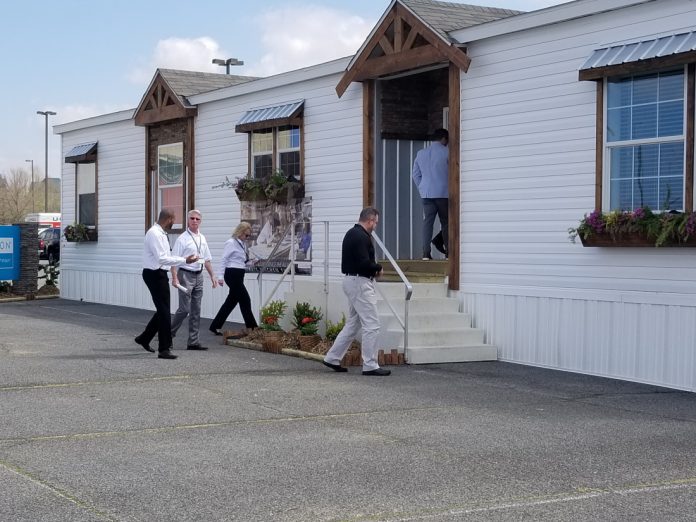
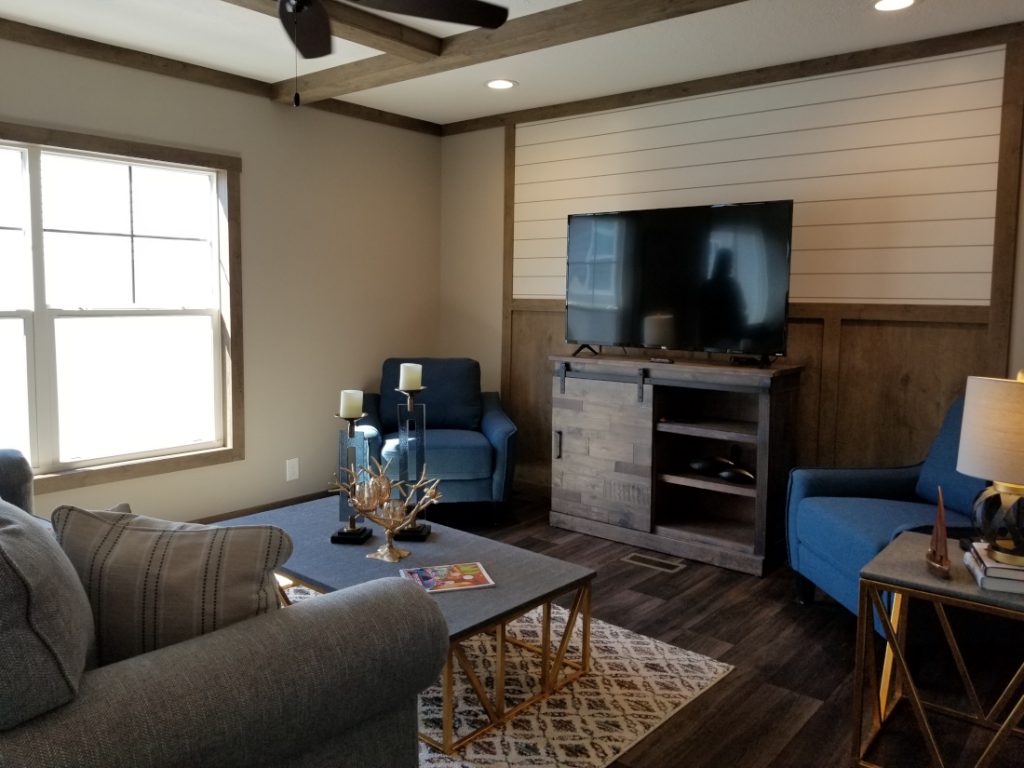
UMH displayed a new manufactured home at the game. Other promotions included sponsorship of radio powerhouse Q92’s game broadcast. Also, regional cable TV provider Massillon Cable aired the game through the region.
Ohio Manufactured Housing Association Executive Director Tim Williams saw limited action in the game, a summer scrimmage. He joined his much younger teammates, including his son, Todd, on the field.
Northwest won the 2019 Independence Bowl 28-0.
The victory came on the arm and legs of 2010 all-state and former college quarterback Bryan Jones. He rushed for nearly 100 yards while throwing for more than 200 yards, including three touchdowns through the air.
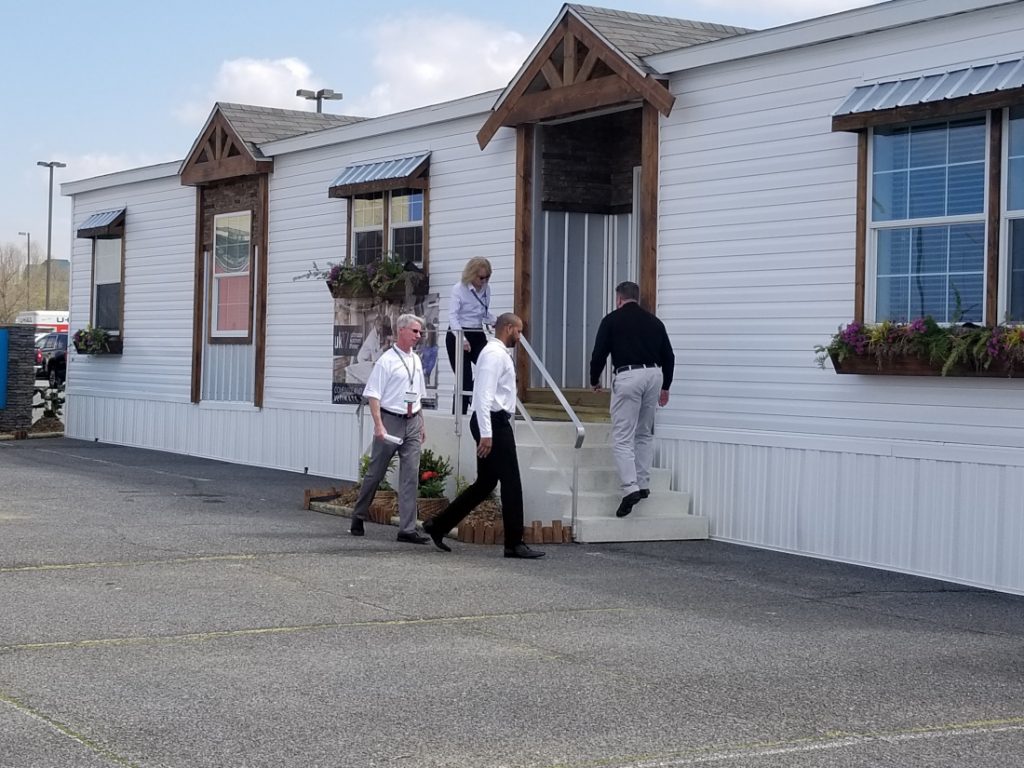
The exterior of a new manufactured home on display as part of UMH Properties’ sponsorship of the 2nd Annual Independence Bowl. All photos courtesy of OMHA.
UMH Provides Creative Approach to Industry Promotions
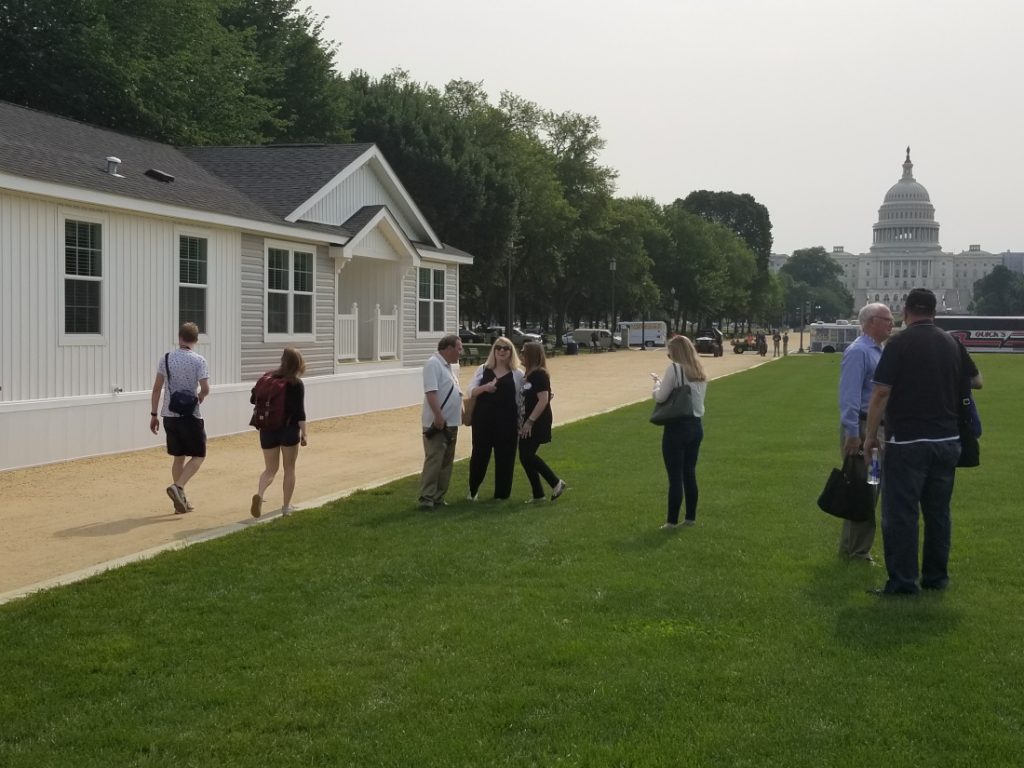
UMH’s industry promotion comes on the heels of its home display on the National Mall in Washington, D.C. The company also has been a primary sponsor of the Eastern Ohio Manufactured Homes Show.
All-Stars quarterback Tim Williams rolls right looking for a receiver during the 2nd Annual Independence Bowl.
“The tremendous and innovative promotions of our industry by UMH in non-traditional settings present our homes to an expanded demographic of future consumers,” said Williams, a former Northwest football player. “Numerous fans at the June Bowl game expressed their amazement at the quality, amenities and ‘wow factor’ of the UMH home. OMHA also thanks UMH for its promotion of our industry in Ohio.”
UMH’s Ohio Regional Manager Angi Smith, Director of Public Relations Kristi McGovern and Mansion Sales Representative Dave Taylor joined Williams’ All-Stars. They served as co-captains for the pre-game coin toss.
OMHA, various Northwest Athletics and Canal Fulton social media posts reached over 15,000 people throughout the two-month promotion leading up to the game. Local businesses including several realtors served as associate sponsors supporting the efforts.
All-New Lineup Offers Affordable Housing Solutions, Building Components for Builder Developers
Skyline Champion Corporation has unveiled its new Genesis® line of homes with a special focus on convenience and affordability for builders and developers. Each of the 11 new Genesis models in the re-configured line can be built as a manufactured home, a modular home, or as an accessory dwelling unit.
Genesis housing solutions will be offered at 23 manufacturing campuses. Collectively, the factory locations will be able to deliver homes to all 48 contiguous states.
“Affordable housing and skilled labor shortages are two of the nation’s largest concerns and with Genesis, we’re positioned to provide solutions for both,” said Wade Lyall, executive vice president of sales & business development for Skyline Champion Corporation. “Each of our manufacturing centers building Genesis employs a consistent workforce totaling over 3,300 skilled team members who build high-quality homes indoors using innovative and efficient building techniques. These benefits contribute significant cost savings making our homes some of the most affordable and desirable in the country.”
The Return of Genesis Coincides with Market Dynamics, Demand
Mark Yost, President and CEO of Skyline Champion Corporation, said the Genesis line will save builders time. It also will provide sustainable and attainable homes to a diverse range of buyers.
Model 4 among the new Genesis homes.
“The off-site component approach to homebuilding gives builders, developers and housing innovators a near turnkey solution, while reducing risk, and alleviates the challenges of managing multiple sub-contractors,” Yost said. “From small, minimalist units to larger spaces for growing families, Genesis will offer homes with the popular features homebuyers are looking for and designs geared for their lifestyle and budget.”
Champion halted production of Genesis homes coinciding with changes in the housing market more than a decade ago. Its return is based upon housing affordability and availability concerns in most major markets.
The new lineup of Genesis models consists of ranch-style homes designed for residential lots and planned developments. In addition, a coming series of five ADUs, equipped with smart home technology and modern finishes, has been developed to meet the growing demand for back-yard units in regions where municipalities are re-writing zoning laws.
Skyline Champion to Show New Genesis Homes at International Builders Show
Genesis will display two of its new models at the 2020 International Builders Show on January 21-23 in Las Vegas. The first model will be a 1,493 square-foot, 3-bedroom, 2-bath ranch with an attached garage. The second model will be a 510 square-foot, 1-bedroom, 1-bath ADU.
Both models will be in the Outdoor Exhibits area IBS in spaces P10 and P12.
Adventure Homes, based in Garrett, Ind., for four consecutive years has won the MHI award for Excellence In Manufactured Housing among manufacturers with fewer than three plants. The company is a privately owned, independent home builder with a strong following in the Great Lakes and Midwest regions.
General Manager Rich Rice recently took some time to chat about the business.
What are your biggest challenges?
The biggest challenge on the sales or consumer side is the availability to finance. On the production side, it’s employment. It’s been very difficult to find and retain qualified employees. There’s a tie-in with states and their TARP money, which is money given to the states to help people keep their homes.
There’s a circle here. Housing is a primary roadblock in stabilizing the workforce. So we need more stable housing to stabilize the workforce, especially when the unemployment rate is at a historic low. Yet, we need employees to help make homes.
What are you most optimistic about?
The No. 1 question at this year’s Louisville Show is where I think this market is going. With modular, manufactured retail, manufactured for communities… My answer was, “Let me walk you through our houses”, because you have to have the product that’s needed in the market no matter where the demand is. The market is going to take care of itself… it just depends on what happens with what kind of financing becomes available, and where the buying and selling occurs.
We have product available in all spectrums, from a low-end rental that can go to a community to a larger sectional HUD home that can go into a new development. We listen to the customer and we’re going to design for what we’re hearing.
What are the greatest obstacles to building manufactured homes?
The key is in the materials and government oversight. With the government getting involved with the tariffs on China, we know the hard material costs are going to change. Now, we can always pay more, even if it hurts. But if at some point you can’t get the supply of materials at all, that will shut down a line.
What major trends do you see coming for MH manufacturers?
The increase of people participating in trade shows and conferences is something that will make a big difference. I don’t think people go to industry events like this and go back home intending to operate in the same way. Professionals from all parts of the industry are taking notice in ways I’ve not seen. They really want and need to stay ahead. They can’t go back home and say, “I’m just going to keep making single-section homes”. It’s very hard to operate that way any longer.
What advice would you give retailers selling manufactured homes?
I’m unsure I’d want to define this as advice, but I will say that it shouldn’t matter whether you run one plant or 90, you need to let your production be focused on what the customer wants. You cannot sit in a boardroom with a designer and product development people and expect to make a home that will sell the way you want.
Karen Rhoades and Sheila Voelkel, family of Harrel and Darrel Cohron, hold the enshrinement plaque and stand in for photos with RV/MH Hall of Fame Chairman of the Board Joe Stegmayer. In the back row is Brad, Bill and Bob Cohron.
Industry Mourns the Passing of Indiana Manufactured Housing Professional
Darrel C. Cohron
Darrel Clyde Cohron of Indianapolis, distinguished among manufactured housing professionals in the operation of manufactured home communities, died Oct. 9, 2019, at Community North Hospital in Indianapolis. He was 86.
Mr. Cohron, always closely associated with his twin brother Harrel, was born on Nov. 11, 1932, near Morgantown, Ky. Darrel arrived 90 minutes after Harrel, and the pair was inseparable from that time until Harrel’s death in 2008.
Their father Ben Cohron died when the twins were two years old. About eight years later the boys’ mother passed away.
Their brother Paul Cohron, his wife Mary, and sister Sarah Dean Kuykendall with her husband Walter raised the twins from there.
The Cohron Family Business
In 1948, Mr. Cohron moved from Kentucky to Indianapolis where he graduated from Warren Central High School. He served in the U.S. Army in the early to mid-1950s and married Shirley Campbell on Aug. 31, 1956 at Cumberland First Baptist Church.
The brothers co-founded Cohron’s Manufactured Housing in 1955.
Cohron’s Manufactured Homes owns seven communities in central Indiana, all within close proximity of each other, including Greenbriar, which is a celebrated community. The Cohron family continues to operate Cohron’s Manufactured Homes.
He noted that the brothers sold on average 550 homes a year during the 1960s and 1970s. Additionally, the two are the only pair of professionals inducted together into the Hall of Fame.
Well-Deserved Honors
Mr. Cohron also was a member of Masonic Lodge 134 in Acton, Ind., and was honored with the state of Indiana’s prestigious Sagamore of the Wabash award. The award has been bestowed upon astronauts, presidents, ambassadors, artists, musicians, politicians, and other Indiana residents who have contributed greatly to Hoosier heritage.
Along with spending time with family, and creating great places to live in central Indiana, other activities Mr. Cohron held in high regard were hunting, fishing, as well as running the farm and tractors.
Mr. Cohron is preceded in death by his wife Shirley; father, Ben; mother, Clyde; brothers Harrel, Getty, Leonard, Paul, and Glen; sisters Sarah Dean and Louise. Survivors include daughter Sheila (Dana) Voelkel; son Robert (Diane) Cohron; sister-in-law Sonja Glassing; grandchildren Kirk (Melanie) Voelkel, Mindee (Jake) Upton, Dustin (Nikki) Voelkel, Matt (Jenni) Cohron, Stephanie (Bob) Ewing, and 10 great-grandchildren.
Services for Darrel Cohron
Visitation will be Tuesday, Oct. 15, 2019 from 4 – 8 p.m. at the Community Life Center at Washington Park East Cemetery. Funeral services will take place the following morning at 11 a.m., also at the Community Life Center.
Burial will follow in Washington Park East Cemetery.
Memorial contributions to the Alzheimer’s Association or a charity of choice in lieu of flowers are encouraged.
Darrel’s sense of humor, big personality and generosity are missed by all who knew him. Guests at the services should wear bright colors to match Darrel’s personality, his family said. Guests also are asked to write down and share a Darrel or Harrel story. A memory table and keepsake box will be available at the Community Life Center.
Frank Rolfe discusses rehabbing older communities.
SECO19 Important Industry Updates and Takeaways
The 2019 SECO conference provided a wealth of industry knowledge to its 450 attendees. To kick off this year’s event, there were a number of seminars to help educate attendees by addressing questions that many new community owners encounter during initial ownership. Subsequent days offered in-depth information about financing options, rehabbing communities and overall park operation.
SECO19 Presenters and Highlights
Day 1: Educational Seminars
SECO19, the symposium for Southeast Community Owners, began October 8 with a number of educational seminars, the first of those being “Everything Newbies Want to Know, But Are Afraid to Ask”. The seminar honed in on some key issues that attendees new to the industry had questions about such as brokerage, rehabilitating older parks, and purchasing new homes for a recently acquired park.
Other informational seminars included presentations on how to get the most out of social media and digital marketing, tax-efficient business structures and community planning.
These seminars are unique to SECO, and created with the intention of providing valuable information to new community owners and operators. SECO exhibitors and industry professionals addressed queries based on experience and knowledge to improve “newbie” processes and success rates.
Day 2: Community Planning, Rehabs, and Marketing
Presentations on the second day of SECO19 involved many industry veterans, like Don Westphal and Darren Krolewski. Attendees were actively involved in panel discussions throughout the day, and questions were encouraged.
Westphal kicked-off the day with commentary on industry history, including his own career which spans over 56 years. He proceeded to engage the audience with a discussion around comparative pricing, community planning, and design.
On consultancy, Westphal described his experience while planning and zoning Memphis Mobile City which required that the 100-year floodplain elevation be raised.
Regarding this setback, he explained that “Success stories are based on finding a site without a lot of negatives and doing your homework.”
Midday, Jon Harrison of Inspire Communities took the stage with an insightful presentation on rehabilitating older mobile home communities. He aided in the renovation of Coweta Mobile Home Park and provided extensive details about unexpected costs, regulations and what to expect when you update a manufactured housing community.
With work, Harrison and the team were able to install new custom units with porches and gourmet kitchens. The renovation also includes ample parking space and large than usual master suites.
The combined efforts produced a beautiful, owner-occupied community for residents of the Atlanta suburb.
He advised community owners on the essentials for building a holistic marketing campaign, including informative signage, web presence, communication preferences and attaining maximum reach.
The remainder of the evening included opportunities to meet and visit exhibitors, a reception, and individual, roundtable discussions with the day’s speakers.
Day 3: Economic Considerations, Financing and Wrap-up
The final day’s events began with a presentation on “The Social and Economic Impacts of Bringing Old Communities Back to Life” by Frank Rolfe of MHU. He provided a detailed explanation of the challenges in revitalizing an older community and considerations for new buyers to be aware of.
Rolfe identified several things that new owners should take note of when assuming ownership of a community. He explained understanding your community’s pride-of-ownership, grandfathering, and rent control.
In order to keep tenants up-to-date on current initiatives, Rolfe implored listeners to educate residents on plans for change before updates begin, explaining to listeners that “Sometimes it helps if you tell people what the heck you’re doing.”
The remainder of the day’s events included a session with mini-TED talks, to address attendee-suggested topics in short form. Another discussion around chattel mobile home financing included a panel of experts, like Jerry Bretton, Scott MacFarlane, and Ron Roldan.
Jerry Bretton, Scott MacFarlane, Kirk McDowell, Ron Roldan, and moderator Ed Barber discuss chattel financing.
The team provided attendees with an extensive breakdown of financing dos and don’ts, and financers for prospective community owners wanting to expand their portfolio.
Bretton advised the audience that his organization, Credit Line says “Roughly 2-3 days to qualify (for financing), but the approval process can take up to 30 days.” He explained that total qualifying time could take slightly more than a month.
The final sessions included an operations discussion about park brokerage and available LLC options for community owners.
Margaret Ann Clark, an experienced community owner from Des Moines, Iowa, commented that “If you bring in a new and home, it’s new now but later it’s just cheap.”
Concluding SECO19
As the week’s presentations came to a close, exhibitors and community owners exchanged contact information and well wishes. This year’s event was a perfect example of the networking and education required in the manufactured home industry.
Attendees experienced the benefits of hearing from educated industry professionals who provided advice to those interested in joining the industry or expanding their book of business.
Mike Bender, left, and Matt Ring, owners of Time Out Properties.
A Focus on Small, Rural Parks Unlikely to Get Corporate Attention
West Estates in Lumberton, N.C. received new homes, poured concrete pads and paths, as well as new asphalt streets.
Operators of small communities in the midst of rehabilitating 30 properties in North Carolina and Illinois are improving affordable housing stock in rural communities.
And, in the near future, the pair may be looking to buy and replicate the process anywhere from North Dakota to Florida.
“For the next four to six months we’re working as hard as we can to get 50 homes per month because the demand is there,” Time Out Properties Co-owner Mike Bender said. “The primary reason to purchase communities in Robeson County is because of the tremendous demand for affordable housing caused by thousands of new jobs at the pork and poultry processing facilities.”
Time Out picked up all but two of the communities in late 2017 and the spring of 2018. Matt Ring owned the two Illinois properties at the time he and Bender, a former software developer, agreed to partner.
Most of the purchases come from individual owners of one or two properties.
“We didn’t go the traditional route, working through a broker. We researched and called around and made some offers,” Matt Ring said. “I think we picked up the first 16-20 parks that way.
“The big REITs are unlikely to go after communities like this because they’re the smaller rural parks,” he added.
Time Out Properties invested more than $13 million for improvements in its communities DURING the past 18 months
Laiken Estates in Lumberton, N.C.
Low Occupancy Communities in Growing Markets
Time Out Properties used all variety of marketing to fill communities, including web, direct mail, TV, radio, and social media marketing, Bender said.
Most new residents in Robeson County have recently arrived for work, Bender said.
“Some of the parks were so bad we really had to bring down everything and start over,” Ring said. “Regardless, the direction and mission is to go out and identify communities that need to be rehabilitated and work toward keeping them in that affordable housing stock.”
At the time the pair began hunting for parks, Bender had lived in North Carolina for 25 years. His solid understanding of what markets could support a rehabbed community came into play. A third of the communities in the portfolio are up to near full if not full occupancy. Another 10 parks are 60% occupied. The remaining 10 are in full rehab mode with low occupancy.
Time Out’s communities provide manufactured homes for sale, and have park-owned rental homes that makes up about 25% of each community.
An aerial view of one of Time Out Properties’ Illinois communities.
Ring and Bender said the Illinois parks generally are more stable than the ones recently purchased in North Carolina. Still, the two move back and forth between the locales to maintain and improve the entire portfolio.
“North Carolina has a tremendous amount of activity, and currently, we’re in Springfield Ill., working with community managers,” Bender said. “It’s important to get everything ready before ice and snow hits the Illinois market.”
Eaglewood Mobile Home Park Will Be ‘Feature Park’ in Portfolio
A focal point of the community rehab process right now is Eaglewood Mobile Home Park in Lumberton, N.C.
The company removed and replaced 30 homes. It also replaced or upgraded water utilities, sewer, electric power and roadways within the community.
“Eaglewood is in a wonderful school district that’s in high demand,” Bender said. “We rehabbed a park right near there and it sold out quickly. So, we know this one is going to work out too, but it’s a hurdle. At some point, this is going to be the feature park that we use to show improvement with before and after photos.”
Pine Run in Shannon, N.C., receives infrastructure upgrades, including new roads.
New Manufactured Homes Arrive 10 or More at a Time
Time Out is buying new homes in sets of 10 or more at a time, primarily working with Clayton Homes and the company’s TRU product, an entry-level single-section home. They are fixing up homes that are in good shape and buying new homes to replace the really rundown dwellings.
TRU even is building a custom 14×76’ four-bedroom single-section home specifically for community infill with Time Out Properties.
All of Time Out Properties’ communities are parks intended for working-class families. And while they’re acquisition strategy will expand to other states, the type of park will remain the same — rural communities in growing markets where affordable housing is in high demand.
“In Robeson County, we removed about 100 manufactured homes. The ones that were really in disrepair and couldn’t be renovated,” Bender said.
Time Out instituted full-time security on some properties. It started community watch programs at others, all in an effort to maintain safe and friendly communities.
“We’re in the poorest county in the state so it can get a little rough at times, but we are confident we can make some nice safe places to live, and we don’t have much competition,” Bender said.
Jon Harrison of Inspire Communities talks to attendees at SECO19 about community rehabilitation.
Experienced Owners at SECO19 Detail Plans for Your Manufactured Home Community
SECO attendees assemble for day two presentations.
SECO19 featured presentations from some of the most seasoned industry professionals. Don Westphal of Donald C. Westphal Associates kicked off the day with a vibrant history of his own professional development and key elements to park design, planning, and zoning.
Westphal designed his first community in Southern Illinois in 1964 and has worked as a designer, consultant and owner in the manufactured housing industry for more than 50 years.
Insight on Community Planning and Design
Westphal spent the morning offering advice to new community owners at SECO19 in Atlanta on how to plan and design communities.
During his presentation, Westphal identified the key members of a planning and design team. Per his guidance, the ideal team consists of a qualified developer, a knowledgeable planner, a respected engineer, and consultants.
With a solid team in place, Westphal recommends that a new community owner develop an understanding of the land they need to fill as well as their spatial constraints. After years working in landscape architecture, Westphal warns that “It isn’t cheap to move dirt.” In other words, the deeper the understanding you have of your community’s specific aesthetic needs, the more cost-effective your strategy becomes.
Comparative Pricing in Communities
This consideration also relates to your neighboring communities and available housing. Looking at neighbors comparatively is a great way to effectively manage the quality expectations of your prospective tenants.
Currently, Westphal is working with a community in New Buffalo, Mich., in part to provide rezoning consultancy. He points out that the community upgrade faces scrutiny from city residents and other housing developers who are concerned about home sales. Still, there is a dire need for affordable housing in the area.
Rehabbing Older Communities
The following presentation by Jon Harrison of Inspire Communities was a fitting segue from Westphal’s as it reviewed the rehabilitation process of Cowetta Mobile Home Park. Harrison explains that there is a need for new foundations and to improve the overall value of the park. To do this, Inspire added homes appraised at or above $70,000.
There are several ways to build a greater understanding of a community, Harrison said.
“If you drive through a community at night, you learn a lot. Drive through a community on a holiday weekend, you learn even more,” he said. “If you drive through a community in a downpour, you find out about its drainage.”
All of this provided valuable insight for novice community owners while driving the message that rehabbing communities and homes is sometimes necessary and always possible with the correct priorities and financing.
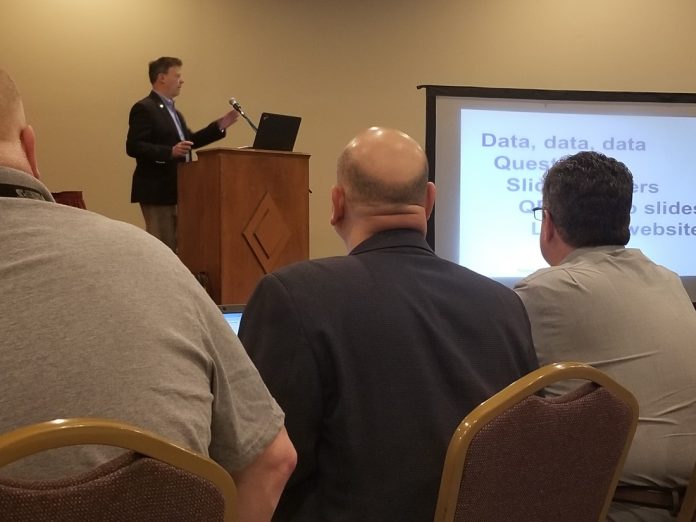
Darren Krolewski speaks on marketing to independent community owners.
He encourages listeners at SECO19 to ensure that prospective residents are aware that new owners’ communities are actively looking for new homeowners and residents, and that community owners clearly lay out what residents can expect to rent or buy. Krolewski noted that there are several ways to spread the word, including print literature that a community owner can dispense to locally inform on availability, features and more.
The presentation extended to digital marketing with a strong emphasis on mobile-friendliness and response time.
“Fifty-three percent of people will abandon a site if it doesn’t load within three seconds,” Krowleski said. Not only that, but sites with poor mobile responsiveness often permanently lose potential buyers and residents.
The evening concluded with information on exhibitors and attendees, as well as a reception and a roundtable on attendee-suggested topics.
Sec. Carson Applauds Nomination of Brian Montgomery
HUD Acting Deputy Secretary Brian Montgomery.
President Trump has nominated the Department of Housing and Urban Development Acting Deputy Secretary Brian Montgomery to hold the post in earnest.
As the second most senior official at HUD, if approved, Montgomery will manage the day-to-day operations of the agency. He would advise and assist the secretary in leading the Department’s nearly 8,000 employees.
Montgomery, a Texas native, currently performs the duties of deputy secretary. He is the first person to twice serve as head of the Federal Housing Administration. He did so under three White House administrations.
“Brian brings tremendous experience to our team and has been a strong voice in the effort to reform the Nation’s housing finance system,” Carson said. “As Federal Housing Commissioner, Brian made certain FHA remains a stable and reliable resource for first-time and minority homebuyers, and other underserved borrowers while protecting the interests of taxpayers. Brian is a key member of our team and I look forward to having him confirmed as our deputy secretary.”
Montgomery has more than 30 years of experience in the public and private sectors. He provides HUD with a deep knowledge of housing issues and vast experience in spearheading large-scale policy initiatives.
“Once again, I am tremendously honored to be called upon by President Trump and Secretary Carson to serve this department and the American people,” Montgomery said. “Service to our fellow Americans is the cornerstone of our department and I look forward to continuing to help fulfill HUD’s critical role.”
As Federal Housing Commissioner, Montgomery managed FHA’s $1.4 trillion mortgage insurance portfolio. With HUD, he also oversees the project-based section 8 rental assistance housing program, as well as the Office of Housing Counseling, and HUD’s Manufactured Housing Program.
Head of Industry’s Largest Lender Optimistic in Face of Change
Tim Williams, 21st Mortgage
Tim Williams is the president and CEO of 21st Mortgage, the largest lender for manufactured homes in the United States. A conservative estimate of 21st Mortgage’s market share is 25 percent.
Compared against total shipment data published by MHI, the volume of home loans levied by 21st equals about 15 percent. Subtract from those same shipment totals the number of FEMA homes, cash sales and loans originated in-house by Clayton Retailers, and the 21st Mortgage market share may be as high as 30 percent.
So, as a matter of understanding the pulse of the lending side of the manufactured housing business, talking to Williams, with his 45 years of MH lending experience, should be viewed as the pinnacle of insight.
A former executive vice president of Clayton Homes and the president of Vanderbilt Mortgage between 1974 and 1995, Williams has led 21st through tremendous growth in recent years. The Knoxville, Tenn.-based lender originates about $1.3 billion in home loans each year, and currently services more than 180,000 mortgages valued at greater than $9 billion.
Let’s Talk About the Opportunities
During a recent conversation with The MHInsider, Williams was asked about challenges in the industry. His response was to immediately talk about opportunity, which in his world always takes precedence over challenges and obstacles.
“The opportunity is really in the product some of the manufacturers are promoting,” Williams said, referring to what many are calling the ‘New Class’ of manufactured homes, which have characteristics that allow them to sit beside site-built homes and be treated as such in appraisal and lending.
Differentiating From ‘Traditional Lenders’
“The traditional mortgage lenders can’t very well manage that product,” Williams said. “Their cost to originate is so very high. Many of them are $8,000 to originate a loan, and that amount cannot be put into a GSE pool and it cannot be passed forward.
“If you can’t pass on that cost, how are they going to finance that new home mortgage that the GSEs (Fannie and Freddie) both want to advance in the $150,000 area?” he said. “We’re better able to serve that market because our origination structure relies heavily on the retailer relationship to bring costs down.”
Traditional lenders cannot operate in the same way, because they don’t have a retail environment for their homes, much less the relationships within the retail environment.
Among the largest operators lending for manufactured homes — 21st, Triad, and Credit Human, for example — none of them are lenders focused on being backed by government-sponsored entities.
“Traditional GSE lenders do not originate many manufactured home loans, because they only do GSE-conforming product. So if the borrower, the house, or site for the house doesn’t fit in the Fannie Mae or Freddie Mac box, then those lenders don’t offer an alternative,” Williams said. “Whereas us traditional manufactured home lenders have alternatives, but we must get qualified to participate with the GSE in order to support the ‘New House’ with lower rates and longer terms that are only available through the GSEs.
“And you still have to be profitable,” he added. “You have to cover costs, which are not $8,000 but are more than a chattel loan… you need to be able to build in a profit.”
What About the Resale Value?
People who sell manufactured homes, and manufactured home buyers themselves, often are questioned about how factory-built homes retain value. There’s skepticism, and misinformation, about an individual manufactured home as an investment. This persists despite a recent pilot report held within FHFA’s quarterly Home Price Index summary that suggests manufactured homes appreciate in a fashion that is very similar to site-built homes.
True, the general public is less inclined than housing professionals to refer to the quarterly HPI report. Yet, Williams points to a couple of specific ways manufactured home buyers proceed that may hinder home value appreciation.
Circumstances Around Home Sale Financing
It has very little to do with the product, and more to do with where the home is placed.
“Fortunately, we have about 40 percent of our customers who buy a home and do it without paying for the land. The downside is you can have a difficult time selling the home,” he said. “If they put it on a private site, like family land, and then they try to sell it, maybe there’s no one to live there… or no one in the family or on the property wants anyone else living there.”
There could be debt on the farm, multiple owners who disagree about what to do with the property, or other legal claims that get in the way of a sale on the independently owned home.
“That happens every day, over and over,” Williams said. “ And I get it, because it’s happened to me.”
Many years ago, Williams made a significant investment in expanding and improving a small home on his family’s property. And he had to walk away from the investment for many years, until the deed holder was ready to hand over the property.
“It’s a great advantage to not have to pay for land,” Williams said. “But it can be difficult to sell when the homeowner needs a change.”
And moving even a single-section home adds another $3,500 in costs to a re-sell. A multi-section home can cost $10,000 to move.
The resale of a home, in terms of demand for the dwelling where it sits, along with potential moving costs, should be put on the list of items a buyer considers, even if the retailers or lenders risk losing the occasional sale.
Manufactured Homes in Residential Neighborhoods
Williams again uses an example from his daily life to illustrate the complexities of integrating manufactured housing throughout the market in a way that can boost the annual percentage of home starts well beyond the 10 percent ceiling manufactured housing professionals have experienced.
“I am optimistic about the new product,” Williams said. “I’m optimistic about manufactured homes getting into better communities where they can sit right beside conventional housing.
“You really expect it to be a better house, and we have a great opportunity to help deliver that,” he said. “Manufacturers have done a great job over the recent years building a better product.”
‘If you can do it anywhere, you should be able to do it here’
“That said, we really do have to start breaking down some zoning barriers,” he said.
Most cities in the U.S. make little if any room for manufactured homes, and many explicitly zone to keep manufactured homes out.
“In Knox County, Tennessee, the birthplace of Clayton, the largest builder of manufactured homes, and backed by Berkshire Hathaway and Warren Buffett, and we can’t get a manufactured home in the city of Knoxville?” Williams said. “If you can do it anywhere, you should be able to do it here. And we haven’t.
“Until we get really good at building homes that are certain to be accepted by not just consumers, but by their neighbors, we won’t get the results we want,” he said. “And that takes time.”
Beyond zoning for an individual manufactured home, the city of Knoxville hasn’t approved a new manufactured home community since the 1980s. Knoxville is not alone. About 313 new manufactured home communities have been built nationwide since 2002, according to information from the industry leader in data, Datacomp.
The 2,645 new communities built during the prior 15 years, including 395 communities built during 1986-87 alone, show the stark contrast between then and now. With that, it’s easy to understand why affordable housing advocates are concerned.
“We’re reaching a saturation point on communities — mobile home parks — where we will start getting some brand-new communities,” Williams said. “It has to happen, or shipments will hurt. There’s only so much of a market for homes on private land.”
What Else Will the Future Hold?
The market is good, so the alarm bells that may sound when Williams says the word “flat” should be taken in stride.
He said 21st Mortgage is able to originate every loan it sees that can be profitably originated. Business lingo might rephrase that to say: They’re not leaving any money on the table. The business is right-sized and sailing forward.
However, the U.S. is in the midst — or potentially in the latter stages — of the largest market expansion in modern history.
It’s one that can’t last.
The market will shrink, which hopefully will qualify as something less than a recession, great or not.
“Our default rate is artificially low,” Williams said. “I suspect many lenders would agree with that. Owners who default are facing the death of a spouse, serious illness or divorce. Typically, unemployment counts for about 30 percent of defaults. But that’s not happening right now, because employment is so high. Anyone who wants a job has one.”
Williams asserts that some lenders will move forward with loans that work today but will be difficult to maintain as the market corrects. Whether confidence is placed on the artificially low default rate or thinning margins, something is sure to give in months or years to come.
“You have to plan for it. And you can’t hedge for it, either,” he said. “You’d be wrong if you make that bet.”
More than 1,500 manufactured housing professionals are expected in Las Vegas April 7-9 as the Manufactured Housing Institute’s Congress and Expo returns to the...
With more homes, more exhibitors, and more buzz than ever before, the 2026 Biloxi Show is expanding, and fast.
The Biloxi Manufactured Housing Show &...