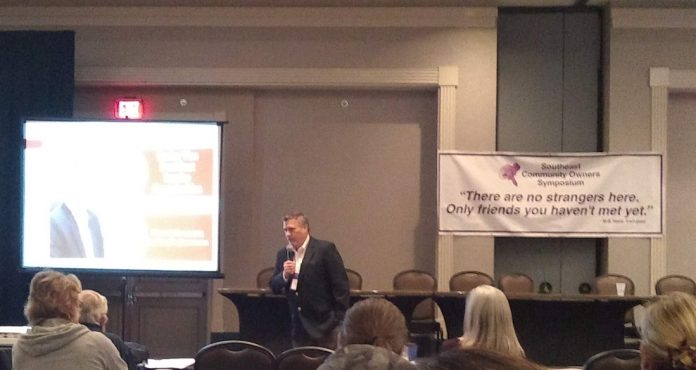
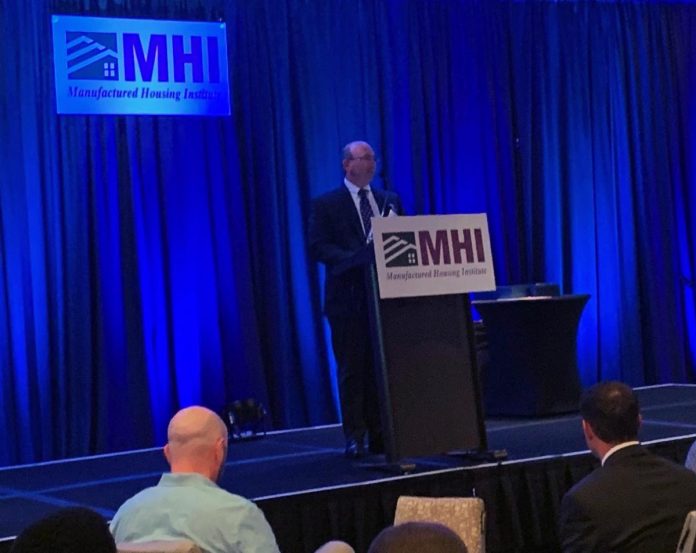
Jon Harrison of Inspire Communities talks to attendees at SECO19 about community rehabilitation.
Experienced Owners at SECO19 Detail Plans for Your Manufactured Home Community
SECO attendees assemble for day two presentations.
SECO19 featured presentations from some of the most seasoned industry professionals. Don Westphal of Donald C. Westphal Associates kicked off the day with a vibrant history of his own professional development and key elements to park design, planning, and zoning.
Westphal designed his first community in Southern Illinois in 1964 and has worked as a designer, consultant and owner in the manufactured housing industry for more than 50 years.
Insight on Community Planning and Design
Westphal spent the morning offering advice to new community owners at SECO19 in Atlanta on how to plan and design communities.
During his presentation, Westphal identified the key members of a planning and design team. Per his guidance, the ideal team consists of a qualified developer, a knowledgeable planner, a respected engineer, and consultants.
With a solid team in place, Westphal recommends that a new community owner develop an understanding of the land they need to fill as well as their spatial constraints. After years working in landscape architecture, Westphal warns that “It isn’t cheap to move dirt.” In other words, the deeper the understanding you have of your community’s specific aesthetic needs, the more cost-effective your strategy becomes.
Comparative Pricing in Communities
This consideration also relates to your neighboring communities and available housing. Looking at neighbors comparatively is a great way to effectively manage the quality expectations of your prospective tenants.
Currently, Westphal is working with a community in New Buffalo, Mich., in part to provide rezoning consultancy. He points out that the community upgrade faces scrutiny from city residents and other housing developers who are concerned about home sales. Still, there is a dire need for affordable housing in the area.
Rehabbing Older Communities
The following presentation by Jon Harrison of Inspire Communities was a fitting segue from Westphal’s as it reviewed the rehabilitation process of Cowetta Mobile Home Park. Harrison explains that there is a need for new foundations and to improve the overall value of the park. To do this, Inspire added homes appraised at or above $70,000.
There are several ways to build a greater understanding of a community, Harrison said.
“If you drive through a community at night, you learn a lot. Drive through a community on a holiday weekend, you learn even more,” he said. “If you drive through a community in a downpour, you find out about its drainage.”
All of this provided valuable insight for novice community owners while driving the message that rehabbing communities and homes is sometimes necessary and always possible with the correct priorities and financing.
Darren Krolewski speaks on marketing to independent community owners.
He encourages listeners at SECO19 to ensure that prospective residents are aware that new owners’ communities are actively looking for new homeowners and residents, and that community owners clearly lay out what residents can expect to rent or buy. Krolewski noted that there are several ways to spread the word, including print literature that a community owner can dispense to locally inform on availability, features and more.
The presentation extended to digital marketing with a strong emphasis on mobile-friendliness and response time.
“Fifty-three percent of people will abandon a site if it doesn’t load within three seconds,” Krowleski said. Not only that, but sites with poor mobile responsiveness often permanently lose potential buyers and residents.
The evening concluded with information on exhibitors and attendees, as well as a reception and a roundtable on attendee-suggested topics.
Sec. Carson Applauds Nomination of Brian Montgomery
HUD Acting Deputy Secretary Brian Montgomery.
President Trump has nominated the Department of Housing and Urban Development Acting Deputy Secretary Brian Montgomery to hold the post in earnest.
As the second most senior official at HUD, if approved, Montgomery will manage the day-to-day operations of the agency. He would advise and assist the secretary in leading the Department’s nearly 8,000 employees.
Montgomery, a Texas native, currently performs the duties of deputy secretary. He is the first person to twice serve as head of the Federal Housing Administration. He did so under three White House administrations.
“Brian brings tremendous experience to our team and has been a strong voice in the effort to reform the Nation’s housing finance system,” Carson said. “As Federal Housing Commissioner, Brian made certain FHA remains a stable and reliable resource for first-time and minority homebuyers, and other underserved borrowers while protecting the interests of taxpayers. Brian is a key member of our team and I look forward to having him confirmed as our deputy secretary.”
Montgomery has more than 30 years of experience in the public and private sectors. He provides HUD with a deep knowledge of housing issues and vast experience in spearheading large-scale policy initiatives.
“Once again, I am tremendously honored to be called upon by President Trump and Secretary Carson to serve this department and the American people,” Montgomery said. “Service to our fellow Americans is the cornerstone of our department and I look forward to continuing to help fulfill HUD’s critical role.”
As Federal Housing Commissioner, Montgomery managed FHA’s $1.4 trillion mortgage insurance portfolio. With HUD, he also oversees the project-based section 8 rental assistance housing program, as well as the Office of Housing Counseling, and HUD’s Manufactured Housing Program.
Head of Industry’s Largest Lender Optimistic in Face of Change
Tim Williams, 21st Mortgage
Tim Williams is the president and CEO of 21st Mortgage, the largest lender for manufactured homes in the United States. A conservative estimate of 21st Mortgage’s market share is 25 percent.
Compared against total shipment data published by MHI, the volume of home loans levied by 21st equals about 15 percent. Subtract from those same shipment totals the number of FEMA homes, cash sales and loans originated in-house by Clayton Retailers, and the 21st Mortgage market share may be as high as 30 percent.
So, as a matter of understanding the pulse of the lending side of the manufactured housing business, talking to Williams, with his 45 years of MH lending experience, should be viewed as the pinnacle of insight.
A former executive vice president of Clayton Homes and the president of Vanderbilt Mortgage between 1974 and 1995, Williams has led 21st through tremendous growth in recent years. The Knoxville, Tenn.-based lender originates about $1.3 billion in home loans each year, and currently services more than 180,000 mortgages valued at greater than $9 billion.
Let’s Talk About the Opportunities
During a recent conversation with The MHInsider, Williams was asked about challenges in the industry. His response was to immediately talk about opportunity, which in his world always takes precedence over challenges and obstacles.
“The opportunity is really in the product some of the manufacturers are promoting,” Williams said, referring to what many are calling the ‘New Class’ of manufactured homes, which have characteristics that allow them to sit beside site-built homes and be treated as such in appraisal and lending.
Differentiating From ‘Traditional Lenders’
“The traditional mortgage lenders can’t very well manage that product,” Williams said. “Their cost to originate is so very high. Many of them are $8,000 to originate a loan, and that amount cannot be put into a GSE pool and it cannot be passed forward.
“If you can’t pass on that cost, how are they going to finance that new home mortgage that the GSEs (Fannie and Freddie) both want to advance in the $150,000 area?” he said. “We’re better able to serve that market because our origination structure relies heavily on the retailer relationship to bring costs down.”
Traditional lenders cannot operate in the same way, because they don’t have a retail environment for their homes, much less the relationships within the retail environment.
Among the largest operators lending for manufactured homes — 21st, Triad, and Credit Human, for example — none of them are lenders focused on being backed by government-sponsored entities.
“Traditional GSE lenders do not originate many manufactured home loans, because they only do GSE-conforming product. So if the borrower, the house, or site for the house doesn’t fit in the Fannie Mae or Freddie Mac box, then those lenders don’t offer an alternative,” Williams said. “Whereas us traditional manufactured home lenders have alternatives, but we must get qualified to participate with the GSE in order to support the ‘New House’ with lower rates and longer terms that are only available through the GSEs.
“And you still have to be profitable,” he added. “You have to cover costs, which are not $8,000 but are more than a chattel loan… you need to be able to build in a profit.”
What About the Resale Value?
People who sell manufactured homes, and manufactured home buyers themselves, often are questioned about how factory-built homes retain value. There’s skepticism, and misinformation, about an individual manufactured home as an investment. This persists despite a recent pilot report held within FHFA’s quarterly Home Price Index summary that suggests manufactured homes appreciate in a fashion that is very similar to site-built homes.
True, the general public is less inclined than housing professionals to refer to the quarterly HPI report. Yet, Williams points to a couple of specific ways manufactured home buyers proceed that may hinder home value appreciation.
Circumstances Around Home Sale Financing
It has very little to do with the product, and more to do with where the home is placed.
“Fortunately, we have about 40 percent of our customers who buy a home and do it without paying for the land. The downside is you can have a difficult time selling the home,” he said. “If they put it on a private site, like family land, and then they try to sell it, maybe there’s no one to live there… or no one in the family or on the property wants anyone else living there.”
There could be debt on the farm, multiple owners who disagree about what to do with the property, or other legal claims that get in the way of a sale on the independently owned home.
“That happens every day, over and over,” Williams said. “ And I get it, because it’s happened to me.”
Many years ago, Williams made a significant investment in expanding and improving a small home on his family’s property. And he had to walk away from the investment for many years, until the deed holder was ready to hand over the property.
“It’s a great advantage to not have to pay for land,” Williams said. “But it can be difficult to sell when the homeowner needs a change.”
And moving even a single-section home adds another $3,500 in costs to a re-sell. A multi-section home can cost $10,000 to move.
The resale of a home, in terms of demand for the dwelling where it sits, along with potential moving costs, should be put on the list of items a buyer considers, even if the retailers or lenders risk losing the occasional sale.
Manufactured Homes in Residential Neighborhoods
Williams again uses an example from his daily life to illustrate the complexities of integrating manufactured housing throughout the market in a way that can boost the annual percentage of home starts well beyond the 10 percent ceiling manufactured housing professionals have experienced.
“I am optimistic about the new product,” Williams said. “I’m optimistic about manufactured homes getting into better communities where they can sit right beside conventional housing.
“You really expect it to be a better house, and we have a great opportunity to help deliver that,” he said. “Manufacturers have done a great job over the recent years building a better product.”
‘If you can do it anywhere, you should be able to do it here’
“That said, we really do have to start breaking down some zoning barriers,” he said.
Most cities in the U.S. make little if any room for manufactured homes, and many explicitly zone to keep manufactured homes out.
“In Knox County, Tennessee, the birthplace of Clayton, the largest builder of manufactured homes, and backed by Berkshire Hathaway and Warren Buffett, and we can’t get a manufactured home in the city of Knoxville?” Williams said. “If you can do it anywhere, you should be able to do it here. And we haven’t.
“Until we get really good at building homes that are certain to be accepted by not just consumers, but by their neighbors, we won’t get the results we want,” he said. “And that takes time.”
Beyond zoning for an individual manufactured home, the city of Knoxville hasn’t approved a new manufactured home community since the 1980s. Knoxville is not alone. About 313 new manufactured home communities have been built nationwide since 2002, according to information from the industry leader in data, Datacomp.
The 2,645 new communities built during the prior 15 years, including 395 communities built during 1986-87 alone, show the stark contrast between then and now. With that, it’s easy to understand why affordable housing advocates are concerned.
“We’re reaching a saturation point on communities — mobile home parks — where we will start getting some brand-new communities,” Williams said. “It has to happen, or shipments will hurt. There’s only so much of a market for homes on private land.”
What Else Will the Future Hold?
The market is good, so the alarm bells that may sound when Williams says the word “flat” should be taken in stride.
He said 21st Mortgage is able to originate every loan it sees that can be profitably originated. Business lingo might rephrase that to say: They’re not leaving any money on the table. The business is right-sized and sailing forward.
However, the U.S. is in the midst — or potentially in the latter stages — of the largest market expansion in modern history.
It’s one that can’t last.
The market will shrink, which hopefully will qualify as something less than a recession, great or not.
“Our default rate is artificially low,” Williams said. “I suspect many lenders would agree with that. Owners who default are facing the death of a spouse, serious illness or divorce. Typically, unemployment counts for about 30 percent of defaults. But that’s not happening right now, because employment is so high. Anyone who wants a job has one.”
Williams asserts that some lenders will move forward with loans that work today but will be difficult to maintain as the market corrects. Whether confidence is placed on the artificially low default rate or thinning margins, something is sure to give in months or years to come.
“You have to plan for it. And you can’t hedge for it, either,” he said. “You’d be wrong if you make that bet.”
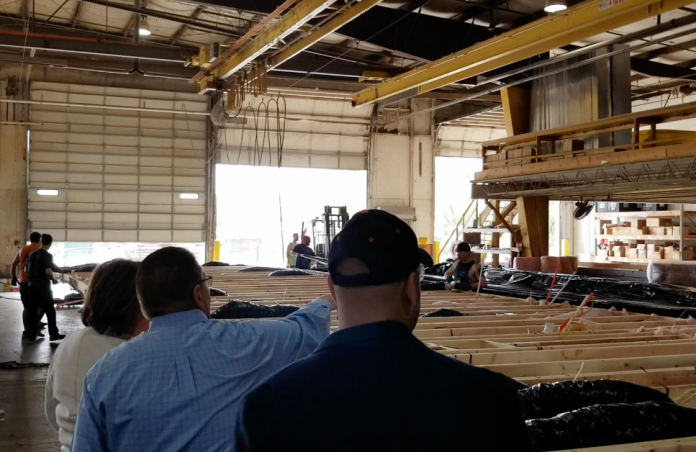
Joe Viglione of Fairmont Homes leads a factory tour of the northern Indiana facility.
Plans Laid to Meet Need for Labor in Manufactured Housing
Steve Like, executive Vice President at Cavco Industries.
The demand for production labor in manufactured housing has been particularly acute for at least three years, and builders in the industry are upping their game to ensure they draw and retain the needed talent.
“It’s been a long time since any of us have had an issue finding labor, so we were a bit underprepared,” said Steve Like, Senior Vice President for Cavco Industries, one of the nation’s top providers of manufactured and modular homes, as well as park models. “We needed to develop some new strategies both to recruit and to reduce turnover.
“Certainly, at Cavco, and from what I’ve seen in other parts of the industry, this has been the case,” he said.
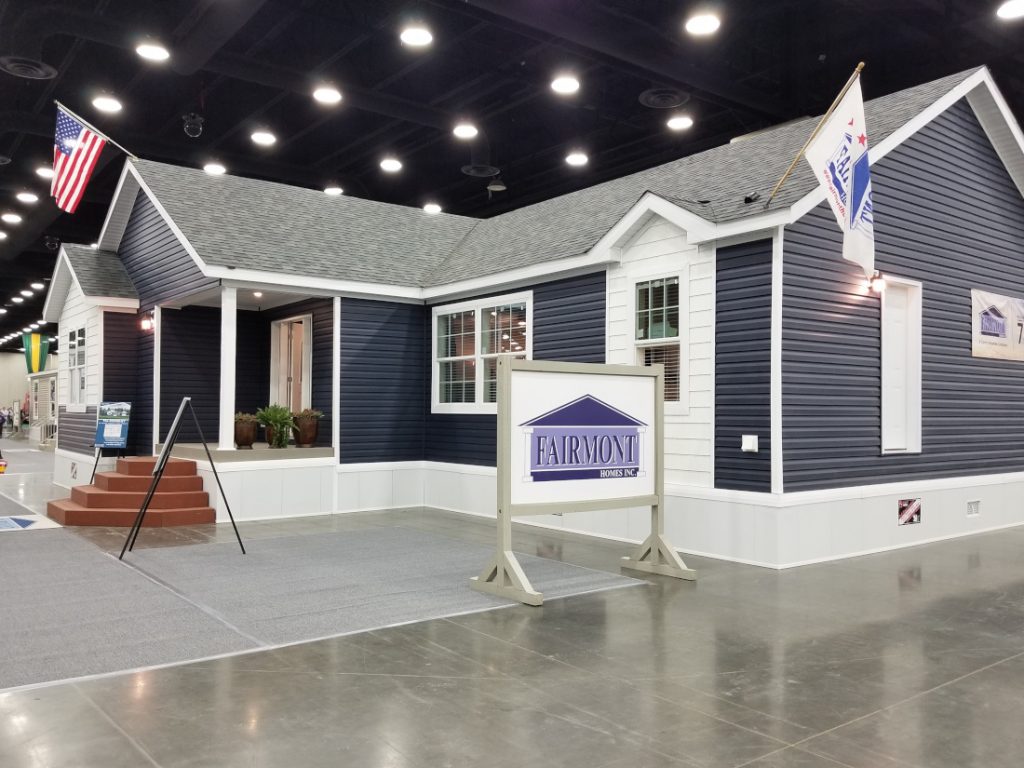
A new Fairmont Home, from Cavco Industries, on display during The Louisville Show in 2018.
How to Find and Retain Talent
Human resources was among the many front office functions consolidated during the economic downturn a decade ago. Like said HR could be rolled into accounting, finance, and sometimes dispatch, depending on the mix of disciplines available.
In the meantime, Cavco has had only moderate success relying on staffing agencies. A push for increased production arose at the same time as the labor crunch, increasing the urgency for change. So, in recent years, the company has regained an internal focus on many of its human resources functions.
“One of the strategies we pursued starting in 2016 was hiring someone who has a lot of experience in recruitment and retention,” Like said. “We do this at the plant level, and look for a local professional manager. That worked much better.”
Wages, Accommodations for Trade Labor in Manufactured Housing
Cavco also has reviewed the competitiveness of its employee compensation and worked to make each plant more inviting and comfortable for employees.
“We took a hard look at the wages in some key markets and found we had significantly fallen behind our competitors. That was a big deal,” Like said. “We’ve largely corrected that, and regularly do wage surveys to ensure we stay where we want to be. We’ve come up 15 to 20 percent in some markets to remain competitive.”
Years of hard work were beginning to show in the manufacturing facilities. Leadership became increasingly mindful of the need for remodeled bathrooms and breakrooms, as well as new TVs and self-service vending machines. They added fresh food, phone charging stations, and new seating.
“The break room itself, just getting it cleaned up and well lit with newer appliances,” Like said. “That helps.”
Once the company began to find success, the push to document processes began, which Like said raised other questions toward operational improvement.
Fairmont Homes model home on display during The Louisville Show in 2019.
Documenting the Process
“We have had a lot of success on multiple levels, but we didn’t have them cataloged,” he said. “So we got that done and developed support materials and training programs around our hiring practices.
“It was a very coordinated strategy and it’s worked out well. With that, we started tracking retention by seniority. That was an eye-opener,” Like said. “We had a lot of loss within the first 30 days. We had to ask ourselves what was going wrong. Why was this so different than what we had anticipated?”
Exit interviews revealed that beefing up early training programs to increase comfort with the construction tools would make a difference in successful onboarding.
“We set up a lab and had it put together off-line, away from the product line, so they could spend some time handling tools and getting experience without the pressure of keeping the line going,” Like said. “We let our new people get proficient before we put them on the line. And we kept up that increased line of communication for the first six weeks. It’s had a great impact.”
Advantages of Working in Factory-Built Housing
5 days a week work
Regular schedule
No weather-related time off without pay
All first shift work
Cooler in summer, warmer in winter
Same workplace every day makes commuting and schedules more predictable
Cavco also partnered with an affiliate of the Manufactured Housing Institute to focus on skill development in Arizona and Texas, with a more formal version of the in-plant training program.
Like said Cavco does not use apprentice electricians or plumbers. Rather, they keep an eye on assembly production who has done some hobby projects or might have a relative who was an electrician.
“If someone has expressed an interest in moving into those areas, we take them aside and get them into the training scenarios. We will train those employees so they can move up into more professional, higher-paying jobs. And the good thing about that is that they’re working in a HUD plant, so they need to learn certain refined aspects of wiring or plumbing. They don’t need to know how to do a 20-story commercial highrise, for instance.”
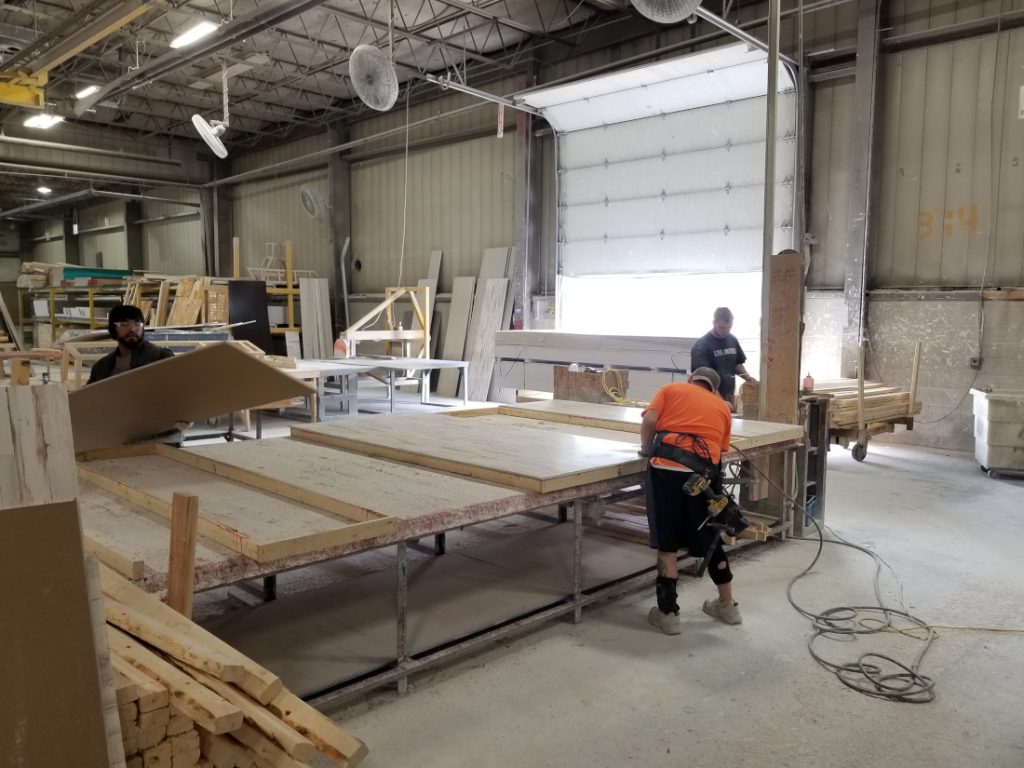
Framers work on the interior walls of a new manufactured home in the Fairmont plant.
Traditional Trade Schools and Alternative Programs
Like said Cavco has developed relationships within the trade and technical schools.
“Those are the people who likely will move into team leadership. These are people who, on their own, have opted to pay for training,” Like pointed out. “We’ve been out to job fairs in San Diego, Dallas and Atlanta. These are focused on people in transition or active military, typically captain level or high enlisted rank. We hired someone with CAD experience and put them into a draftsman position. And we think we’ll be able to get some managers out of that as well.”
The company also is involved with work release programs from Maricopa County Jail, in the Phoenix area. Low-level offenders can finish their sentences on the production line for an area employer.
“That’s working pretty well,” Like said. “These are non-violent offenders, people who may have had a drug or alcohol problem.”
The program has provided a route to facilities jobs as well as trade labor in manufactured housing.
“We’ve put a lot of energy into this and continue to strategize because there is nothing else that has strained our growth more than recruitment and retention of qualified labor,” Like said.
Other Workforce Development Initiatives in Manufactured Housing
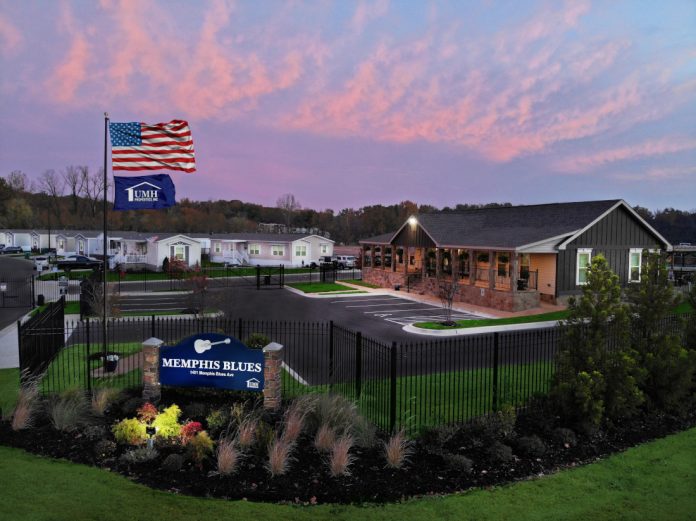
Memphis Blues is a new all-rental community in Tennessee. Photo courtesy of UMH Properties.
Memphis Blues Breaks the Mold Among Manufactured Home Communities
Memphis Blues is the first and only all-rental manufactured home community in the United States. And the community with a view of the Memphis skyline is drawing rave reviews from its residents, as well as the praise of the industry.
The community won the award for the nation’s best from the Manufactured Housing Institute at the annual Congress & Expo this year.
Memphis Blues resident Alexa Lopez, her fiance Edgar, and their two daughters had just come from Texas for work when his job moved. The family stayed in a hotel for two months while looking for an apartment to rent.
“When I saw this online, I was shocked,” Alexa said of the community. “This house, at this cost, with your own parking space and patio and yard. The whole community is beautiful. My girls love the playground and the basketball court.”
Though Memphis Blues presents itself as new, it’s actually a re-built community. It was brought back to life after closing in the wake of near record-setting high water levels on the Mississippi River in 2011. It was a flood that closed many parts of the city.
Lopez Family Among Earliest Residents at Memphis Blues
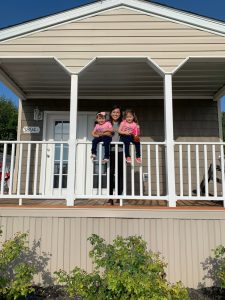
Alexa Lopez and her daughters, Sofia, 2, and Camilla, 4, on the porch of their new home at Memphis Blues, a Tennessee all-rental community from UMH Properties. Photo courtesy of the Garza-Lopez family.
The Garza-Lopez family is the first to live in their new 3-bedroom, 2-bath home.
“I thought it was a fake ad,” Alexa confessed. “I called Melissa in the middle of the night and told her I was very interested and she called me back first thing in the morning. It was just too good to believe. You get way more here than you can find anywhere else. A security guard? Friendly neighbors. It’s so nice. And we have a lot of little community events and we can meet the other neighbors.
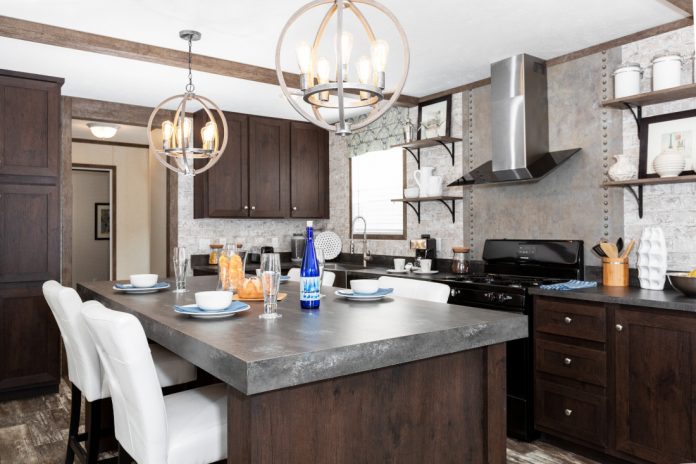
“Honestly, this is way more than what I was expecting,” Alexa said. “It’s very updated and beautiful. We have laminate hardwood flooring and a vintage-modern backsplash, dark wood cabinets, a giant master bedroom, and I love that I have my own little laundry room.”
Alexa said when she found Memphis Blues it became clear that it was what she wanted. And it was what her family needed. Just the prospect of going for groceries, she said, and returning to a third-floor walk-up apartment with two kids was enough to sell her on the value of having the accessible, independent space their manufactured home provides.
Why UMH Properties Opted for an All-Rental Community
UMH Properties operates nearly 7,000 rental homes mixed throughout its more than 100 manufactured home communities in eight states. The company’s experience shows the 16-foot by 70-foot manufactured home with three bedrooms and two baths sitting on a 50-foot by 100-foot lot in a community with ample amenities is the best rental housing value in America.
“UMH has always asked why a community owner cannot get the same financing on our homes used as rental units that any apartment developer obtains,” UMH President Sam Landy said.
Currently, that financing for apartment units is 4%. UMH asked Fannie Mae and Freddie Mac to create a program giving rental manufactured homes the same rates as apartments.
“They came back to us and said the prototype should be an all-rental community. We were just starting construction of Memphis Blues,” Landy said. “After careful analysis, we decided to make Memphis Blues an all-rental community.”
On 150 lots at $60,000 per house, the owner would pay about 7% or $4,200 in interest per house. At 4%, the owner pays about $2,400. That’s over $300,000 a year in savings for the whole community.
UMH Vice President and regional manager for Tennessee Gina Beasley said UMH chose manufacturers Clayton Savannah and Fleetwood Homes Lafayette for many reasons, including potential upgrades such as tile showers, large laundry rooms, energy-efficient double-pane windows, and steel back doors.
“After making the decisions on the manufacturers, our focus went toward the high-end appearance, state of the art amenities, and first-class experience. From the beautiful office and landscaping to the black wrought-iron gated entrance and custom mural, painted by a local artist, no detail was missed,” Beasley said. “Memphis Blues truly is unique and stands out when it comes to what manufactured housing offers.”
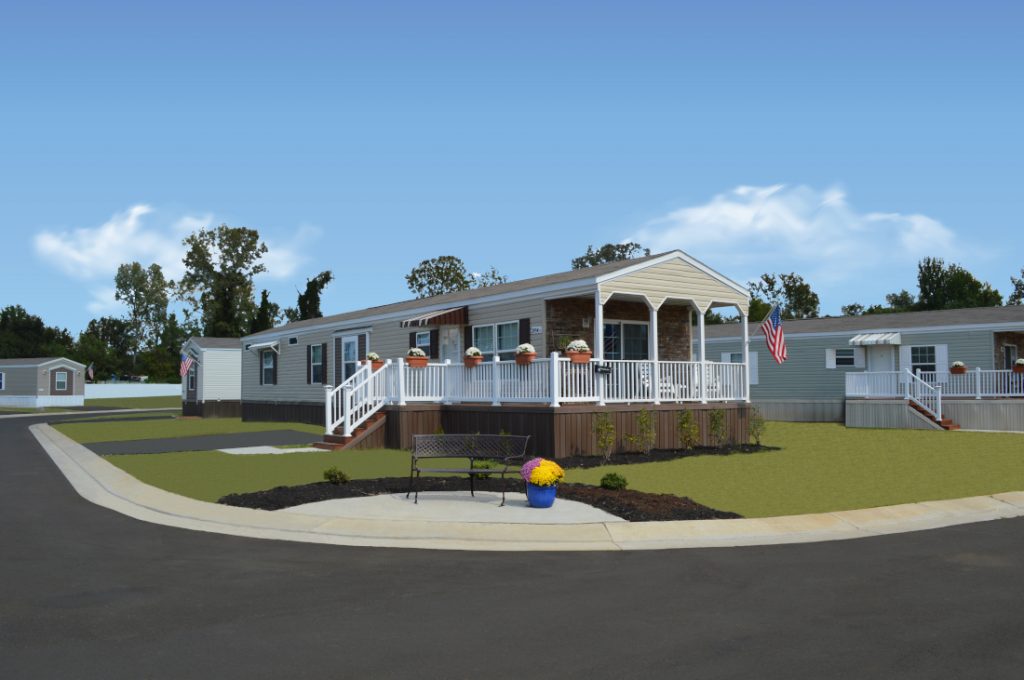
The exterior of a new home for rent at Memphis Blues in Tennessee. Photo courtesy of UMH Properties.
How All-Rental Works for the Residents
“Our experience with renters in our homes has been fantastic,” Memphis Blues Manager Melissa Garrett said. “We completely rebuilt the community, we put in new streets, utilities, perimeter security fences, management office, and amenities.
“Our homes are energy efficient and come with a full kitchen appliance package, washer and dryer hookups, central heating and air, your own personal yard space, covered deck, two-car driveway, a landscaped yard, and storage shed,” Garrett said.
The new, reimagined Memphis Blues had a June 2017 ribbon-cutting. Today, the community is at 100 percent occupancy. In the fall, it will open the expanded section of the community. The new development will provide 50 more new manufactured homes for rent.
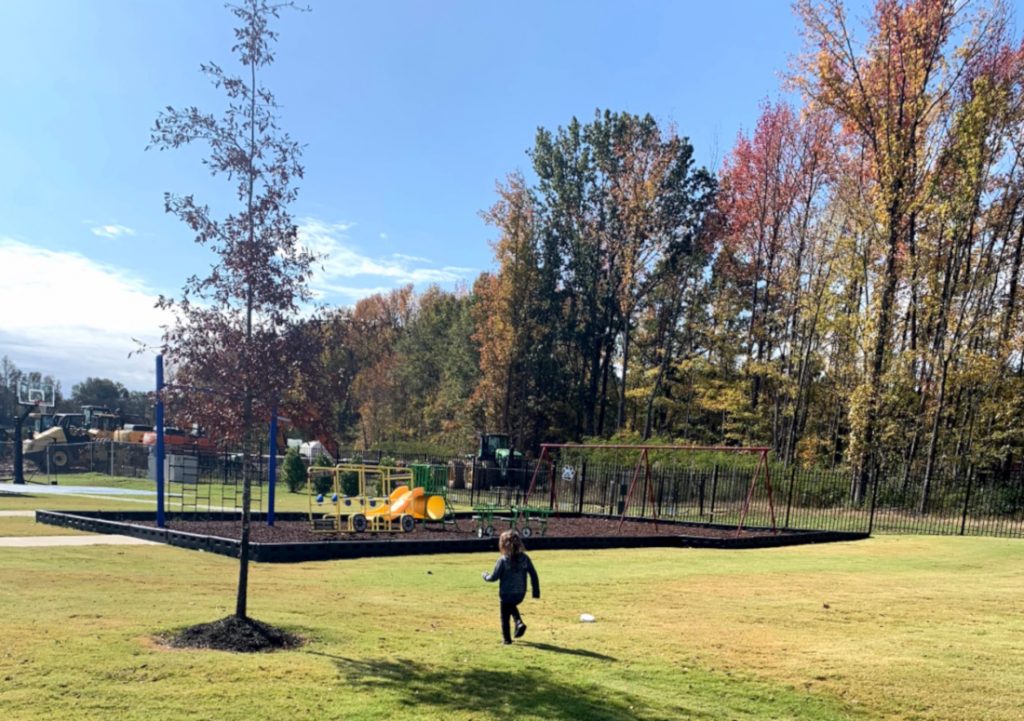
Alexa Lopez’s daughter, Camila, runs to the playground at Memphis Blues.
Accommodations for Community Residents at Memphis Blues
Memphis Blues also boasts a business center, basketball court, dog park, a playground for kids and a huge, relaxing patio with an outdoor fireplace lounge.
Garrett and her staff organize events, including holiday gatherings such as Halloween trick-or-treat, a Christmas party, the annual Easter egg hunt and summer barbecues.
“The residents love getting together with their neighbors. I think it makes everyone feel very comfortable,” Garrett said.
More than 30 prospective renters wait on a list to get in the community. Garrett and her staff work with interested home shoppers. She said they encourage prospects who intend to stay three years or less to rent a home. Those interested in a long-term arrangement are referred to nearby communities where homes are sold.
Garrett said Alexa Lopez’s reaction to the online listing for rental homes in Memphis Blues is common.
“I post photos and get calls from people asking to see the real photos, the photos of the actual home. I had to tell people that photo is the actual home. I’d say ‘I walked right in there myself and took that photo.’ And most of the time people would say, ‘alright, I have to come look for myself.
“People coming here are really amazed by how nice the community is and how beautiful the homes are. If you were to walk into this house… for $799 per month? You can’t find this anywhere else,” she said.
October 2019 JLT Manufactured Home Community Market Reports for Illinois, Indiana, Kansas, Kentucky, Missouri, Wisconsin Now Available
Datacomp has published the October 2019 manufactured home community rent and occupancy reports for Illinois, Indiana, Kansas, Kentucky, Missouri, and Wisconsin.
JLT Market Reports provide detailed research and information on communities in 180 major housing markets throughout the United States. These include the latest rent trends and statistics, marketing programs and a variety of other useful management insights.
Datacomp publishes the JLT Market Reports and is the nation’s #1 provider of market data for the manufactured housing industry. JLT Market Reports are recognized as the industry standard for manufactured home community market analysis.
October 2019 manufactured housing market data published in JLT Market Reports for the six states include information on 308 “All ages” and “55+” manufactured home communities.
Altogether, the reports on the three states’ manufactured home communities include data representations for 76,868 homesites.
“Five of 12 markets represented in the October JLT Reports experienced slight declines in occupancy, while rents continued to rise nearly across the board at an average rate of 3.2%,” Datacomp Co-President and Chief Business Development Officer Darren Krolewski said.
More About JLT Market Reports
Each JLT manufactured home community rent and occupancy report from Datacomp has detailed information about investment grade communities in the major markets. The detailed information includes:
Number of homesites
Occupancy rates
Average community rents, and increases
Community amenities
Vacant lots
Repossessed and inventory homes, and much more
JLT Market Reports also include management insights that rank communities by number of homesites, occupancy rates and highest to lowest rents. Established reports show trends in each market with a comparison of October 2019 rents and occupancy rates to October 2018, as well as a historical recap of rents and occupancy from 1996 to present date in most markets.
Each fully updated report for mobile home communities is a comprehensive look at investment grade properties within a market, enabling owners and managers, lenders, appraisers, brokers and other organizations to effectively benchmark those communities and make informed decisions.
Sam Landy, president and CEO of UMH Properties, accepts a 2019 Chairman's Award from MHI.
Yes! Communities Senior Vice President Shawn Harpin accepts the MHI Chairman’s Award on behalf of Yes! Communities President and CEO Steve Schaub.
Members of the Manufactured Housing Institute have recognized a pair of manufactured housing industry leaders with this year’s Chairman’s Award. Steve Schaub, CEO of YES Communities, and Sam Landy, President and CEO of UMH Properties, received the honor during the MHI Meetings in Savannah, Ga.
Schaub is one of the founders of YES Communities from 2007, and oversees all company acquisitions, capital market activities, and corporate strategy as CEO, a position he has held since 2017.
“Land-lease manufactured home communities help provide a path to affordable homeownership for many Americans,” said Schaub. “We’re proud of the work we’ve done thus far to help many Americans achieve this dream, and we’re ready to continue to expand our advocacy efforts and housing services.”
Sam Landy and UMH Properties sponsored and displayed a single-section home on the National Mall in Washington D.C. for HUD’s Innovative Housing Showcase. UMH also works actively with local, state and federal officials on issues that benefit the industry.
About the Chairman’s Award
The Chairman’s Award is given annually by the chairman of the MHI Board of Directors. It recognizes the outstanding service and dedication to the association and the industry. Outgoing MHI Chairman Joe Stegmayer presented the 2019 awards.
Amy Bliss accepts the annual award for state executive of the year from MHI.Indiana executive Ron Breymier accepts a communications award for his work in the industry.
Indiana, Wisconsin State Executives Honored for Contributions
Ronald Breymier, executive director for the Indiana Manufactured Housing Association, received the MHEC Jim Moore Excellence in Communications Award. Amy Bliss, Wisconsin Housing Alliance executive director, received the State Association Executive of the Year award.
Michigan Manufactured Housing Association Hosts Annual Conference, VIP Event for Professionals
The Michigan Manufactured Housing Association will hold its annual conference Oct. 10 at the Suburban Collection Showplace, 46100 Grand River Avenue in Novi, Mich.
Darren Ing, the MMHA director, said the conference takes place the day prior to the Novi Home Show, which includes the Manufactured Home Showcase.
The 2019 MMHA Annual Conference begins at 8 a.m. with a continental breakfast, including opening remarks from MMHA Executive Director Bill Sheffer.
Ing said the agenda also includes an update from Rick Robinson, head counsel for MHI, as well as a legal panel, legislative update, awards ceremony and several other topical presentations.
Register to attend the MMHA Conference while space remains. Book at a discounted rate of $135 per night at the Hyatt Place Hotel, 46080 Grand River Avenue, when you mention “Michigan Manufactured Housing Association” while rooms remain.
The Clayton American loft kitchen, on display Oct. 10 in Novi.
VIP Event at MMHA Annual Conference
A special VIP event will be held Oct. 10 from 5-7 p.m. for a sneak peek of the Manufactured Housing Showcase.
Industry members, legislative and government officials are encouraged to tour five fully decorated and furnished model homes at an exclusive private viewing. See the newest designs in manufactured housing and enjoy cocktails and hors d’oeuvres. Limited spaces are available for the VIP event. MMHA will take RSVPs for the event through Oct. 8 or until all slots have been filled. Contact the MMHA’s Megan Mosher at mmosher(at)mmhrvca.org for VIP reservations.
Home Models on Display Include:
Athens Park Model by Champion (presented by Sun Communities)
Dutch Diamond by Champion (presented by Augusta Woods)
Redman Advantage by Champion (presented by Sun Communities)
The American Loft by Clayton Homes (presented by Meritus Communities)
The Stoneleigh by Skyline Homes (presented by AJR Communities
The Ins and Outs of Renting Your Mobile Home Seasonally
Seasonal or short-term rentals are properties that house new guests more frequently than typical residential lettings. The seasonal rental option is becoming increasingly popular among manufactured home and community owners seeking to temporarily fill vacancies.
As September comes to a close, many people seek warm-weather housing options for the winter months. This demographic, often referred to as “snowbirds”, can be a great source of revenue for short-term mobile home rentals in markets like Florida, Alabama and Arizona.
But managing short-term rentals comes with a few challenges; here are some tips for marketing and managing your seasonal rentals.
Marketing to Snowbirds
Reaching Different Climates to Rent Seasonally
There certainly is significant value to a strong local presence in your rental market. However, it is important to remember that snowbirds travel from a distance. Therefore, planning your strategy for national reach is key to attracting short-term renters.
Advertising through local papers in areas that expect harsh winters, and, of course, using mobile home listing sites like MHVillage, increases your exposure and the likelihood of securing one, or even multiple renters during the winter months.
It is recommended that you start this process early to allow time for proper documentation and completion of the approval process.
Describe Your Property (Honestly)
When entering the short-term rental market, it is important to provide details of your property thoroughly and to the best of your ability. And, keeping the listing updated, especially the availability, will prevent miscommunication with potential renters.
Be clear about accessibility, pet policies, furnishings, nearby resources, and any problems with the property that may impact your resident’s stay. Often, communities will provide a local guide for short-term renters. This guide should provide community details, information on local attractions, restaurants, nightlife, shopping, or even hospitals.
Make sure to include unique selling points to help your manufactured home stand out. Does the community have any features that would encourage rentals? Have you recently upgraded appliances or remodeled?
Including well-lit, attractive photos that accentuate details in your home and community can be a huge selling point, especially for tenants who may not have the opportunity to inspect the property in-person.
Photo courtesy of Equity LifeStyle Properties.
Managing Seasonal Mobile Home Rentals
Short-Term Rental By Owner
Depending on local rules and community regulations, you may have the option to manage your own rental. This might require that you obtain permits and licensing, as requested by your municipality. If you decide to manage your rental, there are a few things to take into consideration prior to accepting a tenant, like application and screening process for prospective tenants.
Other considerations include pricing, which should remain dynamic based on seasonal demand, market average, length of stay, and special local events. Seasonal rental durations can fluctuate from a few weeks to months or more. So pricing your rental at a weekly rate can save you time and allow you to rent seasonally to multiple parties.
Don’t be afraid to re-assess and adjust pricing for increased revenue. Tracking this data can improve year-over-year planning.
Choosing to manage your own listing means increased revenue. However, it does require your time, so plan accordingly!
Short-Term Rental Management Companies
Another option is to hire a short-term rental management company. Hiring a short-term rental company to manage your seasonal listing can ensure that your property is maintained. This is a great option if you are renting multiple properties at once as a management company can increase responsiveness to tenants, and fulfill maintenance and other requests.
A management fee will be assessed depending on the length of stay and the number of rentals you possess. Often, you can negotiate a price that both parties agree on.
Also, it is standard that a contract is issued to you. This should detail the scope of work and is instilled to protect your property and the company.
Short-term rental management is a good option for the owner who has multiple homes, plans to travel or visits a second home during the lease period.
How to Get Started
MHVillage’s Seasonal Rental Listing Feature
Our short-term rental listing feature allows community owners to set pricing, an availability calendar and leave a detailed description of the property for the prospective renter. This feature can be turned on or off at any time, allowing you to quickly manage and update your listing as needed.
Interested renters can browse listings with the option to filter for seasonal rentals.
Please contact us if you have any questions or would like to set up a tour with one of our representatives!
Turn to Datacomp for Manufactured Home Asset Value
Datacomp is the leading national provider of market-based mobile and manufactured home valuations. The company has spent decades providing manufactured home expertise, quality service and peace-of-mind in home transactions.
“We offer a variety of appraisal products, but one thing many industry professionals have yet to realize is that Datacomp offers full portfolio evaluations of manufactured and mobile home assets,” Mark Johnson, the vice president of personal property for Datacomp, said. “With the amount of sales activity and consolidation in manufactured home portfolios, the service is increasingly more common and valuable for property owners, brokers, lenders and others.”
Datacomp has a national network of more than 750 inspectors who can perform manufactured and mobile home portfolio valuations.
Accurate Collateral Valuations for Chattel Portfolios Large and Small
Datacomp portfolio valuations come in to play when an owner, operator or investor in manufactured home communities looks to purchase a property with community-owned homes or rental inventory. Or perhaps it’s an acquired portfolio of loans that needs assessment.
Some community owners will look to use their community-owned homes as collateral for a commercial loan to improve the community or add new sites.
Datacomp’s valuation services provide the portfolio data manufactured housing professionals require to make informed decisions.
The experienced team of manufactured housing appraisers specializes in determining an accurate worth of housing portfolio assets, using a proven market-based approach to value, based on each customer’s unique needs and underwriting criteria.
What is Your Portfolio of Homes Worth in Today’s Market?
Home values have changed dramatically in recent years. Professionals with new portfolios, expanded portfolios, or improved or reconfigured assets can benefit from an up-to-date valuation of their homes.
Ways to Benefit from a Portfolio Review
Identify a fair market purchase price for a retail or rental home inventory
Determine an accurate value of housing assets for sale, purchase, or for lending decisions
Discover loan-to-value ratios and overall worth of housing assets
Market-based approach for the most accurate representation of value
Oct. 6-8 at Avalon Hotel in Alpharetta, Ga.
Manufactured housing community owners have never had more information available to them — or more decisions to...
The Midwest Manufactured Housing Federation has announced that attendee registration is now open for the 2027 Louisville Manufactured Housing Show, returning to the Kentucky...
HUD’s Innovative Housing Showcase, MHI’s Homes on the Hill and Annual Meeting Begin Sept. 22
Two of the country’s largest builders of manufactured homes will...